
spaghettiThunderbolt

3531

83

3

Surprise, motherfuckers.
Today's post is the beginning of a new series, one which isn't even slightly related to submarines. I know y'all love submarines, but I am all submarined out for the time being. I'm hoping my usual formula works with the new topic, and I hope my writing is good enough to make it interesting.
Anyway, this topic is kinda heavy, and being able to explain it concisely and in layman's terms is far from easy; normally, you need a ridiculous amount of math experience and knowledge to understand it (seriously, terms like "differential geometry" are thrown around a lot: I didn't even know that was a thing that exists), but I'm gonna try to do it with little math (and the only math is basic stuff).

Welcome to quantum mechanics
---
The laws of physics are quite intuitive to us, even if we don't have the equations memorized: gravity pulls things to the ground, light lets us see, objects can only be in one place at a time, two objects can't exist in the same space at the same time, and nothing happens instantaneously. Quantum mechanics, or how things work at the very small scale (atomic and subatomic, called the quantum scale), is basically holding a giant foam middle finger and starting us down while it beats off; pretty much everything you think you know about the universe at our scale is completely wrong at the quantum level. Why? Because fuck you, that's why.
Spooky action at a distance
---
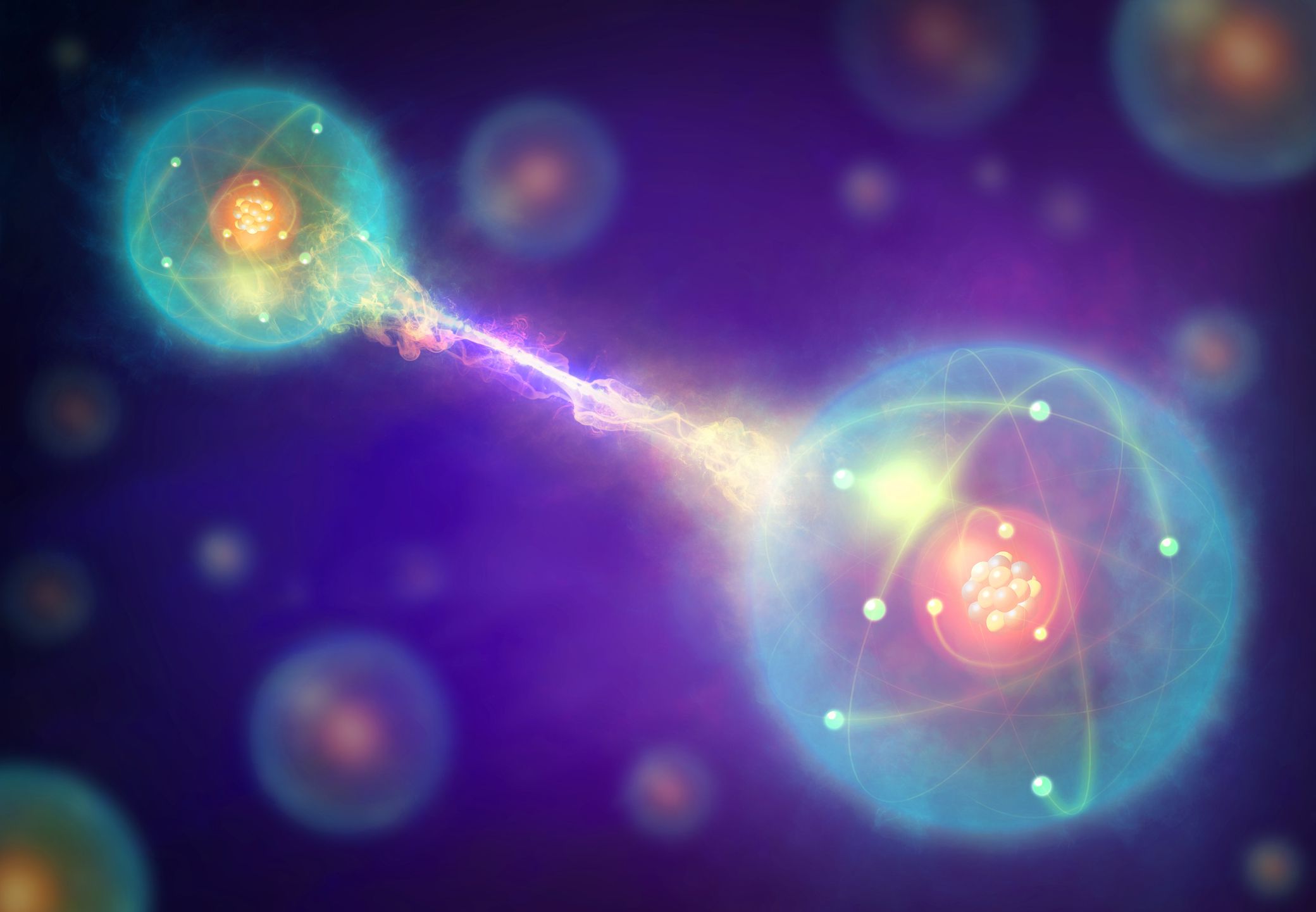
The first pie we get thrown in our face is known as "quantum entanglement." Basically, it boils down to two entirely different quantum systems (just particles, for simplicity) being inexplicably "tied" together by some random property or another. Before we can explain this, however, we must first know some of the properties of particles.
-Spin: Exactly what it says on the tin, spin is angular momentum
-Charge: Basically the electric charge of a particle.
-Mass: You guessed it, the mass of the particle
-Magnetic moment: Essentially how much magnetic fields effect a particle
-Isospin: Not angular momentum at all, relates to the strong force
-Weak Isospin: Same as above, but for the weak interaction
-Weak Hypercharge: Pertains to the weak force
-Position: Where the particle is
-Speed: I think you can figure it out
Normally, entangled particles are entangled by their spin; in a system that is entangled by spin, the sum of the spin of both particles will always stay the same; if one particle's spin changes, the other's will change instantaneously to keep the sum constant. This means that in any system of particles, you cannot describe each one independently: all the particles can only be described as one, treating the system as a whole. This isn't some batshit crazy quirk of an equation: we have observed this to happen, and not only with stuff as big as buckyballs (a structure of 60 carbon atoms) and even small diamonds, but at distances of 750 miles (1200km) or so.
This is incredibly perplexing, as it is literally impossible for information (pretty much everything is some form of information) to travel faster than light, yet entanglement works quite literally instantaneously, even over vast distances. Many physicists believed that quantum entanglement held the key to communicating faster than light, in that you could take pairs of entangled particles, put half on one planet and half on another and change the state of the particles to express messages in binary. This would be a major breakthrough, and a gigantic loophole in the speed of light being the absolute speed limit. But when we tried to use entanglement to communicate, the universe wasn't gonna take any of our shit: changing the state of one particle in the pair breaks the entanglement. That's right. We found a loophole in physics, and the universe fucking closed that shit before we could exploit it. It's not what happened (the universe didn't actually change in response to us), but it's plausible enough for me to believe.
Why? Because fuck you, that's why.

So Einstein, Heisenberg (Driving), and Schrodinger are driving down the road when they get pulled over. The cop walks up to the window and starts talking:
C: "Do you know how fast you were going?"
H: "Nope, but I know exactly where I am."
C: "You were doing 50 in a 30."
H: "Great! Now I'm lost, dick."
E: "He wasn't doing 50, the road was doing 50!"
C: "You guys drunk or high? I'm gonna search the car."
So the cop opens the trunk and finds a box which he proceeds to open.
C: "Did... Did you guys know you had a dead cat in here?"
S: "We do now, asshole!"
---
Uncertainty is one of the more perplexing parts of quantum mechanics: there is always a certain amount of uncertainty in the universe itself, as far as we can tell. For example, it is quite uncertain if a particle exists in one place or another until it is observed, and you can either know the momentum or position of an electron, but never both at the same time. You never know what is in a box until you look inside, essentially. This concept ties very heavily into superposition, which is the next image; this one kinda stops here, because there isn't that much to it (without getting crazy math heavy) that isn't better explained in superposition. Just remember that there is always uncertainty.
The second part to this image is the observer effect: you cannot measure the state of a quantum system without altering it. Contrary to what you may hear, the system has no clue as to whether or not somebody is looking at it, it's actually far more simple: the only way we can measure something is to bounce a particle off of it (the only reason we can see is because photons bounce off things), and due to the small energies and masses at the quantum scale, a particle hitting a system will cause a change in the system. Think of it this way: if you're trying to grab a ball while blindfolded, you move the ball by touching it; that is the observer effect.
The most famous example of these is a thought experiment developed by Erwin Schrodinger, known as Schrodinger's cat. Basically, you put a cat in a box with a vial of poison that is opened by a Geiger counter picking up the decay of a cesium atom inside the box. The cat will almost certainly die, but you have no way of knowing until you open the box to check: it is both alive and dead simultaneously, until you have to go and look at it. Great job, asshole. You just had to go and ruin it for everyone, didn't you?

Superposition
---
A key part of quantum mechanics, and one of the reasons that quantum computing is such an active field of research (combined with entanglement), is superposition. This is the idea that a system exists in a discrete state that is a combination of all other possible states; for example, if my lunch can either contain an apple, a banana, or an orange, then there are 3 possible states. But if I keep the bag closed, then it exists in a "applebananaorange" state, which is the other 3 existing at the same time. Only when I measure the system by opening the bag does this superposition collapse into one of the three possible fruits.
As any property can be in superposition, including location, this means that particles can exist in multiple places simultaneously until we're able to make enough measurements to narrow it down to one specific location at a certain time. This leads to an interesting, and disturbingly possible, theory: the one electron universe. Basically, there is only one electron in the entire universe, and it exists in an uncountable number of places and times simultaneously, and the uncertainty principle prevents collapse of the universe as we know it; if we could know both the position and momentum of the one electron, then the superposition would collapse and that would be very bad.

Tunneling
---
An even more perplexing concept, building off of superposition, is quantum tunneling. Although it can refer to a system moving from one local minimum energy level (false vacuum) to a true minimum energy level (true vacuum) without requiring any external energy, I'm gonna stick to position for the sake of simplicity.
Tunneling is the act of a particle seeming to travel through what should be a solid barrier; but only seeming to. In reality, it already exists on both sides of the barrier, and a measurement or other outside force caused the superposition to collapse and place the particle at only one of the possible places for it to be. This one also isn't some mathematical quirk: it has been proven to exist, but it also causes serious problems for us and is essential to the existence of the universe as we know it. Nuclear fusion, the process that drives stars, requires that atomic nuclei get nice and cozy in a high energy environment; the problem is that the electromagnetic force will keep them from ever getting too close at all but the highest temperatures (temperature is just kinetic energy in a substance). Tunneling solves that: nuclei will randomly tunnel close enough for fusion to happen at more reasonable temperatures, making the existence of stars possible. Tunneling also causes a huge problem for us: computer chips rely on electrons moving in very specific ways through very specific paths; the more paths, the more powerful the chip is. The problem is that we are getting to the point where the paths are so small and close together that electrons begin tunneling to other places in the chip with some regularity, making errors far more common and difficult to account for.

The 4(ish) Forces
Also, fuck gravity.
---
There are four fundamental interactions that govern everything in the universe, as far as our knowledge goes: the strong force, the weak force, electromagnetism, and gravitation. Here's a quick rundown:
-Strong force (Carrier: gluons)
-Fundamental strong force ties quarks together to form protons and neutrons. So strong that it is essentially impossible for quarks to exist freely in our universe's current state.
-Residual strong force keeps protons and neutrons in atomic nuclei, can be broken (fission)
-Weak force (Carriers: W & Z Bosons)
-Incredibly weak, responsible for radioactive decay
-Electromagnetism (Carrier: Photons)
-Acts on charged particles, all light (including infrared, radio,Z microwaves, ultraviolet, x-rays, gamma rays: all of it) is actually just electromagnetic radiation
-Gravitation (Carrier: N/A)
-Odd man out, has no mediating particle and is the only force able to work at great distances. Also the weakest force, by far; gravity is one of our biggest hurdles in understanding the universe.

Fluctuation
---
Even more of a mindfuck is quantum fluctuation: basically, energy will just up and randomly appear (usually in the form of an elementary particle: energy and matter are equivalent as per E²=(mc²)² + (pc)²) and disappear from existence. Really the only reason you don't up and completely disappear at any given moment is sheer probability: you are a lot of energy, and it is ridiculously crazily unlikely that you will disappear. It is believed that tunneling and/or fluctuation played a key role in the Big Bang.

The second suggestion of thermodynamics
---
Entropy is the term for the amount of disorder in a system: it must always increase or stay the same, it can never decrease. Or so we thought. It is now generally agreed that it is highly probable that entropy will increase or remain constant, but it is possible for it to decrease. Entropy is really the destruction of information and the ability to produce new information: a black hole increases entropy by destroying everything that enters to the point that it can never be recovered. As our universe is expanding, entropy is increasing as the matter and energy that become stars and planets is slowly expended and atoms slowly decay into their requisite particles.
Think of entropy like this: if you burn a newspaper, you technically could recreate it from the smoke and ashes, but you'd have a helluva time trying to make it happen.

Big Freeze
---
We are lucky to be alive in such a young stage of the universe: we have a cosmic microwave background (more on this tomorrow) to teach us about the birth of the universe, we can look to the skies and see an endless expanse of light and color and wonder if anyone is looking up from one of those dots of light and looking at ours and wondering the same. But nothing lasts forever, not even the universe.
Eventually, entropy will reach a maximum and the temperature of space will become uniform, asymptotically approaching absolute zero and the only matter will be elementary particles so far apart from one another that they never have any hope of interacting with one another. Thankfully, this event, known as the heat death of the universe or the "Big Freeze," will not happen anytime soon: our universe is approximately 13.9 billion (10^10) years old, and the heat death is expected to happen in about a googol (10^100) years.

Bang!
---
But heat death, if that truly is what fate has in store for our universe, is not necessarily the end. Well, it is. For now. Because I don't want to get too invested in this series if y'all don't like it and I don't want to end up with a super long post for the first one. Plus it gives me some leeway in tomorrow's installment (if there is one).
As always, thank you for reading, and I hope you enjoyed!
SpaghettiThunderbolt out!
Metalhead47
"Why? Because fuck you, that's why." This continues to be my entire understanding of quantum... stuff.
spaghettiThunderbolt
Best and simplest explanation, really.
TexasAggiePlanet
I actually read all of this and feel a bit smarter for it. +1 to you, sir
spaghettiThunderbolt
Thank you! Glad you liked it!
mememurderer
I like this!
spaghettiThunderbolt
Happy you enjoyed reading it!
starkart
Dark ages.... strong force.... nice post ... quantum entanglement
GolFoehammer
I particularly enjoyed the portion that had Einstein, Schrodinger & Heisenberg.
Raz0rking
Quantum mechanics..."IF you understand it, you do not understand it" Lawrence Krauss
BrickShakes
Ain't that a Richard Feynman quote? Krauss only borrows it
spaghettiThunderbolt
Two kinds of people: those that don't understand quantum mechanics, and liars. I'm both, simultaneously, until you ask me.
xPOOKYBUBx
This guy right here, I like"m
starkart
@GBMaker and the gang :D
GBMaker
Oh, yeah, we're here!
GBMaker
@SlutAtNight
GBMaker
@JamesBluntThatSmartassCunt @ThatWeirdFriendEveryoneHas @Arson1st @Angelova33 @FewerNotLess @TimeLordQuiggs @JChilly
GBMaker
@Imjusthereforafuturefriend @watrudoing @starkart @StabbyMcMurder @Hremsfeld @whiskeyandcigarettes @WeRSpecialPeople @Averagegamerdude
GBMaker
@WiggityWonky @JiffyDealer @thunder3bolt @elmetian @corgiliciousdefinition @grapesforducks @YetHereIam @37bushelsofpotatoesx2 @BertTheSmert
GBMaker
@zdrify @DudeWithATie @thelastniceguy @MrArthurRadley @Lesbangle @Rarenimrod @NoscopeQuickscope @areola51 @YodelingEinstein @tokennametaken
GBMaker
@MTimeTraveller @GollumJTrump @auserwithaname @Maddieisawienerdog @Tchjos20 @wildsunshine @hotfudge @SmeachThePeach @quagma @AmishNewsAnchor
GBMaker
@evolution4407 @waterbucketsandsparetowels @AbortedFetusNecrophiliac @GentlemanOfFortune @natemandoo @SpockIsMyHomeboy @MOTHERFUCKINGJESUS