
EVJ22

1659

22

1
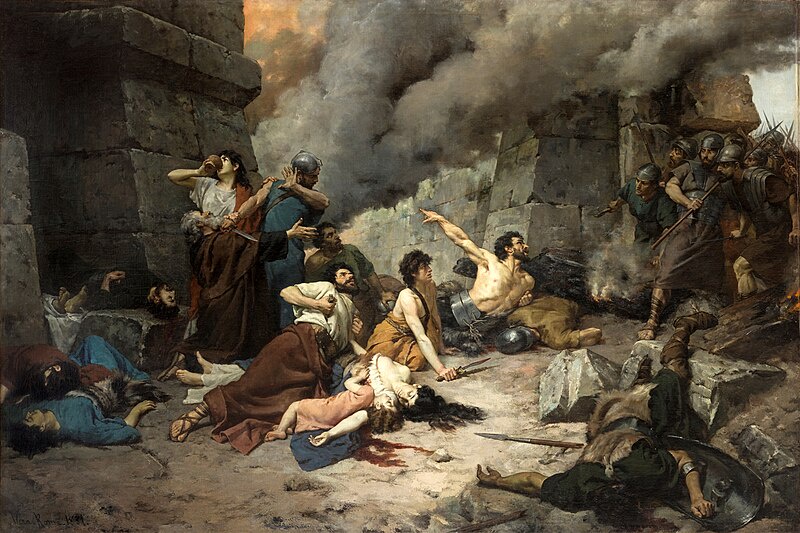
1. "The Last Day of Numantia." Alejo Vera, 1881.
Background: The Celtiberian Wars
First Celtiberian War (181–179 BC):
The Romans sought to conquer the peninsula while expelling the few remaining Carthaginians, moving to contain Celtiberia - a region that today includes parts of Aragon and Castilla-La Mancha.
Tiberius Sempronius Gracchus, proconsul of Hispania Citerior, arrived from Baetica with an army of 8,000 infantry and 5,000 cavalry to liberate Caraues (Magallón, Zaragoza), a city allied with Rome that was being besieged by some 20,000 Celtiberians. Following the victory, he conquered neighboring lands and towns and granted them to the indigenous people, thus winning their friendship. He subdued the rebellious Celtiberians at the Battle of Moncayo, ending the uprising and halting Celtiberian expansion beyond their territorial limits.
After this, he brokered peace with various Celtiberian tribes (the Belli and Titii), achieving a certain level of pacification in their lands. In exchange for territorial autonomy, the Romans demanded an annual tribute, the participation of native warriors in the military service of the legions, and a ban on fortifying their cities. The Celtiberians received this pact positively; after having been treated with harshness and duplicity by almost all previous Roman generals, Gracchus offered them security and well-being. For this reason, for a long time, the majority of Celtiberia remained neutral or even allied with Rome. Until it was no longer possible.

2. Aerial view of the ruins of Numantia.
Second Celtiberian War (154 - 152 BC):
The pretext for the beginning of the second phase of the war occurred in 154 BC with the expansion of the fortress of Segeda (Calatayud, Zaragoza), the capital of the Belli. The Roman Senate considered this a violation of Gracchus's agreements, while the Celtiberians argued it was an expansion, not a new construction. This, along with certain Celtiberian raids on Roman-allied cities due to a lack of resources in their lands and the rise of Roman governors more aggressive than Gracchus, caused Rome to send an army of 30,000 soldiers led by Marcus Fulvius Nobilior to the Belli capital. Upon seeing them arrive, the Belli sought refuge in Numantia, the territory of the Arevaci—the most powerful Celtiberian tribe with the largest territorial control.
The coalition of Arevaci and Belli numbered about 20,000 soldiers and 5,000 horsemen. Under the command of the chieftain Carus of Segeda, they managed to ambush the Romans, causing 6,000 casualties and winning the battle despite being outnumbered. However, this led to the loss of their leader, the Belli chieftain, who fell while pursuing the Romans to save his army.
Despite this, the Romans under Fulvius reached Numantia and began preparing for a siege. They were joined by reinforcement troops sent by the Numidian King Masinissa, a Roman ally, which included 10 war elephants. This prompted Fulvius to launch the attack. It seemed the elephants would be a decisive force, as the Numantines had never seen them and were terrified. However, a large stone thrown from the city's high walls struck one of them, causing it to go unrestrained and attack the Roman lines. Taking advantage of the chaos, the Celtiberians attacked the besiegers and caused 4,000 casualties. Fulvius attempted nothing further and spent the winter in a nearby camp, suffering from food shortages and constant Numantine raids.
The following year, the newly appointed consul Claudius Marcellus managed to conquer neighboring cities, granting them pardon. Seeing this, other Celtiberian cities requested peace in exchange for war taxes. Marcellus responded by offering a pact on the condition that all peoples (Arevaci, Belli, and Titii) surrender simultaneously. He succeeded in this, sending ambassadors to the cities and recommending that the Senate approve the treaties.
However, the Roman Senate rejected the peace offer and prepared new armies. Marcellus had no choice but to declare war on the natives again, conquering more cities and cornering the survivors in Numantia. The leader of the Numantines, Litennon, sued for peace on behalf of all the tribes, and Marcellus accepted it in exchange for money and hostages before the Senate's reinforcements could arrive.

3. "The Siege of Numantia." Ivan Sytin, 1914.
Third Celtiberian War or Numantine War (143 - 134 BC):
The stubbornness of the Senate, which demanded unconditional surrender, along with the violations of Marcellus's treaty by most Roman leaders and Viriatus's victories in Lusitania, forced the local tribes into revolt, sparking the Third Celtiberian War.
In 143 BC, Rome sent Consul Quintus Caecilius Metellus with 40,000 soldiers. Despite capturing several cities, he was unable to occupy Numantia and spent the winter sheltered in his camp.
In 141 BC, Consul Quintus Pompeius was dispatched with an army of 30,000 infantry and 2,000 cavalry. Defeated daily by the Numantines (who likely numbered 10,000 warriors at most), he was forced to negotiate a secret peace treaty. This agreement was canceled upon the arrival of his successor, Marcus Popillius Laenas, in 139 BC. Popillius led unsuccessful battles against the Lusones tribe, south of Numantia, suffering heavy losses.
In 137 BC, Consul Gaius Hostilius Mancinus arrived with an army of 22,000 men. He was defeated several times, and when rumors spread that the Cantabri and Vaccaei were coming to Numantia's aid, he retreated and took refuge in his camp. Finding himself surrounded by the Numantines, he capitulated. They signed another agreement, this time based on equal rights—something the Senate considered shameful. Consequently, they sent Marcus Aemilius Lepidus Porcina, the consul of Hispania Ulterior, to handle the situation. They also ordered the arrest of Mancinus and his delivery as a prisoner to the Numantines. The Romans mocked the consul, stripping him and leaving him tied in front of the city walls so the Numantines could do as they pleased with him. The Numantines, however, did not touch him, so as not to break the pact they had pledged.
Between 137 and 135 BC, no Roman consul or general dared to try their luck with the siege of Numantia, mainly due to the consequences the Senate would impose on them if they failed.
But in 134 BC, Consul Publio Cornelius Scipio Aemilianus—the general who destroyed Carthage—arrived to resolve the situation. The law of the Roman Republic stipulated a 10-year wait to serve as consul again for a military conflict, but in this case, they made an extraordinary exception.
The general arrived in Hispania Citerior, where he assembled an army of 60,000 soldiers and auxiliaries, along with Numidian cavalry provided by King Jugurtha. Upon arriving at the camp in Numantia, Scipio subjected the deployed army to rigorous training and expelled all those unfit for combat. He sought to have a disciplined, well-formed army, submissive and accustomed to hard labor and fatigue. In the summer, he raided the lands of the Vaccaei to prevent them from helping the Numantines, and by autumn, he prepared for the final siege of the city.

4. "The Destruction of Numantia." Juan Antonio Ribera, 1802.
The Siege of Numantia (134 - 133 BC):
Due to the numerous failures of previous consuls, Scipio realized he could not take the city by storm, so he chose a blockade. He surrounded the city with seven camps and watchtowers and blocked the Douro River to prevent the besieged from receiving supplies or water. He ordered the construction of a 4km-long fence around the city, along with a massive wall and trench.
With all preparations complete, the blockade aimed to close off all routes and let the besieged perish from hunger while the Romans simply waited and held their ground.
The Numantines, with a reserve of only 4,000 warriors, carried out one last desperate plan to turn the tide of the war. Retogenes the Caraunian, a Numantine nobleman, devised a plan to escape and seek help from nearby tribes. He gathered five warriors and their servants; together, they raided the fence one night, using the darkness to neutralize the sentries without raising the alarm. The servants secured horses, ropes, and ladders, allowing the group to scale the palisade and gallop away before the Romans noticed.
They traveled through nearby Arevaci cities to plead for help against Scipio, but most rejected them due to the fear the Roman and his army inspired throughout Celtiberia. Only the youth of the city of Lutia (Luzaga, Guadalajara) were enthusiastic about fighting and urged their citizens to aid Numantia. However, the city elders feared reprisals and betrayed the rebellion to the Romans. Scipio marched on Lutia and demanded the delivery of 400 young men, whom he maimed so they could never lift a sword against Rome. Retogenes returned to Numantia empty-handed, entering the city as he had left it. It was then that the Numantines began preparing for negotiations.
The Numantine ambassadors asked for their freedom in exchange for a complete surrender, but Scipio refused. The ambassadors were struck down before the disbelieving population of Numantia, who thought they would reach an agreement with the Romans as they had with Gracchus and others. The city refused to surrender, and the famine began. Cannibalism occurred, and many began to take their own lives along with their families. Seeing the end was near, the Numantines prepared great bonfires to burn the city and chose to perish by fire or through the Celtiberian rite of decapitation.
After a 15-month siege, Scipio entered the city and captured the few remaining survivors. He razed the ruins of Numantia and returned triumphantly to Rome.
This siege remains one of the most historically significant examples of the resistance and character of pre-Roman peoples, who preferred death over capitulation and slavery. I like to think that, despite the many years and ethnicities that have passed through this land, the most primal traits of our culture have their roots in these pre-Roman peoples. Their character and way of life remain invisibly present in our culture, and to deny it would be foolish. We have the past closer than we think; moreover, we coexist with it. Dona eis Requiem. Amen.