
MantisTobagganMD

1453

27

5
Flags of the World. That's right, bitches. That's a lot of flags.

I love flags. Don't know why, can't explain it. But nothing gets my nips nippier than some gold ol' Vexillology (look it up, jabronies).
I decided to share my interest with Imgur. So, the dealio is: I shall post once a day (probably....we'll see....I gots stuff to do) a list of 10 flags and a little bit about them: their history, why they look the way they do, you know....that old chestnut. We will only be looking into the designs of UN Member States Civil Flags. So no maritime flags, or State Flags, etc.. Also, only the current flags will be used, no former variation thereof.
Still, we have 193 UN Members to get through, so lets get cracking!
[By the way, I have chosen the order by way of a random name generator. So we'll see how long it takes to get to the better known flags, meaning Western Europe and the like. Also, the majority of this will be taken straight outta Wikipedia, so don't come here looking for any groundbreaking insights into International flag designs.]
People's Republic of China

Sometimes referred to as "The Five Star Red Flag" (inventive, i know), the flag of the PRC was designed and adopted as the National flag in 1949 when the People's Liberation Army siezed control of the nation. The newly empowered Communist Party of China created a notice to submit designs for the national flag. A fervently patriotic citizen, Zeng Liansong, decided to submit his design (very similar, but with slight variances to the final product), and out of nearly 3,000 entries, had his design chosen.
According to the current government interpretation of the flag, the red background symbolizes the communist revolution and the golden colors were used to "radiate" on the red background. The five stars and their relationship represents the unity of Chinese people under the leadership of the Communist Party of China. In the original description of the flag by Zeng, the larger star symbolizes the Communist Party of China, and the four smaller stars that surround the big star symbolize the four social classes (the working class, the peasantry, the urban petite bourgeoisie and the national bourgeoisie) of Chinese people mentioned in Mao Zedong's "On the People's Democratic Dictatorship". The five stars that formed an ellipse represent the territory of China (including Outer Mongolia) which is shaped like a Begonia leaf.
https://en.wikipedia.org/wiki/Flag_of_China
Angola

The national flag of Angola came into use with Angola's independence from Portugal on November 11, 1975. It is split horizontally into an upper red half and a lower black half, and features a yellow half-gear crossed with a machete and crowned with a star. As in some other African countries, this flag is a modification of the ruling party's flag. The guerrilla movement and eventual governing party, the Popular Movement for the Liberation of Angola (MPLA), used the same design with a golden star in the center. Red stood for socialism and black for Africa. The star was modeled after the red star of the Soviet Union, which sponsored the MPLA. Later the explanation was made less party-specific: The red is for the blood spilt by Angolans during their independence struggles, while the black is for the continent of Africa. The symbol in the middle is of a crossed cog wheel (representing workers and industry) and machete (representing the peasantry, agricultural production and the armed struggle) with a gold star. It was adopted during a time when Angola had a Marxist government, and thus was supposed to evoke the image of the hammer and sickle found on the flag of the former Soviet Union, a common symbol of Communism.
In 2003 a more 'optimistic' flag was proposed, removing the symbolisms of violence. It was rejected, however.
https://en.wikipedia.org/wiki/Flag_of_Angola
Dominica
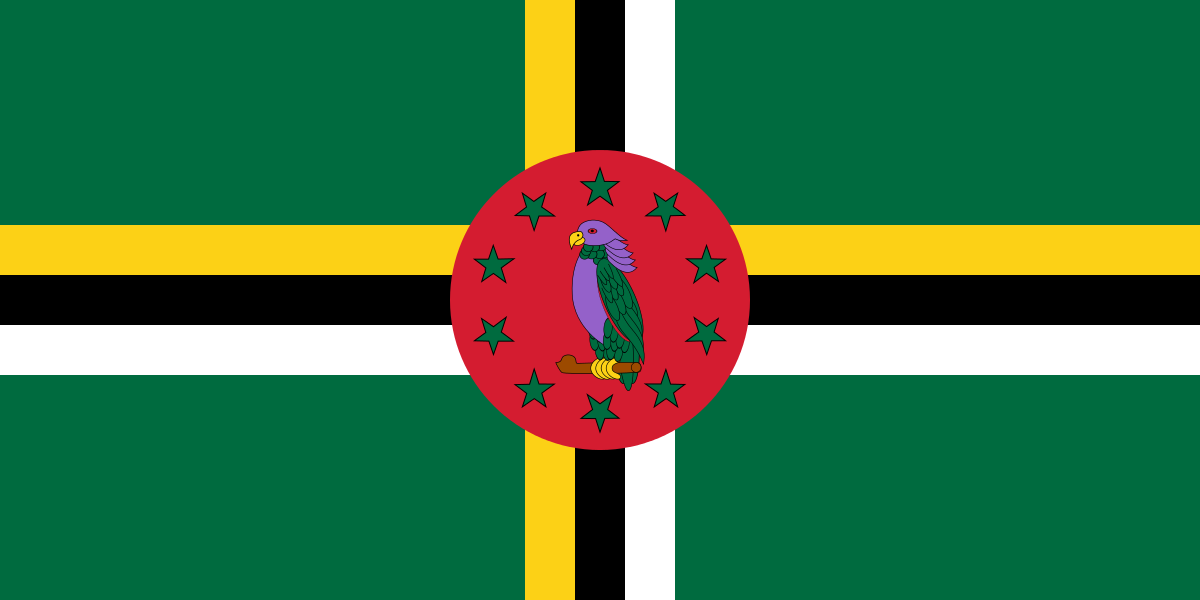
Adopted in 1978, the flag of Dominica features the national bird emblem, the sisserou parrot.. This parrot, endemic to Dominica, is an endangered species with a population of only 250–350. The green field represents the lush vegetation of the island. The cross represents the Trinity and Christianity, with its three colours symbolising the native Indians, the fertile soil, and the pure water. The 10 stars stand for the country's 10 parishes: (St. Andrew, St. David, St. George, St. John, St. Joseph, St. Luke, St. Mark, St. Patrick, St. Paul, and St. Peter), while the red disc stands for social justice.
The sisserou parrot is sometimes coloured either blue or purple (the parrot's actual colour). The use of purple makes the flag of Dominica the only flag of a sovereign state to include the color. However, the flag of Nicaragua features a rainbow and therefore, violet.
https://en.wikipedia.org/wiki/Flag_of_Dominica
Grenada

The national flag of Grenada was adopted upon independence from the United Kingdom, 7 February 1974. The six stars in the red border stand for the country's six parishes, with the middle star, encircled by a red disk, standing for the capital, Saint George's. The symbol in the hoist (half nearest the flagpole) represents a clove of nutmeg, one of the principal crops of Grenada. It also represents a link to Grenada's former name, which was the "Isle of Spice.
The red color of the flag stands for courage and vitality, yellow for wisdom and warmth, and green for vegetation and agriculture.
https://en.wikipedia.org/wiki/Flag_of_Grenada
Cape Verde

The national flag of Cape Verde was adopted on September 22, 1992, replacing the flag adopted during Cape Verdean independence, fought for with Guinea-Bissau, another former Portuguese colony on mainland West Africa.
The 10 stars on the flag represent the main islands of the nation (a chain of islands off the coast of West Africa). The blue represents the ocean and the sky. The band of white and red represents the road toward the construction of the nation, and the colours stand for peace (white) and effort (red). The yellow colour, circular formation of the stars, and dark blue field show similarity to the flag of Europe with 12 stars instead of 10, originally designed for the Council of Europe, but also used by the European Union.
Before independence, Cape Verde did not have an official flag. In the late 1960s, a flag for the Portuguese overseas province of Cape Verde was proposed, consisting of a flag of Portugal defaced with the provincial arms shield in the lower fly. However, this flag was never adopted.
The original national flag of Cape Verde was introduced on independence in 1975, based on that of the Partido Africano para a Independência da Guiné e Cabo Verde (PAIGC), with the common African colours of red, green and yellow. It is identical to the flag of Guinea-Bissau except for the charge in the hoist-side stripe. Their similarity evoked the plans to unite both countries, which, however, were abandoned shortly after independence. Guinea-Bissau gained independence September 10, 1974.
The flag bears a striking resemblance to the flag of the EU.
https://en.wikipedia.org/wiki/Flag_of_Cape_Verde
Kenya
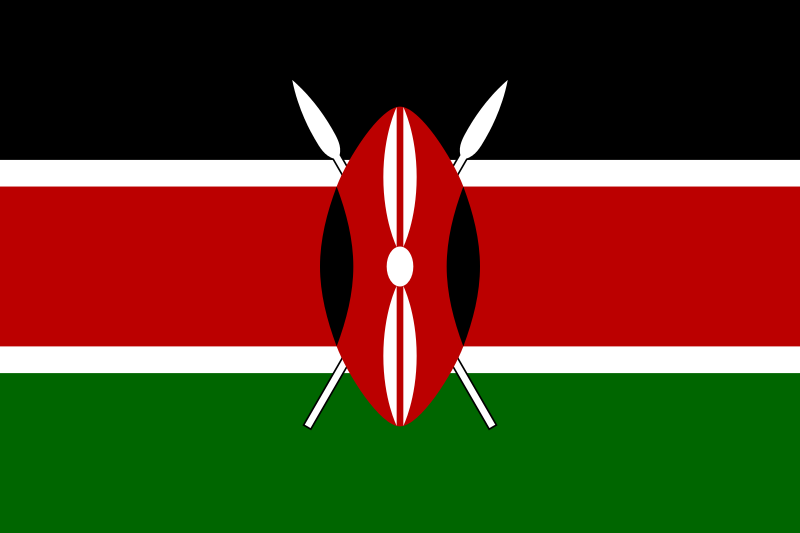
The flag of Kenya was officially adopted on December 12, 1963. It is based on the black over red over green flag of Kenya African National Union, the political party that led the fight for freedom and independence of Kenya. The color black represents the people of the Republic of Kenya, red for the blood shed during the fight for independence, green for the country's landscape and natural wealth. Upon independence, the white fimbriation, symbolizing peace and unity, and the shield were added. The black, red, and white traditional Maasai shield and two spears symbolize the defense of all the things mentioned above.
The meaning of the colors of the flag of Kenya match closely to those of the Pan-African flag adopted by the Universal Negro Improvement Association and African Communities League in 1920.
The flag of Kenya bears a resemblance to those of South Sudan, Malawi, and , of course, the Pan-African Flag.
https://en.wikipedia.org/wiki/Flag_of_Kenya
Azerbaijan

The flag of Azerbaijan, aptly named "The Tricolour Flag" is a tricolor featuring three equally sized fesses of blue, red, and green, with a white crescent and an eight-pointed star centered in the red. The blue symbolises Azerbaijan's Turkic heritage, the red stands for progress, and the green represents Islam. The official colors and size were adopted on February 5, 1991. This flag was used from November 9, 1918 to 1920, when Azerbaijan was independent, and it was revived on February 5, 1991.
The crescent on the flag symbolizes Islam, and the eight-pointed star on the flag symbolizes the eight letters in the name "Azerbaijan" (written in Arabic script).
I find this flag particularly fascinating, because of it's history. It is representative of the first first democratic and secular republic in the Muslim world, as well as a flag that survived after the USSR.
https://en.wikipedia.org/wiki/Flag_of_Azerbaijan
Barbados
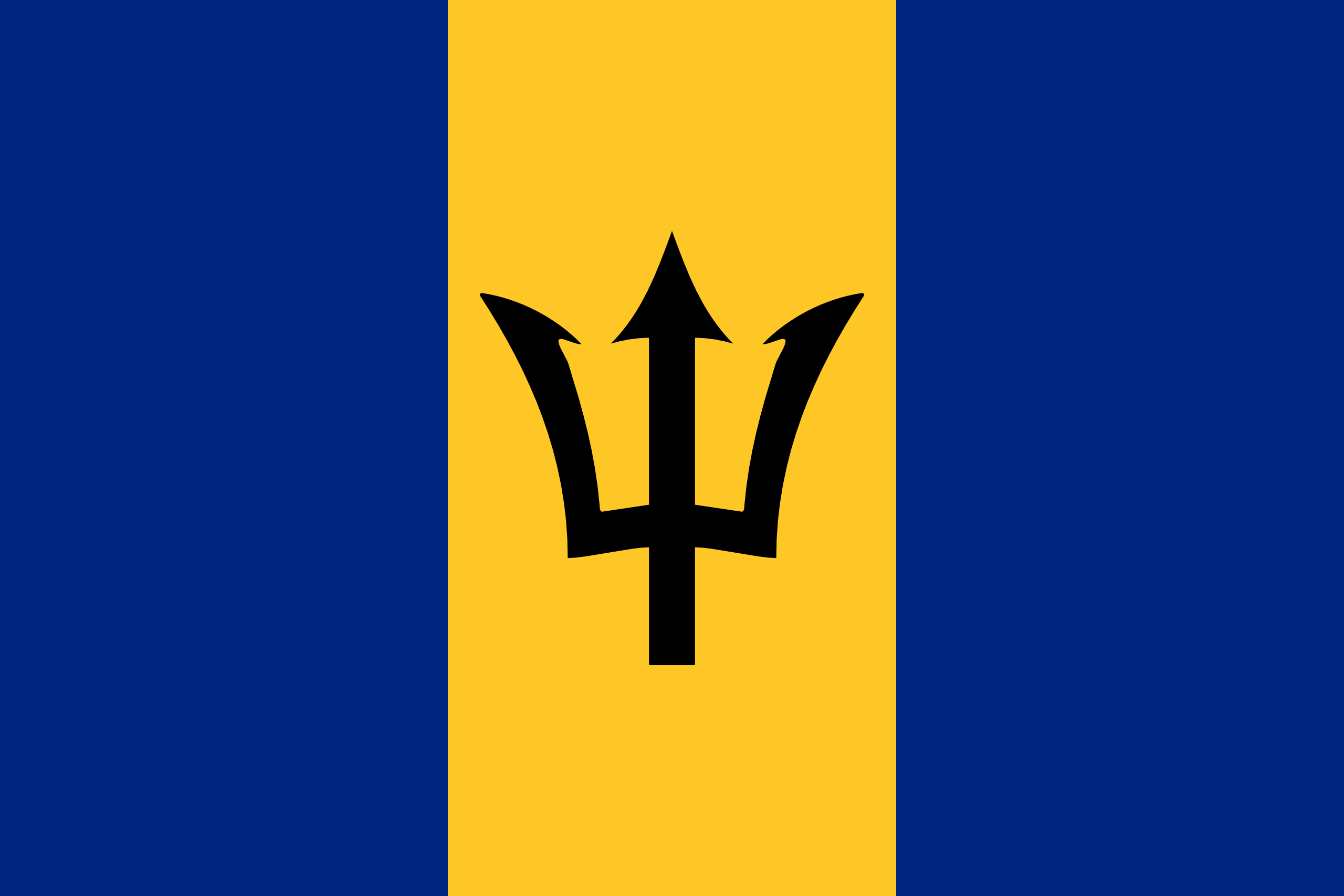
The national flag of Barbados was officially adopted on 30 November 1966, the island's first Independence Day. Named "The Broken Trident", it consists of a triband of two bands of ultramarine, which stand for the ocean, separated by a golden middle band, representing the sand on the island. A black trident-head (commonly called the "broken trident"), is centered within the golden band.
The trident symbol was taken from Barbados' colonial badge, where the trident is shown with Britannia holding it. The broken lower part symbolises a symbolic break from its status as a colony. The three points of the trident represent the three principles of democracy – 1) government of, 2) for, and 3) by the people.
The design for the flag was created by Grantley W. Prescod and was chosen from an open competition arranged by the Barbados government. Over a thousand entries were received.
https://en.wikipedia.org/wiki/Flag_of_Barbados
Sierra Leone

The flag of Sierra Leone is a tricolour consisting of three horizontal green, white and blue bands. It was adopted in 1961, Sierra Leone's independence year, to replace the British Blue Ensign defaced with the arms of the crown colony.
The colors of the flag carry cultural, political, and regional meanings. The green alludes to the country's natural resources-specifically agriculture and its mountains, while the white epitomizes "unity and justice". The blue evokes the "natural harbor" of Freetown, the capital city of Sierra Leone, as well as the hope of "contributing to world peace" through its usage.
https://en.wikipedia.org/wiki/Flag_of_Sierra_Leone
Monaco

Yes, it is Monaco, and not Poland, Indonesia, or the cities of Vienna, Hesse, and Kerkrade....The red atop white flag is quite popular...
In Monaco's case, the colors of red and white have both been heraldic colors of the House of Grimaldi [a prominent Genoese/Monegasque family] since at least 1339. The present bicolor design was adopted on April 4, 1881.
That's really it on Monaco. Prominent family lends its colors to the nation. Cool.
https://en.wikipedia.org/wiki/Flag_of_Monaco
flacoloco
fun with flags - imgur edition
TheRicM
Sheldon Cooper, is that you?
stemokj5
TIL that I can learn about flags that represent countries that I didn't know exist.
StreetFighter
Where is Sheldon Cooper when you need him
MantisTobagganMD
On a shitty tv show, that's where he is.
DavidA1225
http://imgur.com/eSVd8WJ
MantisTobagganMD
You can't claim us, we live here! There are 500 million of us!
DoctorSkeletal
Obligatory question: which is your favourite flag?
MantisTobagganMD
There truly are too many very well put together flags that each have their own merits for me to choose my favorite.
MantisTobagganMD
Bruh...there are too many to have a favorite. I'm partial to Greenland, Wales, Belgium and Germany [similar], all of the Nordic Crosses...
AvastyBabies
Africa is FABULOUS
MantisTobagganMD
Africa is the continent where I can't tell you every flag. Partially b/cthere are so god damned many, partially b/c many look very similar.
mkyner
So did Monaco steal Poland's flag and flip it over? Or other way around?
MantisTobagganMD
Neither. Horizontal bicolors of white and red is a relatively widespread design. Both adopted heraldic colors into their national symbolism.
mkyner
Do you ever design your own flags for places, just for fun?
MantisTobagganMD
I do. Currently working on my design for my house. Nothing concrete though, usually just scribbled on to a scrap of paper.
GeorgePancakes
I always wondered about the writing on the Saudi and Brazilian flags. Off to Wikipedia
MantisTobagganMD
Do it. Learn the things that make me happy, and I shall make you happy.
GeorgePancakes
Ok, the Brazilian one was straight forward. The Saudi one is a bit crazy. The Saudi flag cannot be at half mast, because it is sacrilegious
MantisTobagganMD
Yea, I'm not even gonna get in to all of the convoluted rules for each countries flag. Some places have some weird regulations.
MrGatsby
you had me at "jabronies"
DjenghisRoundstone
You keep using this word jabroni?
MrGatsby
Never really used it. Always thought it sounded hilarious.
DjenghisRoundstone
Lol no Charlie says that in the Always Sunny episode when Mac first uses that
RegularSizedRudy
I thought it was from The League?