
Feralkyn

2847

46

9

After mentioning I volunteered with Wildlife Rescue & Rehab for about a year, I've had a few people asking me for stories. I've spent some time writing some up & laying out some wildlife help tips. Before I start: 1. THESE ARE NOT MY IMAGES. They are allowed to be shared, credits down the bottom, but -my- photos are sadly long lost. 2. There will also be a couple Wiki links as gateways to further info--I know wiki alone isn't a "source" but it's a starting point for you!

Also, before I get into stories: wildlife rescue is NOT a government task for most countries. Many countries have 0 programs to help wild animals. Generally they're privately created & run, though by federally- or state-licensed rehabbers, and though they can get government funding, they depend hugely on volunteers and donations. Find your nearest Wildlife Rescue & Rehab center, see what you can do to help! Many will take ANYONE on as volunteers if it suits your fancy--and it's always good to know their phone number if you need them.

So, Wildlife Rescue generally involves getting a phone call about a sick, injured or trapped wild animal, often in ridiculous circumstances. Rescuers have to head out there with appropriate equipment, which by the way often makes you look like a serial killer: a big station wagon or van, towels/blankets, cardboard/plastic containers, duct tape, knife/scissors, and goggles/gloves... They also often have to get creative when rescuing, as some of the scenarios are... bizarre.
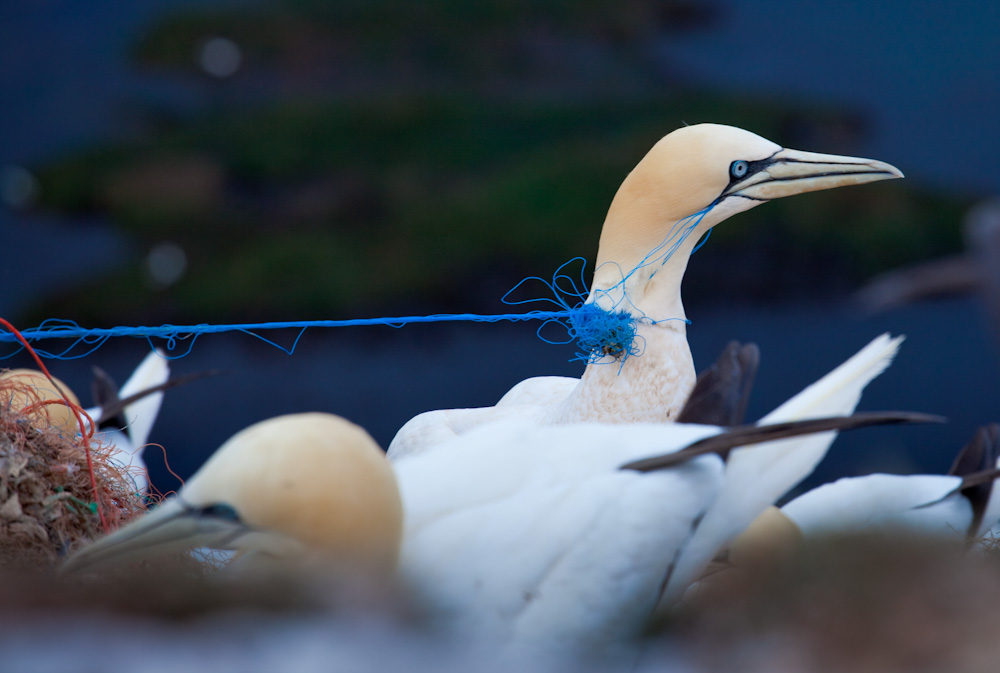
While there's increasing documentation and guides for medical treatment of wildlife, a lot of it is still human resourcefullness. Prostheses made of Lego are a good example of this, but using strange items to make a working bone-splint for a water-dwelling bird's recovery can take creativity, for example. There's also a lot of laws--like the fact that swans and starlings in the US are non-native species, and so not really covered by a lot of wildlife protection laws. As a result, people can just (in some states) keep captured swans as pets if they want, etc. There's also a need for separate housing & licensing for handling "rabies vector species" (bats, foxes, raccoons), etc. There's a lot I learned in my time there.

So, that bird above and this guy? Northern Gannets, or relatives of them (not sure). Memes warn you about swans and geese. Forget it, waterfowl aren't dangerous. THESE GUYS, though. They have KNIVES. On their FACES.

Oh, and did I mention they GO FOR THE EYES? That's right, these birds go stabby-stabby right at your seeing-bits. Goggles when rescuing these, as I -almost- learned the hard way, are a must. Story 1 is only a short moral: if you're gonna be trying to wrap a gannet up in a towel in front of two dozen beach-goers, put your damn gogges on first.

I've had a few people talk about wild animals knowing when they're being helped. Some ABSOLUTELY do. Among my favorites: a very regal swan who treated us as his servants. Each day when we came to clean his pen he'd step out, stately, head bowed. We never had to touch or restrain him; he'd walk out on his own and stand there, supervising our cleaning. As soon as we were done he'd head back in and inspect it all. Iirc that guy was eventually released. They're good dogs, Brent.

Another was a red-tailed hawk who was hit by a car while, ironically, trying to scavenge roadkill. I got the call, went out and picked him up, took him in. A few days later I went to clean out his cage and the door swung open more than expected, and this mf with hooks on his feet casually hops out onto... My. Bare. Arm. I froze, because those talons can punch right through flesh (see the owl later) but he just wobbled around, wings half-spread, balancing very carefully so as NOT TO SCRATCH ME. I've had DOGS with less awareness. When I shakily, politely asked him to go back inside (b/c what else do you do with a hawk on your bare arm), he looked at me, blinked, turned, and hopped back in. He was also sent on to another facility for further recovery & later release.

Another time, we had a spate of weird seabird issues: there seemed to be a fish shortage or the like, and a lot of birds were coming in underweight (we were coastal so a LOT of our patients were seabirds), or eating things they shouldn't. I'd heard earlier this day that a fellow volunteer had had to fish (ha) a sea robin (spiky boi, 0/10 do not swallow whole) out of a seabird's mouth. So when we had another group bring a cormorant into the center with a weirdly-spiky throat, I wagered a guess as to what it was. Maybe they do sometimes eat these, idk but normally not *tail first,* I can tell you that.

I should add here that the guy bringing the bird in MOCKED me for suggesting that a sea robin was stuck down there. He was standing quite close, arms folded, insisting over and over that cormorants would never eat those fish, and I was SUPER wrong. Meanwhile, I was carefully maneuvering both my tiny woman hands down this bird's entire throat, bending each sea robin spine carefully down so I could pull it back out. The moment the fish was out, this bird turned all the way around, ignoring me (with my hands still in its face) to bite that guy hard enough to draw blood. I like to think bird bro knew exactly what was happening, but either way, I think the bird and I were both satisfied. He also was released shortly thereafter (and he never bit me).

So. Owls. I've heard they're not so smart. Beautiful birds, but covered in mites, and though they have fantastic eyesight, they don't see tennis nets so well in the dark. Now, you ALWAYS wear thick gloves while handling birds, especially birds of prey, but trying to untangle a tennis net from a pissed-off, five-foot-wingspan bird of prey is really hard with gloves on. I had to make a choice: bring back the bird in a box, still tangled in sharp net so it might further harm itself, or risk injury & remove one glove to first cut it fully free?

Long story short, I ended up with one of these bad boys punching directly through the meat of the thumb muscle, down where it meets the palm. Holy SHIT. That hurt. And yes, it did get infected, but it healed up fine. The bird was freed from the net, though, and released after treatment. Worth it.

Swans. Again, I love these guys. We had a bathtub where we bathed the waterfowl daily. It was raised up, and had a shower curtain so they'd have privacy; the birds loved to dabble around in it. One day a swan was in the bath, and a co-worker and I were walking past it. I was behind him and watched in shock as a long white snaky boi slipped out of the shower curtain, yoinked his wallet from his back pocket and vanished back into the tub with it. Clever girl. (The wallet was retrieved without harming any birds.)

I also heard two stories from fellow rescuers, though I wasn't there for them. The first was a call for a deer trapped in a lake by a loose dog. The dog was chasing it around both on shore and in the water, and the deer was exhausted, close to drowning. The rescuers were struggling to catch up with either one--but lo and behold Swans™ arrived, got between the dog & deer, and chased the dog away, circling to keep it away from the deer until it could escape. In another story, an injured swan was rescued from a lake where it lived with its mate. When it was released a full year later, at the same lake, its mate flew out to meet it (swans mate for life) and the two immediately began a joyous courtship dance. What a beautiful reunion it must have been!

It's not all sunshine and happiness, though. There's some weird stories, for example a call one of our people got: hunters had shot some Canada Geese, poorly (since it's scattered birdshot) and left them to die. It took an hour to get out there & find the geese, and this was AFTER the call, yet the hunters were apparently still around and upon seeing the rescuer boxing up the geese, came over & tried to demand them back. While some animals do need to be left to bed down and bleed out after shooting, a wounding shot like this on downed waterfowl should have been immediately followed up with a humane kill. I'm pretty sure responsible hunters can back that up? Poke me if I'm wrong. (This picture is just some happy Canada Goose rescue, unrelated.)

Another semi-sad tale: a lot of our work overlapped with a very wealthy beachfront area. One call we got was for a nest of swans whose nestlings were periodically vanishing. The owner of the property upon which they nested believed a snapping turtle was eating them, and had seen one swan with a badly-wounded leg. I went out there and couldn't find the bird, and promised her I'd come back the next day. When I returned, her husband met me at the door and told me to leave, since (to paraphrase) "my snooping around looked bad to the neighbors." I never did find out what happened to that poor cygnet. On the plus side, as I left, I HAPPENED to find two Mallard ducks tangled completely in fishing line, hanging from the side of a dock. They were returned for treatment, and later released.

On a semi-related water-bird note: Great Black-Backed Gulls became one of my favorite birds. While most smaller gulls are noisy, jittery bastards, these giant fellows--evolved to be predators as much as scavengers--have a mentality very similar to a bird of prey: measured, calm, and intent. They are also, however, very intelligent. While the far more common Herring Gulls would freak out every time I came near, the Black-Backeds would watch me carefully, gauge my intentions and react accordingly--and fearlessly, though rarely with aggression. Absolutely earned my respect.

I now have a story of Moist Owlettes. They were two Great Horned Owl nestlings; one had fallen (likely kicked by the other, as owls sometimes do, as I later learned) out of the nest, and one was sitting alone at the bottom of the tree in the rain. I'd like to tell you that they looked like this: fluffy, adorable, and sweetly innocent.

But they looked like this. Scraggly, hissing hellspawn determined to tear your fingers off. The clack of their beak was SHOCKINGLY loud. I had to climb a thirty foot tree and use Creativity™ to help: by duct-taping a shallow wicker basket up as high as I could and plonking that snapping little bastard into it, and HOPING the parents found it. The property owner called the next day to update: the parents both found & cared for the young one. The basket+duct tape was a success, and the nestling successfully fledged.
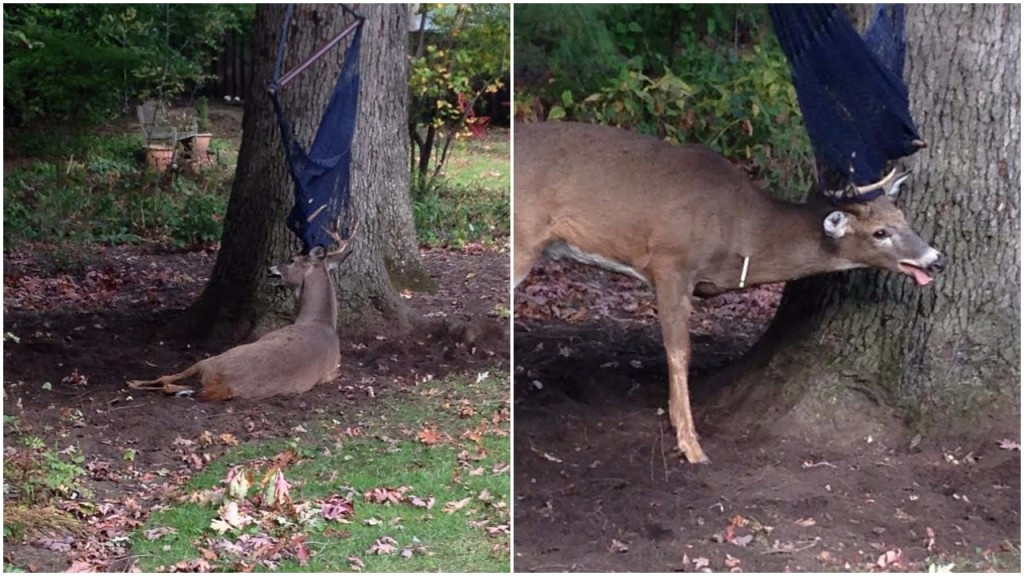
So, White-tailed Deer are absolutely ubiquitous where we were. And the bucks. Got tangled. In EVERYTHING. Deer fence, netting; this guy (not ours) was tangled in a goddamn HAMMOCK. Like, how?! Anyway, we got a call and to summarize, please picture six wildlife rescue volunteers running fruitlessly around a two-acre fenced plot trying to catch an upset buck dragging fifteen feet of deer netting behind him. Needless to say, we looked like idiots & it didn't work; cue Benny Hill music. Once he exhausted himself a day or two later, he was captured & freed.

Another time, our center was asked by a local news company to demonstrate an animal rescue. We had no calls that day, so our guys set up a re-enactment of a rescue; a captured sea duck (not pictured) who'd been caught in a plastic six-pack ring was set to be released. They decided they'd secure the duck, make a mock-up of the situation, and "free" it for the news piece, since he was to be released anyway. Unfortunately, the duck ACTUALLY got stuck, necessitating an ACTUAL rescue where our fully-clothed employee had to jump into the bay and swim over to it. The bird was fine, if disgruntled; the employee was wet. It was hilarious.

Speaking of six-pack rings, something a little grimmer: you can find tons of photos like this online. Birds, mammals, reptiles--they all eat anything they can find and that includes plastic, and Carl, that kills people! Yeah, they die. So please, find a trash can. Don't throw out your litter.
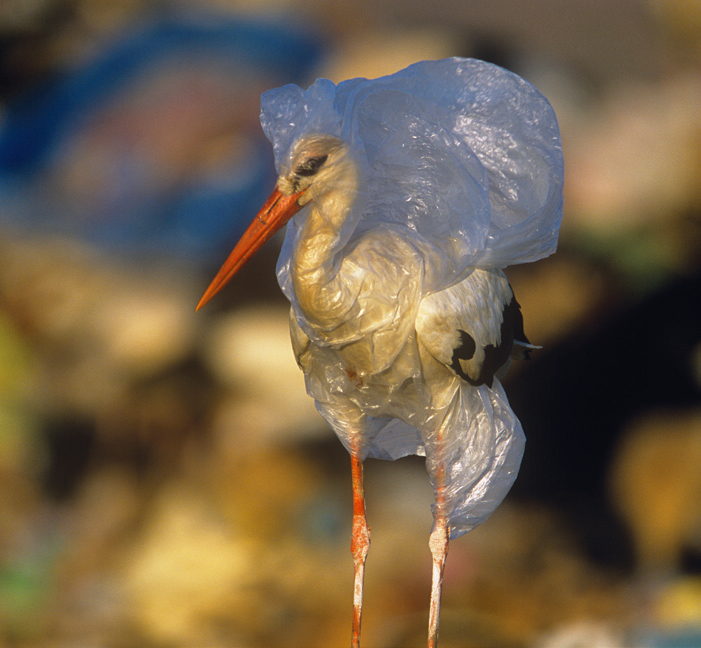
Yes, most ocean plastics come from other countries, but not all. We had a Humpback Whale calf in our area tragically wash up dead on shore; he had a local plastic grocery bag blocking his gut, which killed him. I can't imagine how painful that was, or how tragic to a social, loving family species. Hopefully, the bird in this pic was okay. But again: don't litter, please!

Remember the hawk I mentioned, the Red-Tailed who got hit while trying to scavenge roadkill? That's also a hell of a cycle. If you hit a (WILD, don't move a dead pet where it can't be found) animal, and it dies, and IF (and only if) it's safe to do so, please pull well off the road and (using hand protection) remove the dead animal and move it well off the road so that scavengers don't share its fate.

Further advice: if you find a baby bird on the ground, look it over. When in doubt, call your local rehab/rescue. Hatchlings should be replaced, or if they can't be, they'll need to be rescued & cared for; fledglings are learning to fly, their parents still care for them and they should be left alone. If someone touched the bird, DON'T WORRY. Birds have a really shitty sense of smell; the idea that human odor causes a bird to reject its nestlings is a myth. (Exception: New World vultures have a great sense of smell but I doubt you'll be carrying their babies around any time soon.) If the bird doesn't have a broad, brightly-colored beak (to signal parents to feed it), it may be a sick or wounded adult.

Likewise, if you find a fawn in the woods (at least in North America, I'm unsure about elsewhere), leave it alone. If it's wandering and crying, or near a dead doe, then call a wildlife center--but mothers leave their babies hidden while foraging. It's probably fine, and mom will come back for it--don't assume a lone fawn is "abandoned!" Though the effect of human scent's debated, it's best not to leave yours stomped all around a fawn by picking it up, and risking spooking the mother off.

Next tip: don't feed birds bread. Though the details are debated, the short version is, it's not their natural food. Too much bread is suspected to fill them up without the proper nutrients. They can gain a ton of weight, rendering them unable to fly, and developing young birds suffer from "Angel Wing" (pictured above) which without immediate correction will mean they can -never- fly. Bread is also reported to fuck up the environment through the altered bird feces (smothering plant growth, which IS their natural food), and potentially attracts rodents. https://en.wikipedia.org/wiki/Angel_wing

Early cat tax; cats are another huge risk to wildlife. Keep your pet cats indoors wherever possible. Estimates put cats as the HIGHEST cause of migratory bird deaths annually in the USA, with something like 300 million per year. America's birds didn't evolve alongside small feline predators, and are often killed purely out of instinct even by non-hungry cats. In addition, even a scratch is usually fatal: without antibiotic treatment, a cat's claws (they bury their poop, and lick their claws with cat saliva) cause fatal infection in many animals after even short contact. We always brought cat victims in for a full round of antibiotics before release! https://en.wikipedia.org/wiki/Cat_predation_on_wildlife
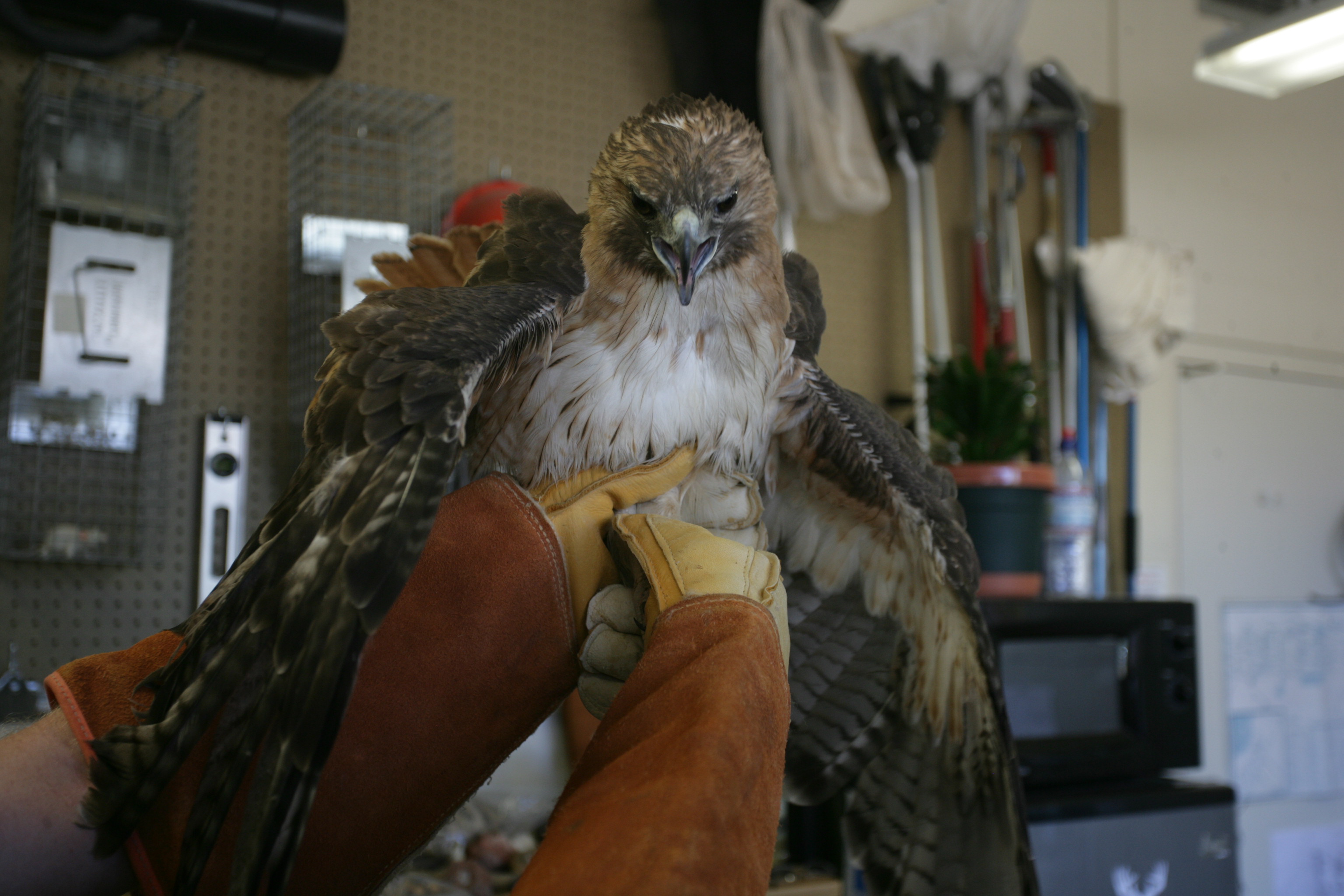
DON'T try to handle wildlife without protection. Big thick gloves, goggles where needed, a towel, blanket, etc. Better yet, leave it to the professionals. And by professionals I mean volunteers frantically duct-taping a deer's legs together. (If it works...) Also, NEVER, EVER take an animal in your car without -fully- securing it. If it's in a box, TIE OR TAPE THAT BOX WHOLLY SHUT. I was told of a death where a rescuer had a swan or goose in a box, the animal escaped and began flying around the car while the driver was on the highway, and caused an accident that killed the driver. I can't verify it but I can definitely believe it, so use caution & don't do that if you're transporting a wild animal to a rescue facility.

https://www.youtube.com/watch?v=8oG9Shpyni0 Bonus video: watch this happy duck's reaction to being rescued.
Image credits:owl talons - https://www.flickr.com/photos/mshades/484879368
swan rescue - https://www.flickr.com/photos/ian-s/6149895279
red-tailed hawk - https://www.29palms.marines.mil/News/Photos/igphoto/159137/
canada goose angel wing - https://www.flickr.com/photos/audreyjm529/4825105321
goose tangled in fishing line - https://www.flickr.com/photos/shyammenon/2455042266
fledgling sparrow - https://www.flickr.com/photos/audreyjm529/3645109314
hatchling sparrow - https://www.flickr.com/photos/audreyjm529/3645109314
fawn - https://www.flickr.com/photos/oxherder/3500037385
seabird rescue - http://www.ecocitizenaustralia.com.au/australian-seabird-rescue/
deer rescue - https://chicago.cbslocal.com/2016/10/20/riverside-police-free-deer-stuck-in-hammock/
Mrgolde
Keep being awesome!
Feralkyn
As a headsup, some of this might also be out of date, as my last volunteer service was something like 10 years ago-...
thebelltollsforme
Volunteered a bit back in the day. Had to wear faceshields when retrieving a great blue heron as they apparently have a habit of 1/2
thebelltollsforme
Striking at the glimmer in eyes. Still folded down to fit in a cat carrier though. 2/2
Feralkyn
I had a friendly dove decide to peck the shine in my eyes, too. He actually hit, and that HURT. Just curiosity but damn!