
TheJuiceLoosener

4023

73

25

The championship of the professional American baseball league is determined in what we unironically call the World Series. The World Series is a best-of-seven series, where the first team to win four matches wins the championship.
Say your team wins the first three games of the series 20-0, and loses the next four games 0-1. What that means is, your team loses the series. Even though your team scored more runs/points during the series by a margin of 60-4. That's right, a team can win the World Series by scoring just four runs, if they're properly distributed against the scoring pattern of the opposing team. Distribution of scoring is decisive, not simply scoring more in total.
In the World Series, there is no moral victory in scoring more total runs during the series. There's no point in "winning" on terms that aren't relevant to how the rules dictate the winner is actually determined. It's just a quirky way of losing, a piece of trivia. Winning is winning, you take home the trophy, and losing is losing, you go home empty-handed. The record books will not even give your team an asterisk.
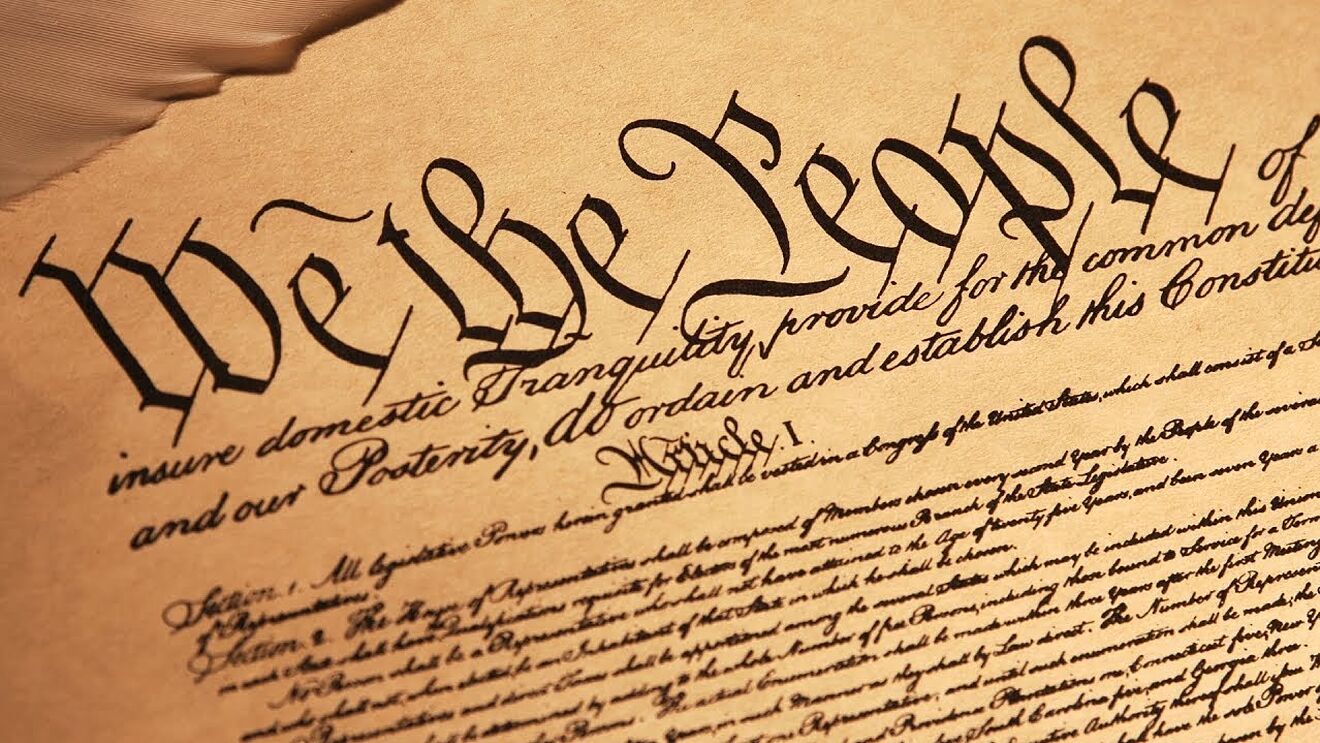
This same conceptual framework applies to winning in US politics. The rules for winning control are set forth in the US Constitution. Even though, like runs, votes are the basis for how individual matches are won, they are NOT summed and compared for determining political control in a national election cycle. Just like in the World Series, distribution of votes is decisive, not total votes.
At the national level, there are three venues for voting: your single representative in the House, your two US Senators, and the slate of Presidential electors for your state. Much attention has deservedly been given to gerrymandering House districts, which is an important and complex issue, but not one that I will focus on here. This post will focus primarily on the US Senate, though what I will propose here would likely have some impact on outcomes in races for control of the House and the Presidency as well.
The left has noted that there appears to be a non-trivial majority of voters nationally who support the Democratic Party with their votes. In 2020, in voting for control of the Presidency, that surplus was over 7 million votes, or about 4.5% of the total votes cast. But because distribution of votes is what actually determines the outcome, in fact, control of the political branches was, in some aspects, much more closely contested than these mostly irrelevant totals might suggest. The relationship between your total votes and your political control is one of efficiency of distribution. This efficiency is the key to the game. The Republican Party wields outsized power compared to its total votes, due to a greater efficiency and, conversely, the Democratic Party wields reduced power compared to its total votes because of poorly/inefficiently distributed votes.

The US Senate convenes anew every two years, comprised of 2/3rds returning Senators serving out their 6-year terms and 1/3rd Senators coming in fresh off their election/re-election. There is a tradition in the Senate that as few as 40 Senators can withhold support for pending legislation, and that legislation will fail. This is known as the filibuster, and it has also been the subject of no small amount of ink and electrons, mostly because this is a convention, rather than a rule written in the Constitution. The last time there was a 60-vote supermajority alliance in the US Senate was a period of about 7 months, or 72 in-session days, from late 2009 through January 2010, for the Democrats.
At this time, politically, the rural/urban political divide manifests heavily to the favor of low-population, rural states in the Senate. Wyoming, a state of fewer than 600,000 people, gets the same two Senators that California gets, with its population of more than 39 million. These are the rules. There's no more point in complaining about them than there is in complaining about the rules in the World Series. There are no moral victories here. You have to try to win under the existing rules. If the American left had the political power to change the rules, there'd be no need to change the rules.
Because of this tilted playing field, Democrats are properly loathe to set the precedent of eliminating the filibuster. They understand that, at this time, winning control of the Senate is inordinately difficult for them, so preserving tools that serve the minority party is a legitimate interest. I'm not saying that preserving the filibuster is necessarily the wisest course of action at this moment, just that the argument for it has a rational basis.
As I noted a moment ago, we can't change the rules because there's an opposing party that wields enough power to prevent any changes that would level the playing field. This is reality. Political power is generally a tug-of-war, where your actions and options are limited by the political power of your opposition. But this is not true in one particular regard that's of interest to me, and that is the inferred Constitutional right to freedom of movement.

Americans are allowed to move, freely, between states. This is typically not considered a potential election strategy because it tends to be a very gradual, almost tidal change, especially in comparison to 2-year periods between elections, where some voters may shift their allegiances based on any number of factors. At this point, though, you're probably starting to see where I'm going with this. I believe the Democratic Party needs to address its inefficiency problem, and there is an available mechanism to do so that is, fortunately, largely immune to being contested by the opposing party.
The Democratic Party has enormous numbers of reliable voters that are distributed with very low efficiency in certain states. CA, NY, MA, IL, and MD each had over 1 million vote margins in the 2020 presidential race, which I'll use as a proxy for illustration purposes. CA's margin was 5 million votes. Those 5 million excess votes in California earned the Democratic Party 0 extra senators and 0 extra electoral college votes. This is what inefficiency in distribution looks like. Another example is Washington D.C., where hundreds of thousands of Americans vote and receive 0 Senators and 0 representatives in the House. Again, terribly inefficient.
Hypothetically, if these were frictionless pieces in an electronic simulation that could be re-distributed at will, the Democratic Party could take two Senate seats in Alaska by moving fewer than 50,000 votes. For about 100,000 votes, the Democratic Party could take two more seats in North Carolina. For another 100,000 votes, they could lock in the one seat they currently hold in Montana, and take the other. For fewer than 150,000, they could take two each in SD, WY, and ND. Sum that up, and it's 11 Senate seats for moving under 750,000 people. This is admittedly idealized, but it's also enormously well-leveraged power, going after the lowest hanging fruit.
To be conservative, I'd say that a top-down directed effort to identify 1 million reliable Democratic voters in inefficient locations and move them to more efficient locations could lock in 10 additional seats in the US Senate. Although you could target a total of 60 to achieve that Senate supermajority, in reality, if the Democratic Party were confident of a floor value of, say, 55, that might give them the comfort they need to eliminate the filibuster and the 60-vote threshold.

"But wait! Isn't this cheating?"
No.
100% absolutely not. It's 100% by the rules. It is the opposite of cheating. These are the rules of the game. Winning is winning, by the rules. This isn't even trying to change the rules of the game. It isn't even unfair. What's unfair is that the current distribution of votes structurally disadvantages one party in comparison to the other. This is an effort to address that unfairness and to win the actual game that actually determines political control, which is a game of vote distribution. The fact that it can be implemented without offering a veto to the opposing political faction is a feature, not a bug. Happy to discuss further in the comments.

The nuts and bolts.
What this project needs, first and foremost, is donors. It needs money, because moving people isn't cheap. Not to get too spooky, but what I propose is modeled after a program run by the Masons. I'm not super familiar with the details, but broadly, the Masons have retirement villages where retired members are entitled to go live. The Democratic Party could start a similar program. Start building retirement communities in Alaska. Comfortable places, not luxurious by any means, but not junky either. Could be dormitory style. Build them with an elderly population in mind, so female-oriented, safe, handicap-accessible, environmentally low-impact, some centralized services, including medical services, transportation, etc. This would be a left-leaning population, so anticipate supporting activities that folks in this age-range enjoy (the arts, nature/outdoor activities, etc.). Diverse in race, sex practice, religion. And obviously, support in political activism and voting (assistance w registration, establishing a convenient polling place, etc.). This is what donors would be building.
Then you want to find your people. Registered Democrats, say for 10+ years, with reliable voting records. Retirement age. Probably little to no personal savings or nest egg, relying on SSI, pensions, etc. Living in large population deep blue states, but willing to relocate to low population red states. The enticements are 1) a warm, clean living condition, 2) rent and other living expenses substantially subsidized under the program, 3) participation in the greatest left-wing political project of their lifetimes. Establish program offices in the major cities of the big blue states (NYC, Chi, LA, SF, Boston, DC) so that people can apply, have a scoring mechanism to identify good candidates, and have support in the form of outreach, moving teams, etc.
I want to drill down into #2. I think that having a financial incentive here is important. Wealthy retirees are not the target audience. These will be working-class people who haven't necessarily amassed a secure retirement for themselves. They are getting by now thanks to their communities, so in order to get them to move, there has to be a similar community waiting for them. This isn't an ownership model, we're not trying to make the money back. We are trying to fill the beds and keep them full, so that we can win elections under the existing set of rules, not to mention providing a little nicer life in retirement for those who have supported left-leaning causes for years. So, expect to offer this retirement option at a VERY competitive price (think free, or near-free) to eligible and interested persons. There may also be ways to allow residents to contribute to supporting the community beyond finances. For example, retired medical professionals could still serve in volunteer roles in some capacity and if they're interested. Perhaps a willingness to do so could additionally offset costs or move you up the eligibility score. Obviously, though, we're not going to boot anyone who loses the capacity to serve in this way. Not to be macabre, but this would be a til-you-die community, to be clear about the arrangement. No one living in the community should have to fear being turned out. And when someone does die, that opens up the space, and the next willing applicant should be moved in.
Anyway, the details of this stuff isn't exactly my wheelhouse. I'm not an expert in retirement communities. What I know is what does and does not win the World Series and the same in American politics. This is how the American left can win. We're in a new political era in America. The stakes are high and the system is unstable. This is the best plan I can see for winding down the very dangerous politics we've developed here. Open to input on what I've laid out here.
Thanks!
obviouslyrob
I'm not sure why this is getting downvoted.
HoochIsCrazzy
the move to remote work makes it more feasible to up and move too.
Panicpeace
I ain't reading the whole thing. Is your strategy to have people move to other states?
MaximilianShade
Yes, but in a coordinated targeted fashion.
ParadoxLost
Speaking as something who moved from California to Texas after 2016. I’m right there with you bud. Been recruiting and relocating my staff
JustDumbCommentsAndCorrections
You're gonna run afoul of a whole bunch of voter bribery laws (varies by state)
TheJuiceLoosener
I'm not seeking any assurance about the future. There is nothing contingent upon voting, not voting, or voting for or against anything.
JustDumbCommentsAndCorrections
You'd think that should matter.
TomBrokaw
Interesting read and idea, thanks for posting.
NotSomoneElse68
My issue with not removing the filibuster is that you know Mitch McConnell is going to end it the moment he's back in charge.
TomBrokaw
Yep. "You better not do X or we'll do Y in retaliation" and then they do Y as soon as they get the chance regardless
We11thatwasC00L
There is one "rule of the game" I see standing in conflict with this plan. It is unlawful to discriminate based on political inclination 1/x
spaceystacey
True because buying votes is illegal but if Republicans want to live in cheap housing called democrats united or whatever that's cool
We11thatwasC00L
When screening applicants for housing. Unless I'm missing something, there's little you would be back to do if some Rs figured out 2/x
We11thatwasC00L
What was up for grabs and wanted in. They would be able to show that there was discrimination based on party and go to court.
TheJuiceLoosener
Can the Democratic Party discriminate based on political inclination for hiring its own CEO?
spaceystacey
Wait, what?No you are not allowed to discriminate. Period. If the leader of the party wants to vote with the opposition they can
TheJuiceLoosener
Not period. There's a proven exception for ministers in churches.
mooserunningwater
This is not a good solution. At all. Overhauling the system is better than trying to encourage people to relocate for the sake of politics.
viila
First you have to get into a position where you can overhaul the system. R's can stop any serious overhaul attempt right now.
TomBrokaw
It's worth consideration, because how likely is overhauling the system? If the Rs win the midterms, how will the US ever recover from that?
obviouslyrob
Everything is worth consideration at this point. The GQP isn’t the only one with billionaires. This would be a drop in the bucket for them.
obviouslyrob
The votes need to be there FIRST. Then we reform the system. You have it backwards.