
frogbog

773

20

1
Background:

Recently saw an unpopular puffin attributing obesity as the result of only bad behavior: http://imgur.com/gallery/qS8hFBg. I don't think that is fair. Back in 80s, Coleman / Friedman (Phds) discovered a genetic pathway for hunger so powerful that mutation would force the mouse to either: (1) starve itself, for thinking that it wasn't hungry, or (2) over-eat to become 4 times its healthy weight. This is a story about that research, which I find well complicates the relationship of biology and free-will in humans.
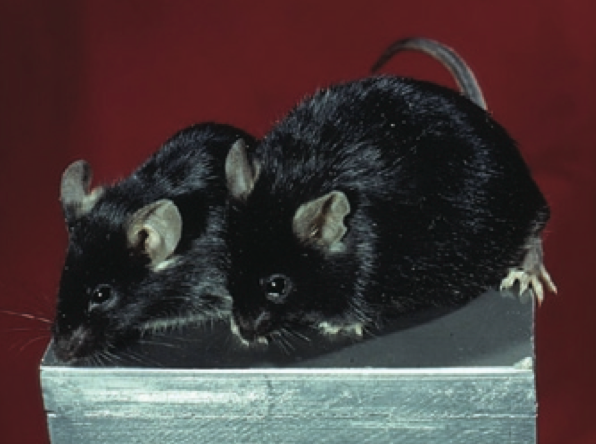
Background: In 1949 and then again in 1965, researchers identified two types of mutations that were associated with huge weight gain in mice. They named them Obesity ("Ob") and Diabetes ("Db"); an organism typical to its species is known as wild-type ("Wt"). The photo here is of an Ob mouse and his Wt friend. http://jhered.oxfordjournals.org/content/41/12/317.long; http://www.nytimes.com/2014/04/26/us/douglas-l-coleman-82-dies-found-a-genetic-cause-of-obesity.html?_r=0.
The Setup:
Here is a photo of an Db mouse compared to his Wt friend. Coleman, thought that there was a connection between the two mutants, Ob and Db, and speculated that they might might implicate blood-borne signaling. To test this out, he grafted the two mutants together so that they would share the same circulatory system. He did the same for each of the two mutants with Wt. http://www.laskerfoundation.org/awards/pdf/2010_b_coleman.pdf.
The Results:

Some More Background: The Ob mouse under-expressed the hunger-inhibitin ligand, leptin, which circulates in the blood. The Db mouse produced a healthy version of the ligand, but had a mutant receptor which precluded it from binding. The result in both cases there were a large number of unbound receptors, signaling to the mouse that it was hungry. And so the mouse would eat and eat and eat. Id; http://www.ncbi.nlm.nih.gov/pubmed/9013731.
What Happened: The Db mouse produced healthy ligand, but could not bind to it. Any mouse that shared its bloodstream would be drowned in excess ligand; its receptors would all be bound and the mouse, inhibiting hunger. So powerful was this effect that even the massively fat Ob mouse died of starvation - and, in less than 1 month. The Db mouse would remain as fat as obese as ever, since its receptors were broken and no amount of ligand would ever fix that. http://www.laskerfoundation.org/awards/pdf/2010_b_coleman.pdf.
When the Ob mouse was hooked up to the Wt mouse, it gained access to the hunger-inhibiting ligand and would return to a healthy weight. The Wt mouse remained healthy. Id.
Takeaway:

Obviously, humans have free-will that mice probably, to a large extent, lack. But, even so, the fact that a single molecule could tell a mouse to either become 4 times his weight or to starve, is demonstrative of a hugely powerful mechanism. And, while leptin-based mutations are rare in humans, they do exist and treatment of it is effective.
For the other cases of obesity in humans, it is unclear how strong the physiological / genetic signaling factors are. In all likelihood there is a large number of genes in play and, as a result, a spectrum of how difficult it is for a person to overcome them and forcibly diet. Our decision to diet, as with most things in life, is based on a cost-benefit analysis - implicit or not. So while we all have the free-will to diet, no matter how powerful our signal for hunger, it may simply be too exhaustive or uncomfortable in some cases for it to be worthwhile. The result is not good - obesity is dangerous - and, I believe it is proper for society to encourage healthy weights. But, we should refrain from superlatives and not judge others based on a glance or incomplete information. Imo.
The image here is one of the signaling cascades triggered by leptin-receptor binding. http://www.scielo.br/scielo.php?script=sci_arttext&pid=S0004-27302012000900001
Thanks For The Read!

Probably most of you will not read and will instead post "didn't read lol" gifs. But I hope you enjoy these fat mouse pics! I included this one so that people who scroll to the bottom before reading will see stuff that doesn't look like science. :)
KyleYoungblood
You can explain this all day. People will still fat shame. It makes them feel good about themselves.
knitsandpurls
Yeah, science bitch!
FartsSmellBad
Mice are not capable of understanding calories in/calories out. Are you saying fat people are also this stupid?
bewilderedbadgers
"So honey, how was work today?" "Oh, not bad, just stitched a bunch of mice together." Is no one else weirded out by this?
PleasantPeasantPheasant
Yay science! But a lot of the people that blame genetics probably haven't taken a test for it and apparently it is treatable(1/2)
PleasantPeasantPheasant
So, to be fair, it still is a bit their own fault...
tipsyferret
Chubby little mouses :3
zigzagler
Fat doggies make me sad, but fat mice make me grin. I wonder why that is.