
spaghettiThunderbolt

105008

2001

56

In the modern battlespace, dominating the skies is crucial to winning: you may not necessarily *lose* (strictly technically) without air superiority, but you are almost certainly not going to win without it. Airplanes, however, are a relatively new addition to the militaries of the world: weapons using gunpowder have been around for the better half of a millennium, ships have been around for far longer, but the first fixed-wing aircraft did not fly until 1903. Initially scoffed at by many, including those high up in militaries and governments across the world, airplanes proved their worth early in their lives during the fires of the First World War. Since then, things have only been advancing faster and faster: the first manned hot air balloon flight (likely one of the first manned flights of any type) took place in 1783; the Wright brothers made their historic flight 120 years later in 1903, and the first aerial combat happened in 1914. The first jet (meaning turbojet) aircraft flew in 1939, and man first broke the sound barrier in 1947; in 1969, men walked on the motherfucking moon, less than 70 years after the Wright brothers flew the first fixed wing aircraft in history. As time marches on, the rate of advancement only seems to increase.
This one will be a combination post; half about military aviation in general, and the other half specifically about the US (other nations to be covered in later parts); although the two are kind of intermixed, the general aviation stuff is mostly there when relevant to the aircraft being discussed.

If it absolutely, positively *must* be destroyed overnight
---
Meet the best all-around bomber on the planet, the Northrop Grumman (originally just Northrop, before the merger) B-2 Spirit. It isn't the fastest bomber. It can't carry the most bombs. It can't fly the highest, and it's about as maneuverable as a truck. But none of that matters, since nobody can see it.
To start, I have to explain how radar works: at a basic level, radar is just an incredibly advanced flashlight. The whole idea is to send out electromagnetic radiation (aka light) at very specific wavelengths/frequencies (they are inversely related; v = λf, where v is velocity, λ is the wavelength, and f is the frequency) and amplitudes with the intent that things, like airplanes, will reflect the waves and send them back to the radar system (like light from a flashlight bouncing off of a mirror into your eyes). But if none of the waves are returned to the radar station, then it figures that nothing is there because the radar didn't bounce off anything; aircraft like the B-2 are able to absorb the radiation as well as reflect it away from the source incredibly effectively: this 170 foot wide, 70 foot long behemoth has a radar cross section that is smaller than a hummingbird. Not only this, but its belly is painted a very specific shade to blend in with the sky at the altitudes it operates at, the engines are designed to be quieter and put out less heat (another way aircraft are detected), and there are reportedly several systems which aid the pilot in maintaining an optimal level of stealth.
Fully loaded, if has a range of more than 6,900 miles, damn near a third of the circumference of the Earth at the equator; it is also capable of aerial refueling, a capability it relies on for many missions. Generally speaking, a B-2 can take off from the US, strike a target halfway across the world, and return home in time for dinner without anyone being any the wiser. In fact, when Libya was going nuts (the whole Gaddafi thing), a pair of B-2s effectively wiped out the entire Libyan air force in one fell swoop. Whether you want to put a nuke through a window in the Kremlin or destroy an ISIS bunker, the B-2 is one of the best tools for the job.

Bone Time
---
Meet another bomber in the US arsenal: the Rockwell B-1B Lancer, affectionately known as the "Bone" (comes from B-one). Capable of carrying 125,000 pounds of "fuck you," it can break the sound barrier and strike targets halfway across the planet without flinching. This bomber is quite unique in that it has variable geometry wings, meaning the wings are able to sweep to accommodate speed and altitude; forward (almost perpendicular to the fuselage) for low speed (like takeoff and landing), and back (closer to the fuselage) for high speed. Originally designed to deliver nuclear weapons to the Soviet Union should the need arise, it has a heavy focus on survivability without using stealth (although it is designed to minimize radar signature, it was not central to the design like in the B-2): it features advanced avionics dedicated to letting it fly close to the ground to avoid radar, jamming equipment all over the place, high-tech missile warning systems, countermeasures (flares, chaff, and decoys), the same guidance computer used in the space shuttle, and an offensive targeting radar for taking down enemy aircraft for self-defense.
Additionally, it has a targeting pod mounted underneath the cockpit, allowing the Bone to provide very accurate guidance for weapons from great ranges; it can also carry JDAM (Joint Direct Attack Munitions) equipped bombs, allowing friendly forces on the ground or other aircraft to provide guidance to the bomb. Advances in technology also gave it capabilities to link data between units (so it can share and receive information without needing direct communication and input) and carry standoff missiles (meaning hella long range) in its bomb bays to take out targets from a safe distance away. Its four massive turbofan engines put out over 17,000lbs of thrust without the afterburners, and more than 30,000lbs with them, let it fly faster than the speed of sound and climb to over 60,000 feet at nearly 6,000 feet per minute. Screw the A-10: this thing is tied with the next aircraft for the best in CAS (Close Air Support).

The BUFF, seen giving somebody a *really* bad day in this photo.
---
The B-52 Stratofortress, affectionately known as "BUFF," for Big Ugly Fat Fucker, is one big fucking airplane. The first one entered service in 1955, and these things are expected (with upgrades) to continue to fuck shit up well into the 2040s (damn near a fucking century after introduction), and with good reason. It can't fly supersonic. It can't fly as far as the B-2 or B-1B, and it cannot go as high as the other two. In fact, it cannot carry as much ordnance as the other two, either; so the question is raised, what exactly is it still around for? Psychology and missiles. In most modern conflicts, a friendly aircraft generally has to perform a "show of force" before it can rain hell on the enemy: generally, the aircraft will fly very low and very fast over the enemy position in a move that essentially says "stop fighting or you will be destroyed." If one of these buzzes your position, or you even see one in the sky headed your way, you're not gonna be happy, it's an incredibly powerful demoralizer. Not only this, but it can loiter for quite some time (far more than an A-10), awaiting any requests for strikes from forces on the ground. Having one on station nearby is like having a guardian angel that will unleash so much hell that there will be a crater in the place of the enemy position, should the need arise. For me, this thing is tied with the B-1B for being the best aircraft for CAS.
---
And now, for some humor: an F-16 (single engine multirole fighter) is having engine problems and needs to make an emergency landing before the thing fails completely. Upon being told that he would have to land after a B-52 that suffered a failure on one of its engines, his sarcastic response was:
"Ah, the dreaded seven engine approach."

Danger zone!
---
The F/A-18E/F Super Hornet, known as the Rhino, and the EA-18G Growler (pictured; electronic warfare variant of the F/A-18F, known as Grizzly to avoid confusion with the E-6B Prowler over radio) are the US Navy's workhorses: the single seat (F/A-18E) and two seat (F/A-18F) variants are both multirole fighters, capable of air-to-air and air-to-surface combat as well as serving as electronic warfare aircraft or tankers when needed. Although American carriers are huge (the 12 biggest are all American), the number of aircraft carried is quite a bit smaller than that of an airbase due to the limited space available; a Nimitz carrier can host 90 fixed and rotor wing (helicopters) aircraft, which means that multirole aircraft are a necessity.
Equipped to handle the stresses of taking off and landing from an aircraft carrier, where aircraft are flung down a 300ft catapult accelerating them from 0-180mph+ in two seconds for takeoff, and literally slam onto the deck to catch a wire and decelerate at almost the same rate for landing, these birds are truly amazing feats of modern engineering. Capable of soaring at nearly twice the speed of sound more than 50,000 feet above the ground, an altitude it can reach quickly with a climb rate of about 45,000 feet per minute, and carrying enough missiles, bombs, and external fuel tanks to make your head spin, these things can easily dominate the skies.

Unkillable
---
This is the F-15 Eagle, an aircraft with precisely zero combat losses across all of its operators (US, Israel, Saudi Arabia, and Japan are the primary ones), built to rule the skies in a Cold War gone hot. Although originally built purely with air supremacy in mind, it can carry out CAS and other strike missions with ease: there is even the F-15E Strike Eagle, a two-seater variant dedicated to ground attack missions. As a true speed demon, it can easily top twice the speed of sound and then some (official figures are Mach 2.5+); not only this, it can fly at more than 65,000 feet and climb at a mind-boggling 50,000 feet per minute. In fact, it is one of few aircraft in existence capable of breaking the sound barrier in a completely vertical climb. With an armament of up to a dozen fuel tanks, AIM-9 Sidewinder, AIM-7 Sparrow, AIM-120 AMRAAM missiles, or "dumb" bombs and even JDAMs, this thing is far more versatile than anyone ever planned it could be. Even better: the F-15 is also the only aircraft in the US military with the capability to deploy the ASM-135 ASAT anti-satellite missile capable of destroying any satellite in low orbit within 400 miles (horizontally) of the F-15 launching it. In a day and age where militaries are becoming increasingly more reliant on satellite based navigation and communication, the ability to destroy enemy comms and nav satellites is invaluable.
---
Fun fact: In 1983, an Israeli F-15 successfully made an emergency landing after flying ten miles to an airfield after losing an entire fucking wing in a collision. This story was the inspiration for part of the backstory of Larry "Solo Wing / Pixy" Foulke, the player's wingman in Ace Combat Zero.

Falcon punch!
---
The F-16 Fighting Falcon, much like the Eagle, was designed originally as an air superiority fighter able to wrestle control of the skies away from the Soviets if needed; they both entered service within a few years of one another (in the mid '70s), but the Falcon performs far better as a multirole fighter than the Eagle does. There are 26 users of the F-16, ranging from the USAF (obviously), to Portugal, to Poland, and even Pakistan and Iraq. Slower than the Eagle and not able to fly as high, you might think this bird isn't as capable, but that's where you're wrong: between its 20mm cannon, dozen weapon and sensor hard points, and similar thrust to weight ratio, they're relatively even. The one big disadvantage the F-16 has is only having the one engine: in a twin engine fighter, like the Eagle or Hornet, even if you lose one engine, you will still have enough power to make it to the scene of the crash. But if the F-16 has engine troubles? Better to eject unless you're on your landing approach, because you lose all thrust if that one engine fails due to a general mechanical failure or through battle damage. In a dogfight, energy is life (both kinetic and potential), and an F-15 still stands a chance if a burst of gunfire knocks one engine out. The F-16 pilot will almost certainly have to eject in such a circumstance, as airplanes do not glide nearly as well as you would think.

Stealthy
---
The F-117A Nighthawk was the world's first, true, purpose-built stealth aircraft. Featuring paint intended to absorb as much radar as possible with the rather odd geometry reflecting most of the rest, the first prototype flew in 1977 and it was kept as an incredibly closely guarded secret until 1988, when the government officially acknowledged its existence. It isn't fast, it can't fly high, it can only carry two bombs (totalling less than 5,000lbs combined), and it's about as maneuverable as a brick; further stoking the fire, it is the only stealth aircraft to have suffered a combat loss (one was shot down over Yugoslavia in 1999). Despite this, it wasn't removed from service until 2008, due to the F-22 coming onto the scene for whatever reason (F-117A is an attacker despite having the "F" designation, F-22 is an air superiority fighter). With the advancements in computer technology allowing engineers to simulate curves and other, more subtle, shapes (than that of the F-117A), designs like the B-2, F-22, and F-35 came into the scene, all of which are far more capable than the Nighthawk.

The Raptor
---
The pinnacle of modern fighter aircraft is the Lockheed Martin F-22 Raptor: fast, maneuverable, stealthy, and filled with highly advanced avionics and weapons systems; it is the only production fifth generation fighter on the planet. Rather than conventional control systems, where the pilot input directly manipulates either cables and/or hydraulics, the Raptor is purely fly by wire: a computer processes all inputs and allows the F-22 to be incredibly maneuverable through inherent instability in its flight. The more stable an aircraft is, the more resistant it is to changes in its flight path; before fly by wire, there was a "sweet spot" where the bird would be maneuverable enough to be useful, but stable enough that the pilot could keep it straight. The incredibly rapid minor corrections made by the computer are simply not something a human is able to do without loads of talent and training. Combine this with its stealth, armaments, and other advanced computer systems providing data links with other units, and you get a very deadly aircaft. A flight of four Raptors working in pairs could easily down an entire squadron before they knew what hit them.

BRRRRRRRT!
---
The A-10 Thunderbolt II, commonly known as the Warthog, is a gun with an airplane built around it. I can see why people love this thing, despite its numerous flaws (slow, big, not maneuverable, mechanical problems, poor loiter time, stuff like that): it is a beautiful machine. The GAU-8 Avenger 30mm gatling cannon was designed as both an antitank weapon for aircraft and a point defense system (as the Dutch Goalkeeper CIWS system); originally meant to counter Soviet tanks in Europe should the Cold War go hot, the A-10 is great at CAS when it can actually show up. Unlike the B-1 or B-52, the A-10 cannot loiter for long periods of time, and it does not carry nearly as much weaponry; additionally, it is far more vulnerable to ground attack due to the low altitudes it generally operates at. Although a great choice should T-72s start marching through Poland, the A-10 simply isn't the best tool for the job in the Middle East, where the situation changes incredibly rapidly and forces on the ground could end up needing support quickly with little or no warning. Sending a Warthog from Saudi Arabia is a lot slower than using a B-1 already patrolling the area, and it's also better for the boots on the ground: when you call for air support, you want as much ordnance as you can get on target, and the B-1 can unleash a helluva lot more than the A-10 can with the same accuracy. And with being a ground attack aircraft, it is pretty much helpless against anything resembling a competent foe in the air. I know I'll get criticized for not 100% joining the A-10 circlejerk, but it isn't god in aircraft form: it has flaws.
But it is a very tough nut to crack: the engines are placed above and to the rear of the aircraft to keep them out of the way of enemy fire, and keep them out of the fuselage if they do start on fire; the pilot also sits in what is effectively a bathtub made of titanium, designed to protect them from fire from the ground (which it does quite well). Most systems are designed with at least two backups (triple redundancy), and it is able to fly with half of each wing missing (albeit not very well, but still stay airborne). There is also a false canopy painted on the belly designed to confuse the enemy about which direction the bird is going/turning.

Though I fly through the valley of the shadow of death, I shall fear no evil; for I am at 80,000 feet and climbing.
---
The coolest airplane to ever exist: the SR-71 motherfucking Blackbird. Whereas other aircraft turn and dump countermeasures when a missile is launched at them, the SR-71 just accelerates. Whereas other aircraft focused on being undetected by flying low and destroying air defenses, the SR-71 just flies too high to touch. Other military pilots have g-suits and oxygen masks, SR-71 pilots resembled astronauts more than pilots. A commercial flight from New York to London is 7 hours; Concorde was only able to do it in 3. The SR-71 still holds the record at 1 hour, 54 minutes, 56.4 seconds: an average speed of 1,807mph, or well over twice the speed of sound (close to Mach 2.4). It holds the record for the highest sustained flight (meaning flying at the altitude, not just reaching it) at 85,069 feet (more than 1/20 the altitude of the ISS), and it holds the record for fastest flight at 2,193.2mph (Mach 3.3). This isn't some cutting edge aircraft that's incredibly new: the first prototypes flew in 1962, and the SR-71 was retired in 1998. It holds these insane records, and it's been retired for twenty years.
A reconnaissance aircraft, the Blackbird was designed to fly so high and fast over enemy installations that they literally couldn't do anything about it. This thing is no less than an engineering marvel, and one from well before the days of computer aided design. On the ground, it pissed fuel everywhere, by design: the heat caused by the friction of the air at high speeds caused the aircraft to expand quite a bit, so everything was designed to operate at those high speeds and temperatures, meaning it didn't have completely sealed fuel tanks on the ground to accommodate the expansion of the airframe. It was also an early foray into stealth aircraft design, being designed to minimize its radar cross section by shape as well as radar absorbing paint; the reconnaissance equipment on board, primary some kick-ass cameras, meant that the SR-71 could take crazily detailed photos where even individual people could be counted, from 85,000 feet and three times the speed of fucking sound. These things were absolutely amazing.

Eject, eject!
---
When something goes wrong in an airplane and it is heading towards a certain crash, the last place you want to be is inside of it. In the early days of military aviation, it was pretty simple: climb out and open your parachute; but as airspeeds increased, it became more and more difficult to wrestle your way out of a stricken aircraft. In comes the ejection seat. Most aircraft in combat roles, even B-52s, feature ejections seats; for other aircraft not intended to fight, such as tankers, the aircrew has no choice but to fly it to the scene of the crash. In every fighter aircraft, there is a very big and obvious black and yellow handle, and pulling it initiates the incredibly traumatic, and fast, ejection process.
First, explosive charges completely jettison the canopy; should that fail, there are one or two redundancy systems: some seats have points on them designed to bust the canopy before the pilot's head hits it, and some canopies are rigged with explosives (the black lines you sometimes see) to detonate the whole thing. After this, rocket motors in the seat fire, sending it way clear of the (in combat, likely burning and soon to explode) aircraft; during this, the pilot experiences anywhere from 14-20g (1g is gravitational acceleration, 9.8m/s^2, or 32ft/s^2) of acceleration. It is not uncommon for stress/compression fractures, spinal damage, or unconsciousness to occur due to this. Once the pilot is at the top of the trajectory, the seat falls away and they're left in freefall until the parachute automatically deploys (around 14,000 feet to prevent hypothermia and hypoxia), or they deploy it manually. Should the need arise, they have 5-8 minutes worth of oxygen with them. Upon landing, more injuries can occur (particularly if the pilot is already hurt): broken ankles and whatnot on landing are not uncommon.
But that is not the only source of trouble for a downed aviator: pilots are considered valuable prisoners, and everybody that flies in the US military needs to go through SERE (Survival, Evasion, Resistance, & Escape) school (will be explained in a later part).
Any landing you survive is a good one, really
And carrier landings are controlled crashes on good days, anyway.
---
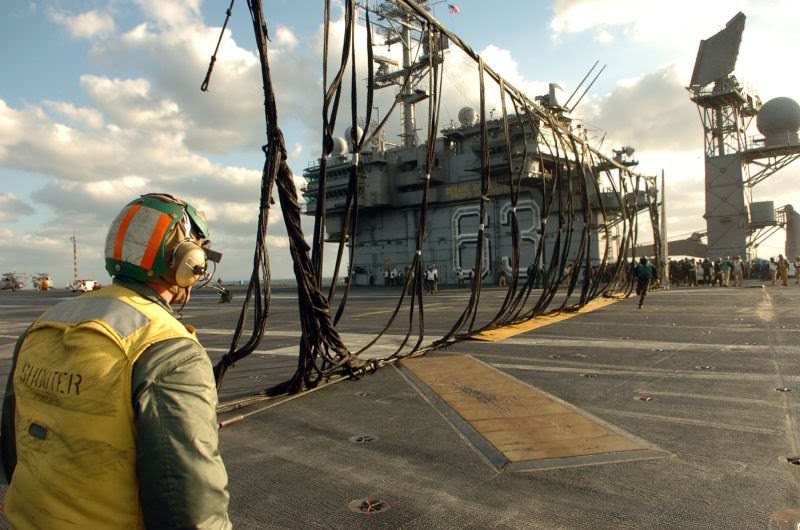
When a carrier-based aircraft encounters an emergency and must land yesterday and it cannot divert to a land-based airbase (aka most of the time: you don't wanna land your bird in Baghdad. An aviator did that once. Seriously.), the only options are to land on the carrier and save the bird, or punch out and hope you so much as get a chance to think about airplanes again. Regularly, aircraft have to catch one of four wires to be able to stop on a carrier; in an emergency, an additional barricade is put up (pictured) to keep the plane from going right off the bow (getting hit by a carrier is bad for your health), SAR (Search And Rescue) resources are put on high alert in case the aviator needs to eject before they are able to land, and medical personnel, firefighters, and other rescue personnel assemble, ready to spring into action the moment the bird stops. This entire setup takes a few minutes between the order going out and the carrier being ready; LSOs (Landing Signal Officers) will still guide the plane in as usual, but ready to dive into their safety chute (basically a giant padded slide they can dive down to avoid an aircraft) or give the order to eject: it is generally accepted that if an LSO tells you to eject, you pull the damn lever and ask questions later. The worst case scenario is a ramp strike, where the airplane will fly right into the back of the carrier, below the flight deck; best case, the plane lands and is stopped by the barricade, the crew is removed by rescue and medial crew and taken to sickbay to be evaluated, and firefighters are ready to douse the plane in foam should the need arise.
After that is a inquiry into why exactly you had to make an emergency landing (those jets are expensive); if you're at fault for whatever reason, you'll face captain's mast, a step in the punishment process where you try to assert your innocence by being yelled at for two hours straight. After that, if you're still fault, you'll be lucky to be able to look at an airplane ever again, let alone fly one.
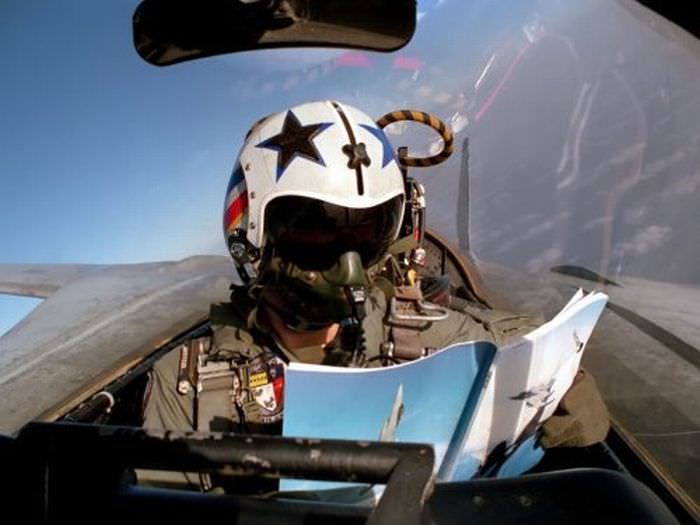
Airspeed, altitude, and brains: only two are needed to keep an aircraft airborne.
---
That concludes this post on flying machines. I wasn't quite sure where I was going with my posts on the universe, and I literally have nothing else about submarines to write, so I decided to go to airplanes, the submarines of the sky. I know there are probably a lot of things everyone wants covered, which will be done in due time. Thanks for reading!
joebuck123
overlordchris666
I've seen everyone one of these in person...except the B-2, never seen one before. ???? Good Job @OP nice post!
RoyDMercer
Definitely going into the appropriate Favorites folder.
spaghettiThunderbolt
Glad you liked it!
RoyDMercer
Very nice collection of info. Appreciated.
BradHawkDown
DO ONE ON HELICOPTERS
spaghettiThunderbolt
If the wings are moving faster than the fuselage, it is a helicopter and therefore unsafe. A part on helos would be pretty fun, though.
UglyHorribleGrouchyOldMan
Did you know that the only way helicopters actually fly is that the earth is repelled by their sheer ugliness.
BradHawkDown
You right :(
WellThatsOriginal
I hope Jung Un don't see this.
spaghettiThunderbolt
I mean, we had to tell him we flew B-1s right by him, so I don't think he'll see his one.
longblacktubefullofseamen
Fun fact... There are more planes in the ocean than submarines in the sky.
Techpriest93
forgetfulvegetarian
Fuck I was gonna type this
TerribleAwful
http://imgur.com/WOX87yX
spaghettiThunderbolt
Airplane boners = best boners.
LewdSomnambulist
B-52 has longer range than both the B-2 and B-1. And can most definitely fly higher than the B-1. And its mission capable rate is double.
UglyHorribleGrouchyOldMan
That, and you can use the wing pylons to greatly increase payload. (Former 52 EWO)
star1022
You took a long time to write this so I'm giving an upvote
spaghettiThunderbolt
I don't have a whole lot of productive things to do with my day, so I may as well share knowledge! Thank you!
AccountCreatedToUpvoteDogs
#12 Wanna own an ejection seat? https://www.boeingstore.com/collections/see-all-custom-hangar/products/f-4-phantom-ii-ejection-seat-ii
spaghettiThunderbolt
You know, if I had the $20,000 to spend and a place to put it...
UglyHorribleGrouchyOldMan
I sat on one for so many hours over the years the novelty has turned to revulsion.
spaghettiThunderbolt
What did you fly, if you don't mind my asking?
UglyHorribleGrouchyOldMan
I was an EWO, NOT a pilot. Started on B-52s then EC-130H CC then both RC-135s (RJ & SENT).
spaghettiThunderbolt
Ooh, fun times. Might I ask what an EWO on a B-52 specifically does? Legitimately curious.
bigeasy44
Idk if I agree w/ your premise that submarines > airplanes. Planes can go underwater too, but I've never seen a submarine in the sky.
realargonwolf
All I can say is that when they invent a submarine airplane hybrid (like in Red Alert 3) OP's going to cream himself dry.
spaghettiThunderbolt
Because airplanes want to imitate submarines. Submarines are cool on their own, so they don't need to copy airplanes.
UglyHorribleGrouchyOldMan
I've seen the bubbleheads try to get their subs to leap out of the water, so don't think they wouldn't if they could.
doubleL312
Where’s the F-14 Tomcat? Anytime Baby!! Sad that it wasn’t included.
MaverickGoose2020
Negative ghost rider the post is full
TurduckenMcNugget
Username/comment game on point
spaghettiThunderbolt
Only so much time in the day to write, unfortunately. Don't worry though, I've got plenty planned for the F-14 and its AIM-54s.
realargonwolf
Ah yes, the ol' "Intercontinental Ballistic Air-to-Air Missile" strategy. Can't wait to hear from the expert!
spaghettiThunderbolt
Me neither, I'm excited to see what the expert has to say!
realargonwolf
You's the expert.
spaghettiThunderbolt
Well, fuck. This is an "somebody get an adult... Wait, I *am* the adult" moment for me, haha.
TheOnlySedail
TrueNateDogg
F-18 is the coolest motherfucker out there and if you disagree with me get the FUCK OUTTA MY FACE BITCH INDEPENDENCE DAY WOOOOOOOOOOOOOOOOOO
Roland191145
YOU DID IT AGAIN YOU GLORIOUS SONOFABITCH! TO THE FRONT PAGE WITH YOU!!!
tracereading
How warm is your average flight helmet?
spaghettiThunderbolt
Not a pilot, but (based on experience with military equipment): not nearly warm enough, and/or way too warm.
UglyHorribleGrouchyOldMan
It's what skull caps are for. Helps evenly distribute the heat.
UglyHorribleGrouchyOldMan
I always kept my skull cap on to help evenly distribute the heat build up. If it gets to warm, just turn drown the cabin heat for a bit.
CuntPuncher1000
A Saudi F-15 was just shot down over Yemen. Still an impressive record tho.
zenoshogun
There's been combat losses since the 90s too, so it wasn't even the first.
DavidBrooker
It was hit by a SAM, but there's no shot of wreckage yet, so it may not be a shoot down.
12rt2345g342563
OP must be thinking of air-to-air losses.
Ballistic09
It was likely hit, but not downed. They also hit a Tornado a day earlier in the same area and showed the wreckage, but didn't for the F-15.
Ballistic09
They also claimed an F-15 downed previously, but it turns out a hung fuel tank ripped off a pylon while maneuvering. The Houthis exaggerate.
SaItamontes
"The ... Super Hornet, known as the Rhino, ..." Oooooh-kaaay.
spaghettiThunderbolt
Super Hornet is the "official" name, Rhino is used to keep it separate from earlier F-18s.
realargonwolf
*Jet Fighters* do not glide as well as you think. Lots of planes have decent gliding ability, but supersonic ones have high stall speeds.
UglyHorribleGrouchyOldMan
Lots of these birds have been dead sticked back to base and made successful landings.
noupvotesforgretchenwieners
Your writing style is a goddamned national treasure.
spaghettiThunderbolt
Respectfully disagree. Thank you, though!
ParaBellum96
I've been on planes in I've been in subs. There's a reason my contract is for aviation.
ParaBellum96
Because I'm not in the Navy
spaghettiThunderbolt
Hey, don't feel down! You can always turn your airplane into a submarine if you're determined enough!
ParaBellum96
Oh God I actually hate submarines. I was on a boomer for 36 hours and I wanted to die.
spaghettiThunderbolt
Pfft, if you think the boomers have it bad, try living on a fast attack!
howcansomeonepossiblyhavethesameweirdusernamealready
F-16s are basically flying lawn darts. The wingspan is so short, they pretty much rely on thrust to stay airborne.
12rt2345g342563
Single Seat! Multi-Role! Fly right up our own asshole!
MaelinStarpyre
Actually the 104 is the lawndart. We have one in our air park.
Shockywell
Which air park would that be??
MaelinStarpyre
The one that belongs to the 184th
DavoMoto42
You're not wrong, the CG is so far back in the envelope the flight control software has to constantly correct just to keep it in control.
overlordchris666
But that's what it was designed to do. 50/50 is great, but in that 30/70 = better turning in a dog fight.
owlest
wouldnt bigger wings be more maneuvarable??
overlordchris666
No! More drag & stability. Now if you're talking about F-22 or F-15 then it's proportional to the size and it's fine.
DavoMoto42
Exactly, it's because of the inherent instability that the plane is so maneuverable, marvel of flight engineering.
overlordchris666
DavoMoto42
spaghettiThunderbolt
It's actually pure spite, of the pilot, crew chief, and engineers that designed it combined.
MarkRavingMad
Ah, a design element borrowed from helicopters I believe: an aircraft held aloft by pure, ugly resentment of gravity.
agermanguy
I like that.
beachbum273
I thought that's what kept helicopters afloat?
SwagicalYololord
Helicopters can actually glide though unlike the F-16
Techpriest93
spaghettiThunderbolt
You're mixing up spite and black magicks.
ignimbrite
Voodoo, I hear.
SteevyT
Nah, helicopters don't actually fly. The ground is just fucking terrified of their whirling blades of death.
Talmorean
Where's the F-52?
HauntingPariah
I bet you’re a hoot to be around
HauntingPariah
All the downvotes and I wasn’t being sarcastic, lol
sahdad
Seriously this guy. Everytime he opens his mouth his staff are like
azazyel
It's funny that he says so much stupid shit so often that it's actually hard to keep track of
spaghettiThunderbolt
Honestly, every day of 2018 so far I have had to check one headline a dozen times because it's just a "no fucking way that's real" headline.
DonaldJTrump
overlordchris666
bigfatninja
and also those B-52s
spaghettiThunderbolt
Norway took them all :(
MrsSlavicHorse
What a shithole country!
Sparks1729
Why would we let them in!?!? Swedes are cool tho
reaperhead
Damn Norwegians! *shakes fist at sky*
TheRealStalinWhoIsStandingUp
*Norwegian flips you off from F-52 cockpit*
spaghettiThunderbolt
And we'd go up there to catch you, but our F-35s won't stop bursting into flames at inopportune times.
Arsinick
Contrary to popular belief, single engine fighters have higher survivability than twin engine fighters.
Arsinick
https://defenseissues.net/2014/08/09/single-vs-twin-engined-fighters/
millenniumdragon
I loved the f-22 cause of Command & Conquer: Generals, but aren't they plagued with issues/hardly usable cause constant problems irl?
rocketturttle
I thought is was a bit funny after his F-22 love letter he says the A-10 has mechanical problems
chugeknight
There were a lot of problems with it yes. It was discontinued for a while.
wtfIm
A lot of issues and expensive. That’s why they killed production and now make the more expensive f-35 joint fighter... fucking Lockheed.
wtfIm
The issues are fixed now and f-22 have been on successful missions. YF-23 was the better choice!!
UglyHorribleGrouchyOldMan
The F22 lost its funding due to interservice squabbles for funding as much as it was the cost. The 90s drawdown was very bitter.
bobert22334
+1
spaghettiThunderbolt
Thank you!
ZanarkandAbes
Do one about Migs and Russian/Soviet planes, please!
spaghettiThunderbolt
Ask and ye shall receive. Part 2, tomorrow(ish) will be the Reds!
Umbra1
.
ZanarkandAbes
Heck yeah! Great stuff. I look forward to it.
realargonwolf
I like Soviet/Russian planes too. There's a certain aesthetic of low-tech ingenuity to their designs.
spaghettiThunderbolt
The Soviets, and also Russians, have a certain "if it's stupid, but works..." and "if it ain't broke..." engineering philosophy. I love it.
ZanarkandAbes
"Just put a bigger engine on it." or "looks like it needs additional larger engines on it." the Foxbat comesbto mind.
realargonwolf
Except the MiG-25/31. It's just a rocket ship pretending to be a jet fighter and hoping that nobody notices.
sirsmeghead
Do a part on Swedish planes too if you can :) (Love the Viggen!)
spaghettiThunderbolt
I'll have to, most definitely. Scandinavia as a whole is pretty much overlooked by the West in terms of military equipment, at least I think
sirsmeghead
BuckeyeBTH
@OP a point of clarification, the F-15 has not been downed by enemy aircraft. A few (2-3) F-15E's were downed via AA or Sams
DavidBrooker
And one F-15J was shot down air-to-air in a friendly fire incident.
BuckeyeBTH
Correct, although i didn't know about that one til I read the hull loss wiki
DavidBrooker
I only read about it on The War Zone comments section like, two days ago, so basically the same boat.
spaghettiThunderbolt
Was this recent? I know there have been a bunch of accidents, but none combat related. Though I've heard Egyption F-15s have had some losses
BuckeyeBTH
https://en.wikipedia.org/wiki/List_of_F-15_losses So trust it at you discretion. 01/18/91, 01/20/91 and 1 F-15J via friendly fire 11/02/95
spaghettiThunderbolt
I'll be damned. What really puts the icing on the cake is the fact that, on mobile, I literally cannot edit the F-15 to change that, either.
BuckeyeBTH
Meh, not a big deal. Only serious aero nerds like you and I care. Throw a caveat up there when you get a chance
spaghettiThunderbolt
in Yemen.
BuckeyeBTH
Not recent, Desert Storm 1 + 1 F-15J via friendly fire in 1995