
VB6ftw

293011

1200

31
Commercial yeast is just one of many different types of yeast. Some of which already grow in the flour you buy.
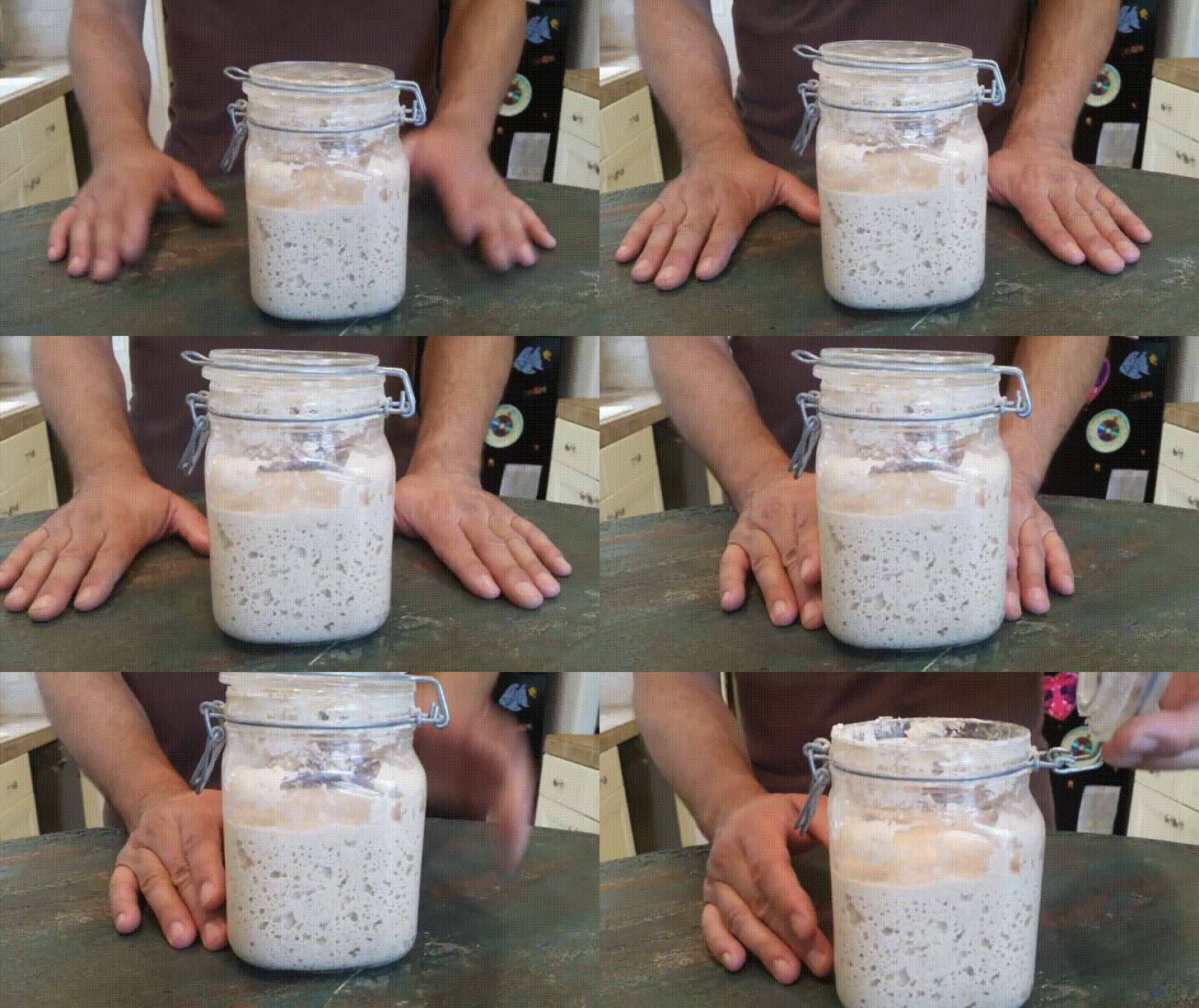
So why not use them, the old school way?
You will need a jar, one that does not close tightly.
If you use a jar like the one shown in this gif, remove the rubber band around the seal.
If you use any other jar, make sure that air can pass through the seal.
You want oxygen to be able to get in, and CO2 to be able to get out.
You will also need some flour and some water.
Start by adding equal amounts of flour and water (by weight) to the jar.

If you don't have a scale at hand, it translates into 3 tablespoons of flour for every 2 tablespoons of water.
When you start the cultivation, it will give good results to use un-sweetened pineapple juice instead of water.
This lowers the ph-level, which benefits the yeast.
Then give it a stir, put the lid on and set it in in a corner somewhere; a warm dark place.

It doesn't have to be pitch black darkness.
Just avoid any direct sunlight.
Take the jar out and give it a stir every 8-12 hours, to give the yeast some oxygen.
Every 24 hours, you add another load of flour and water, equal amounts by weight.
Or 3 tablespoons of flour for 2 tablespoons of water.
After 3-5 days, you should see bubbles forming in the jar.

This is the yeast breathing, releasing CO2.
The jar should have a pleasant yeasty smell.
If it smells sour or foul, then the yeast have died and you are growing something else.
You must keep feeding the yeast once a day, by adding flour and water.
When the jar becomes to small, you can take out about half of the yeast and throw it away (or use it), and just feed on the remaining half in the jar.
If you do this right, the yeast can live forever and provide you with fresh free yeast every time you need to make a bread.
You can also set the yeast aside in the fridge. The cold temperature lowers the activity of the yeast.
Then you only need to feed and stir it once a week.
Sauce:
https://www.youtube.com/watch?v=0wTt8VGyBdk
ruferto
"If it smells sour or foul, then the yeast have died and you are growing something else." i want to paste that in the bread aisle of a store
mikeolinzock
Someone’s about to get a Weist infection.
zmurfus
Mine is already dead.
babssherman
"pleasant yeasty smell'
NotTinyPancakes
Step 1: open op's mums legs
TrixNStix
This is especially good for those living at higher altitudes. Yeast doesn't like to rise in a thinner atmosphere.
Ilieoften
Nah. It rises anywhere
NuclearMonk
Become a slave to feeding yeast....or just buy a pack when I need it. Hmmm....
Valarauko
We get it you bake!
softlittlebite
I've wanting to do this. Anyone done this? Results good? Bad?
GravyHavok
Then there's this gal: https://www.cosmopolitan.com/sex-love/news/a49894/yeast-infection-sourdough-bread/
vindik8or
Yeah, what you've got there is far more complex than just 'yeast'.
JockoV
I thought this was going to involve wearing the same panties for a month.
bumbl3b33
.
grumplestiltzkin
"add flour daily" and "have free yeast" are two completely different things, unless you know where I can get free flour.
cdimartino
Can you do neopolitan pizza, you think?
Ireadtoomuch
Wouldn't you want to sanitize what ever vessel you make your yeast in anyways
UndulatingTerrain
Sourdough culture - a combination of wild yeasts and lactobacilli bacteria.
xizar
Please do not cultivate your *own* yeast. (People will make cheese of it, if you do.)
MaladaptedMedic
Lmao, or yogurt
georgejimmydoodle
It's not free, it costs 3 Tbsp flour every day, that's about 5 cups a month. Unless you use it often, buying yeast is prob cheaper.
usernamesaresostressfultopickout
Or put it in the fridge and feed it once a week. Or every two weeks.
IamMelonLordeYaYaYa
Or, like the post says, retard it and use about 1c a month
JPandhismightypotato
Dont forget about your opportunity costs. Time Is money,not to mention 1 more daily chore to save a couple bucks occasionally.
UnitConversionBot
3 tablespoons equals 44 mLs
[deleted]
[deleted]
UnitConversionBot
2 tablespoons equals 30 mLs
imadethisaccounttotellyouthis
30 mls of water isis 30 cubic cm of water, which is 30 grams water. Try them conversions on bot! :O
Pseudobatrachotoxin
1 lb is 453.592g. There are 16oz in a pound. Therefore, there are 28.35g per oz; 3.54g per eighth. At $200/oz, 1g=$7.05. Useful conversions.
TheGhostMinx
People with Trypophobia beware!
Ilieoften
As a fellow amateur artisan baker: you only need water and flour to start the culture, no need for juice. Also, do not stir the culture.
Ilieoften
That just rushes the process needlesly and makes for a weaker concentration of active yeast
HelloToe
The advantage is for the bacteria. Different bacteria thrive at different acidity levels, and some at near-neutral pH can be harmful. (1)
HelloToe
Adding an acidic juice jump-starts the acidity, and makes sure that the proper bacteria types take hold in your starter.
HelloToe
And remember: the yeast only makes it rise, it's the bacteria that give it flavor.
fessusIntellectiva
It doesn’t have to be water. I’ve had nice luck feeding them with beer.
GondwanaCraton
If you use a bottle conditioned beer you might even get away with omitting the yeast entirely and just cultivating the brewing yeast.
HelloToe
Beer is basically just liquid bread, after all. It's all fermented grains, bubbles in beer and bubbles in bread, it all comes from the yeast
Sadoun
Just call it what it is; sourdough...
IamMelonLordeYaYaYa
Only we call it sourdough. Big sand poolish are proper terms
Ilieoften
Why do Americans love the term sourdough? Sourdough is juast one type of yeast culture out of a hundred types of levain.
riplikash
The type used for topical quick rise bread is "bakers yeast". This type is called sourdough because the increased acid makes it taste...sour
IamMelonLordeYaYaYa
No, it doesn’t. I’m sad this other guy is getting downvoted for knowing this.
Ilieoften
I’ve read tens of books about baking bread. No serious baker calls this type of dough a sourdough. I’ve been baking for years myself
riplikash
You're using ton get into a weird argument here. Plenty of "serious" bakers call it sourdough. Lots of books do. And many of us have...
riplikash
...also been baking for years. You may as well start arguing about pop vs soda. It's just a regional thing.
KenanAndKelThuzad
I have read twenties of books about baking bread and call it sourdough. And my father was a loaf of pumpernickel.
Ilieoften
So in other words you know jack shit about levain bread. Sarcasm < knowledge.
THEcableguy
Does that make you a Cantaloupe?
BakeBike
Mine is named Harlan. 3 years old. An excellent and tasty pet.
themuttonisniceandlean
Mine was named Haight and Ashbury, because I was trying to replicate SF sourdough. Now I have a starter from the old Columbo Company.
IamMelonLordeYaYaYa
I have Giuseppe
PimpinKen
At culinary school, we made a starter out of rye flour and Guinness. We named him Ryan Guiness.
Ilieoften
I haven’t named mine. I’m taking suggestions
Iputthebestinbestiality
Frank(-lin)
genbadger
Yeast beast
BrewmasterDan
NorthYeast
maxrazorwin
Adam Levain
RealSlimJakey
Clint yeastwood
Ilieoften
You win!
RealSlimJakey
BrewmasterDan
Middleyeastern something
BrewmasterDan
Lacto ma dilly
BrewmasterDan
Sir visiae
BrewmasterDan
Son of the yeast
BrewmasterDan
The yeaster bunny
BrewmasterDan
Eugene VonKaryote
BrewmasterDan
The yeast of my concerns
Ilieoften
I shall start a new batch and name it as you proposed
riplikash
This is a sourdough culture. You user it to make sourdough bread. Very different than bakers yeast bread.
spalone
Maybe that why my ale tastes like garbage.
kartagine
Thanks for pointing it out! I was about to comment the same.
themaskedhobo
I have a portion of what I call the family experiment in the back of the fridge. My great grandma's starter from over 100 years ago :O
themaskedhobo
I make bread like once a week.
PimpinKen
Its actually just a "starter" and the same technique can be used for almost any type of bread.
GondwanaCraton
It can be. But: "If it smells sour or foul, then the yeast have died and you are growing something else." Sour aroma comes with being a
GondwanaCraton
sourdough starter. This appears to be hoping to just be a wild yeast starter and not the yeast and bacteria mix which is a sourdough starter
PballQhead
Unlikely, Lactobacillus is pretty commonly present in raw flour
redfox00
Well how do you make proper baking yeast?
ProphetofEntropy
you buy it.
yachifa
Grew my own non-sour yeast for a year. Started with feeding sourdough culture bleached white flour and kept it in the fridge. 1/2
yachifa
Extra benefit is it grows slower so you don't have to feed it as much. Made bread once a week (but it's less potent than store-bought)
whyamihungryallthetime
You don’t. You can however ( very rarely) buy the good stuff from a brewer.
GondwanaCraton
It would take very careful attention to sanitation to not get any bacteria in the mix. Your best bet would be to use a commercial yeast and
yachifa
Commercial yeast always left a bad aftertaste for me - much preferred my home-grown stuff - never cared about sanitation 1/2
yachifa
yeast maintains a ph that most other bad stuff can't grow in. 2/2
GondwanaCraton
Some yeast will actually kill bacteria as well. In brewing it's best to make a yeast starter so you're pitching a large cell count that will
GondwanaCraton
grow it as you would a sourdough. But yeast is so inexpensive that this isn't really worth the time and effort to do. The reason is is worth
GondwanaCraton
the time and effort for a sourdough starter is _because_ of the bacteria which grow with the yeast and which provide the acidic/sour quality
redfox00
Well I cannot find live east in Canada, I see only dry, and always struggle to convert live to dry yeast when following recipes 1/2