
Frupus

142118

3033

42

This one is quite bug heavy, you've been warned.
Automeris larra (no common name)
Ok to be fair you may have seen this image before, I just wanted to put someting really attention grabbing as the first thing. This picture made the rounds a few years ago as "the Saturniidae caterpillar", which is really not very helpful.
Saturniids are a family of moths with over 2300 species, there is no THE Saturniidae caterpillar.
This is the caterpillar of Automeris larra, a medium sized moth from South America. It also shows the caterpillar right after a molt, after which colors are often very vivid.

Here it is with its normal (still very nice) colors. The spikes are soft and tipped with urticating hairs to deter predators.
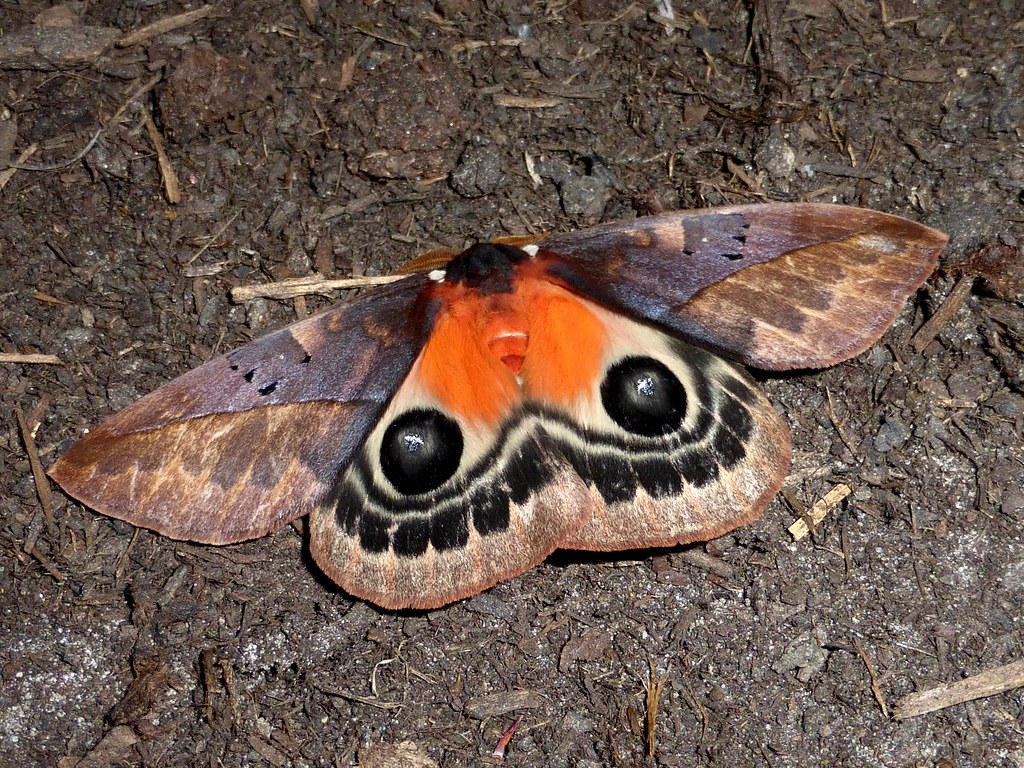
And that is the (also pretty) moth it turns into.

Imantodes inornatus (Western Blunt Head Tree Snake)
Imantodes is a genus of small arboreal (tree living) snakes from Southern Mexico, Central and northern South America. There are 8 described species and they all look similar to the one pictured here.

They are about 1 meter long, very thin and have huge bulging eyes and a blunt snout. They hunt mainly small lizards in trees at night, which is why they need their excellent vision. They are rear fanged, venomous Colubrids though their toxicity is unknown. Their venom is probably mild and not dangerous to humans.

Side view of head.

Trombidium grandissimum (giant red velvet mite)
This absolute giant among mites (about 15mm!) occurs in north and central India and eastern Africa and is not dangerous to humans. Velvet mites are free living and predatory as adults, and parasitic on various insects as larva, but normally a lot smaller than this. You may have seen the regular sized ones yourself, they are about 2 to 3 mm long.

Here's an interesting tidbit I found about giant red velvet mites: “Although often difficult to find, they are sometimes extremely abundant locally, if only for a few hours at time. For example, after a brief yet intense thunderstorm, a massive emergence of giant red velvet mites was sighted from the air at an altitude of 1500 feet just north of Tucson (Nigeria). An estimated 3-5 million mites had emerged in an area roughly two acres in size! The annual emergence of the giant mites is apparently timed to coincide with that of their primary prey, termites. However, their opportunity to gorge themselves on abundant termite reproductives is quite limited. After mating, the termites quickly shed their wings and bury themselves so that they are out of reach of the mite’s predatory embrace. Adult giant red velvet mites spend most of their lives in subterranean burrows in a diapause-like state waiting for a specific set of ecological conditions triggered by summer monsoons.”

Erpeton tentaculatum (tentacled snake)
From Vietnam, Cambodia and Thailand this only abut 70cm long aquatic snake has evolved little tentacle-like growths on its snout, which are probably sesory organs to detect water movements, similar to the lateral line organ in fish. Yes that's moss growing on it.

They have a unique way of catching their prey, small fish.
They sit underwater with their bodies in a typical J shape. When the fish is in the right position it moves part of its body, tricking the fish into reflexively attempting to escape in the wrong direction. Unlike most predators, the snake doesn't aim for the fish's initial position and then adjust its direction as the fish moves, it aims directly for the location where it expects the fish's head to be. The ability to predict the position of its prey appears to be innate, not learned.
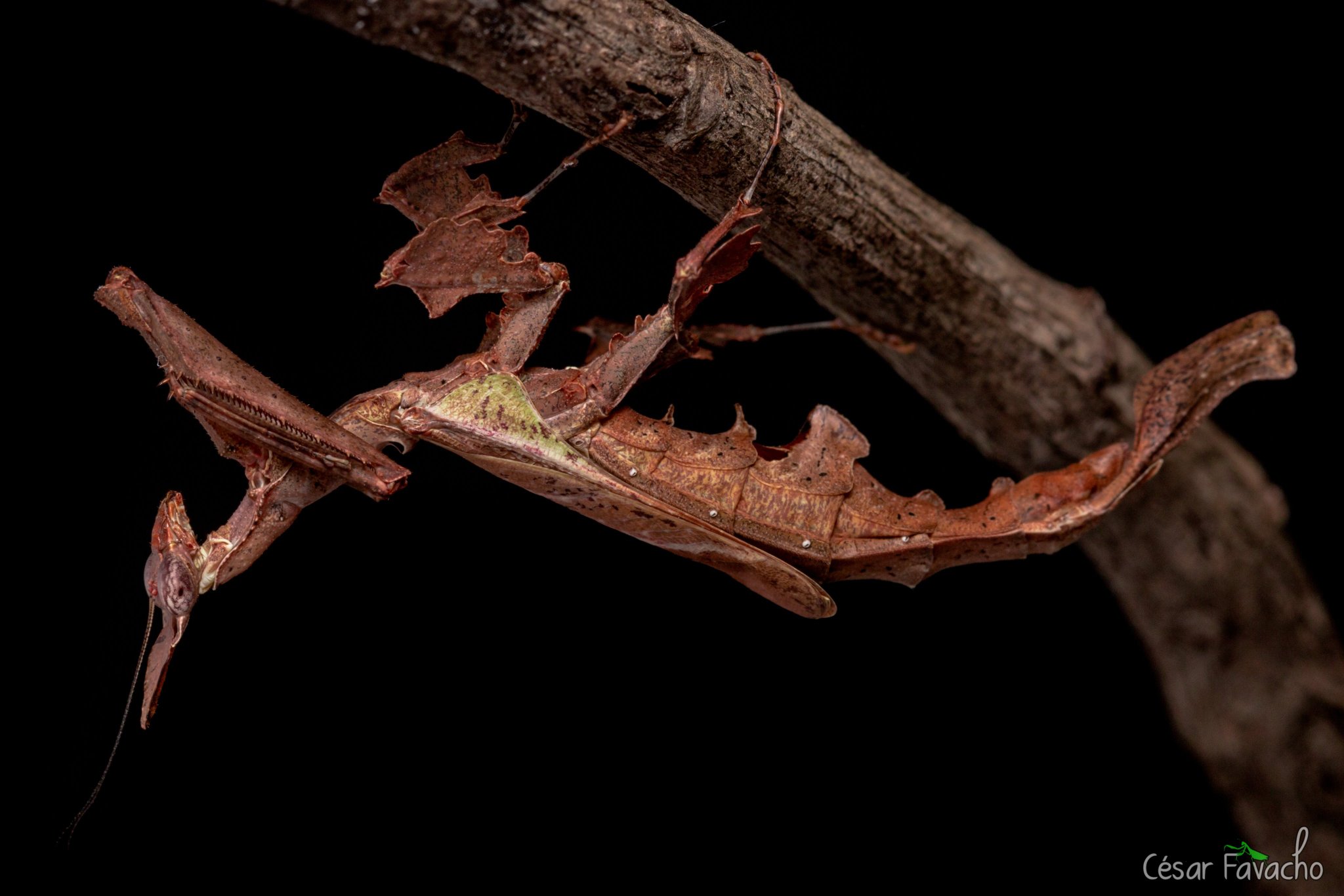
Stenophylla (Dragon mantises)
A lot of you really liked the Toxodera (dragon mantis) I posted last time. What if I told you there's a second group of praying mantids, totally unrelated and from another continent that are also called Dragon mantis?
These are Stenophylla, not closely related to the Toxodera from the last post at all, and from South America and not from Asia. They often get confused and there are lots of mislabeled pictures. The one in this picture is Stenophylla lobivertex.
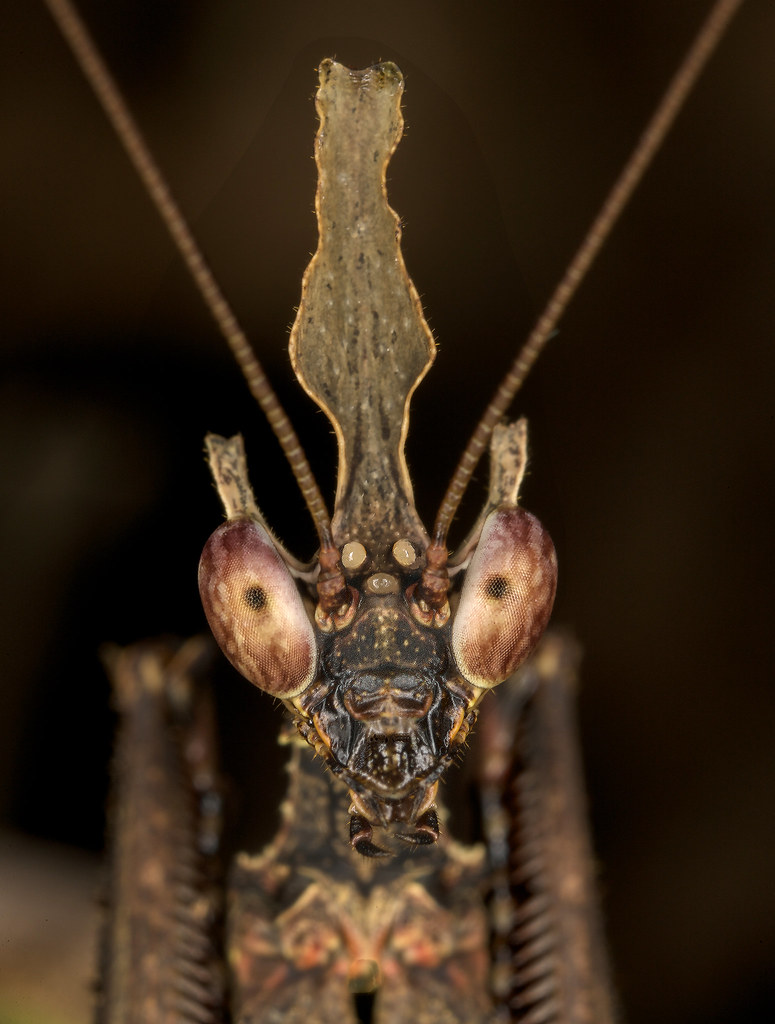
This is a portrait of Stenophylla cornigera. They generally stay smaller than the huge Toxoderas of Southeast Asia.

For comparison here's a Toxodera (T. beieri) again.

Calyptocephalella gayi (helmeted water toad)
From Chile where it lives in deep ponds, this is one of the largest and potentially heaviest frogs (up to 3 kg in very large individuals). They are noted to be particularly aggressive. They are threatened by capture for human consumption, habitat loss, pollution, introduced species and the frog killing fungus that's currently going around the world.

To get an idea of their size and mass.

And here's the tadpole.

Trichoplax adhaerens (no common name)
Maybe the simplest animal of all. In school you are usually told that title belong to sponges or jellyfish, but that is not true. Trichoplax are usually 1 to 2 millimeters in diameter, lacking any organs or internal structures. They consist of only two cellular layers. The top layer is made of ciliated "cover cells" flattened toward the outside of the organism, and the bottom layer is made up of cylinder cells that possess cilia used in locomotion, and gland cells that lack cilia.
That's it. No organs, no real structure. They are basically multicellular amoeba, which actually is one of the leading theories to how complex animals evolved, from amoeba that stuck together and started cooperating as one body.

Don't let its simple structure deceive you though. These animals have been around since long before sponges even evolved and are still around today. That means they had more time to evolve than any other animal on the planet. They might be simple, but they aren't primitive. They have an absolutely fascinating array of capabilities (for example transducting signals and reacting to their environment without any nerves!!) I recommend you read up on them more, they are incredibly interesting: https://www.eurekalert.org/pub_releases/2008-08/dgi-gos082108.php

Calyptra thalictri (vampire moth)
This eurasian moth has evolved the ability to suck blood. Specifically the males do it and present it to the female douring courtship as a nutritious source of sodium, which is valuable for them as their usual diet lacks it almost entirely.

This seems to be a recent development as only some males do it and they aren't very good at it either. They are large, conspicuous and clumsy and have no way to hide their activity like other bloodsuckers do with a local anesthetic. This behavior probably evolved from sucking on overripe fruit and was first noticed in a population in Russia in the late 80s. It seems to give male moths that do it a reproductive advantage which is why it is spreading. By 2008 the first blood sucking moths appeared in Sweden and Norway. We are really watching evolution at work here, a novel behavior spreading across a population rapidly and probably a new species in the making.

Typhochlaena seladonia (no common name)
A tiny colorful tarantula from Brazil. It is arboreal and only gets about 4cm big (with legs). They build small very well hidden tarp like nets over a branch with a little door they sit under and wait for prey to walk past.

Here's the door with a spider butt sticking out. They are entirely harmless to humans.

Daphnia lumholtzi (African spiny water flea)
You may know Daphnia (water fleas) as barely visible tiny jumpy things in ponds, rain barrels or as excellent food for tiny fish. This one is quite a bit bigger and also looks pretty painful to eat.
Their entire body is surrounded by a two-valved shell, on the front their modified legs filter tiny particles out of the water, on the back (at least in females) there's an egg pouch where their eggs can develop in safety (the black orbs).
They swim not with their legs but their modified huge antena (not visible in this image because they're pointed directly at the camera), which leads to their jerky jump like motion which got them the name water flea.

Here's an electron microscope image where you can see the antennas.
Interestingly these long spines you see are only produced when there are predators in the water, which the Daphnia senses by chemicals the predators emit. This is called an induced defense and the biology behind it is super fascinating. The two in this image are both the same species, one grew up in water which had predator chemical in it, the other didn't.

Chaoborus (Phantom midge) larva
And this is one of the predators the water fleas change shape for. The aquatic larva of phantom midges (Chaoboridae). They are bascially miniature submarines. The two bright structures you see at the front and back are actually air sacks that they use to float in the water! They can draw gas from the water and pump it into and out of the sacks to rise and sink in the water column.

Funnily enough they also have modified antennae, the large fang like structure in this image. They use them to catch prey. The water fleas with spikes are probably harder to grab a hold of and subdue, which is why the spikes are an effective defense.
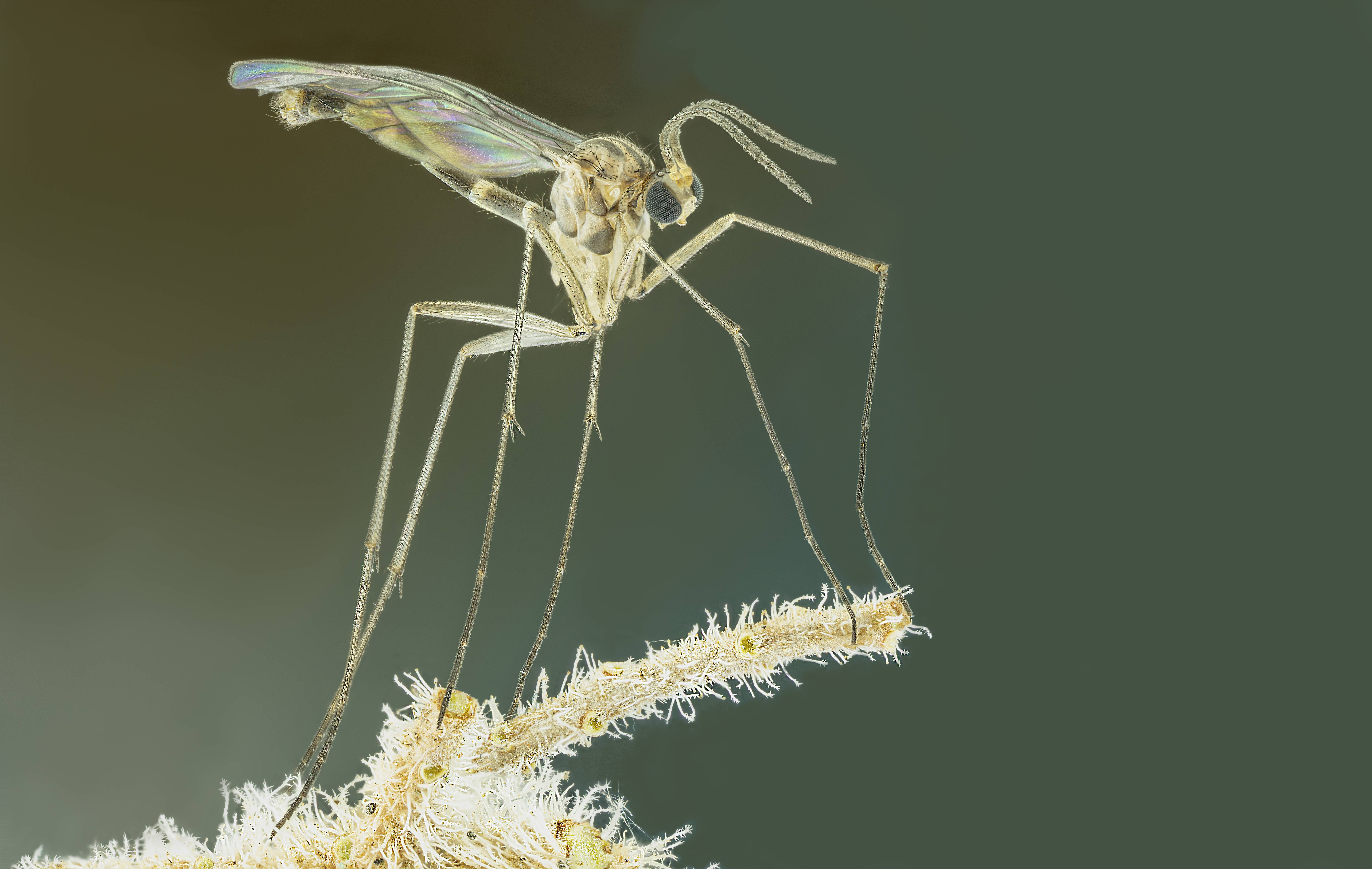
And here is what the midge looks like that these larva turn into. They are closely related to mosquitos but usually don't eat at all as adults, or if they do eat then only nectar.

Alipes multicostis (Cameroon Flag Tailed Centipede)
Centipedes of the genus Alipes fail from tropical Africa and are medium sized (8 - 15cm) centipedes which have strangely modified last legs. They carry feather like vividly colored structures. When the centipede is disturbed it raises these legs up and waves them around and produces a chirping sound as a warning of its venom.

If disturbed further the legs can be thrown off and continue moving and making noise, hopefully distracting the predator while the centipede flees to safety.

Chrysina (Jewel scarabs/shining leaf chafers)
These beetles belong to the family Scarabaeidae, or scarab beetles and are found from the southern US to Ecuador, though the most spectacular ones (which I'll be showing here) are from Central America, specifically the central mountain ranges that emerge from the dense rainforests.
These rare beetles mostly live on these mountains that are much cooler than the surrounding rainforest, which limits their ranges. This has led to a staggering diversity of them, with unique species on each mountain range.
This is Chrysina chrysargyrea.

They also come in gold. This is Chrysina optima.

And in pink, Chrysina optima (Pink Form).

There's a staggering variety and I have to stop myself or I'd just dump Chrysina all day long.

Epomis (no common name)
If you're looking at this with your kids or are generally squeamish you might want to skip this one. I'm not joking.
The unassuming (and kinda pretty) ground beetles (family Carabidae) of the genus Epomis are notable for being so called "role reversal predators".
Their larva expose themselves and move in a worm or grub like manner to attract the attention of frogs, which mistake them for prey. Note that the larva are way smaller than the frogs they attract so they fall well into the prey spectrum and the frogs just see them as a snack.
The frog then strikes at the larva and tries to eat it, but it can't. They are heavily armored and not bothered by being bitten by the large frog. They instead bite back and latch onto the frog (most often its mouth) with their strong mandibles. The frog is not strong enough to remove the larva. It then starts eating the much larger frog. They have no venom or anything so the frog is eaten alive from wherever the larva attached. I will not show images of this in the later stages, just freshly attached larva.

This is actually a large larva and a small frog.

This is a more normal size relation. There are pictures of Epomis eating into the throat of frogs on google if you're into that.

The adults also feed on ambhibians, however they actively hunt them by sneaking up on them from behind, then paralyzing by making an incision in the pelvic region with its mandibles. The amphibian loses its ability to move and is eaten by the beetle.
Epomis are distributed in the palearctic ecozone, that means all temperate climates in the Northern hemisphere (US, Europe, Russia, etc.)

Anolis barbatus (Western Bearded Anole/false chameleon)
Let's recover from that with something nice and harmless. This large (like 15cm body length, hey it's large for an anole), big headed lizard from Cuba is a specialist for eating snails. The large head and strong jaws are needed to crack open big land snails that it feeds on almost exclusively.

Yum. Very unusal for lizards are also its big, rounded teeth.

Here's the skull. Sharp, fragile fangs aren't exactly good for cracking open hard shells. This adaption however is not unique to this anole.

Dracaena guianensis (Northern caiman lizard)
This beautiful and not closely related relative of the tegu from northern South America also eats snails for a living and has similarly adapted teeth.

Here's the skull.

Anax tristis (Black Emperor)
Ever wondered what the largest Odonate (dragonflies + damselflies) is?
You probably know of the giant flying insects of the Paleozoic (related to dragonglies), which grew to wingspans of over 60cm enabled by high oxygen levels and lack of competition in the air, but how large can they get today?
That is actually not as easy to answer as you might think. Pretty much every source will tell you the wonderful helicopter damselfly (Megaloprepus caerulatus) is the largest. That is true, if you go by wingspan. However this is a very thin and fragile animal with proportionally very large wings, it is the largest but not even by much, and definitely not by weight. It gets the title by about 2cm, with a wingspan of up to 19cm.

This chunky fellow here is a dragonfly, not a damselfly and they are much more heavily built aerial predators. It just misses out on being the largest by wingspan (17cm in large females). All Anax (emperor dragonflies) are large but this one is the largest of them. Found in eastern Africa it's probably at least 5 times as heavy as the helicopter damselfly and pretty much all of that is flight muscles. They are amazing predators that can reach top speeds of 70 kph and fly all day.
The pictures here are sadly just of the slightly smaller males, I couldn't find a picture of a big female on a hand to put its size in relation.

Tropidolaemus (temple pit vipers)
Some of my favorite snakes, the temple pit vipers (genus Tropidolaemus). There are 5 recognized species and they occur in India and Southeast Asia. They show heavy sexual dimorphism. Females are heavily built, often very colorful and get about 1 meter long, males are much thinner and smaller, only about 70cm. Pictured here is Tropidolaemus wagleri or Wagler's pit viper.

This image shows a mature male and a female. The females spend their life almost motionless, waiting for prey to pass by them. They eat everything that's small enough for them to overpower.

This is a female of Tropidolaemus laticinctus. All of them have potent venom, they are reportedly not very aggressive snakes but they do tend to sit still when disturbed instead of fleeing.

And Tropidolaemus subannulatus. There are often several color forms of the same species and many even change colors as they grow up. They are somtimes kept as pets and even bred in captivity but both their venom and their strict care requirements means that only experienced venomous snake keepers should even consider getting one of these.
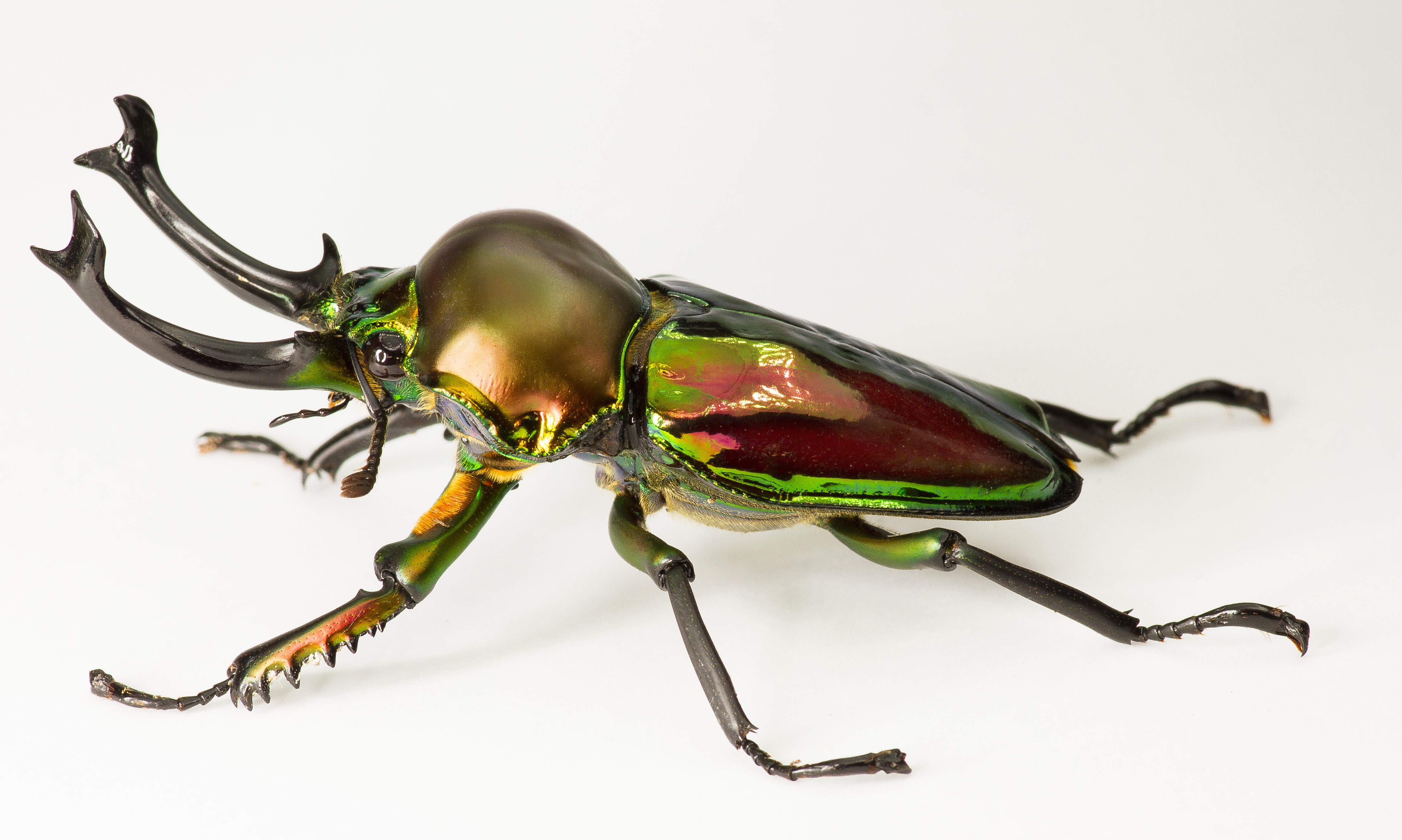
Phalacrognathus muelleri (rainbow stag beetle)
Closing it out with something that's maybe not as obscure, though I really don't know how well known this beetle is outside of the beetle breeder scene.
This medium sized stag beetle (up to 7cm for males) from a pretty small area in Queensland, Australia is maybe the most colorful of all stag beetles. And luckily also one of the easiest to breed in captivity. It's small distribution combined with the recent wildfires in Australia have probably decimated its wild population.
It belongs to a weird little subgroup of stag beetles that don't develop their mandible horns fully formed as pupa but instead inflate them once they hatch. That's also why their shape is rather simple with fewer spikes than other stag beetles (and to me they look almost balloon like).

This is the female. Without horns but just as pretty. The adults feed of tree sap. Males are dependant on either finding already existing tree wounds or females that bite into the bark of a tree to get it to leak sap, as they can't do it themselves with their oversized mandibles. The larva feed on rotting wood, like all stag beetle larva.
Ok, that was the 3rd installment, tell me what you think! This time it was quite bug heavy, which is probably due to arthropods making up about 90% of all species of animal on this planet, so there's obviously more cool bugs than for example mammals. Thanks for reading!
RufusPimperton
I love these, but they are a terror gamble on mobile
SaltyHermitShoe
Thank you for the post and descriptions :)
KingsBollegeBainbridge
tveye82
A very nice post
chelli
This was so very awesome. Thank you!
raygret123127001
Fuck me this planet is unbelievable
HighlandViking
@op Do you perhaps have a pic of the Lochness Monster? Asking for a friend.
Frupus
Sure! Here's a rare closeup.
HighlandViking
Thanks!!
kitub360
Dude I hope this thread does give me nightmares.
cre8majic
Loved it, and the fact that there's ton more out there piques my interest and my disgust
eternalentity
The tentacled snake looks like some Shadow of the Colossus creature.
Cactus21
Excellent, thanks!
jubalharshaw
Coolest thing I’ve read in a while. Thanks
Lukapaka
Blathers be like "OHH" :s
MishiMoshiSquishyToesies
They're good bugs Blathers.
lifeisadadjoke
Came here just for this. Thanks!
4thwalled
Awesome!! v
v
Nirvash1
This post bugs me.
ohjohnboy
I swear ive seen one of those huge dragonflies in Maryland. Scared the crap outta me
Frupus
Hopefully in a good way
CaptainLaserQuacker
Love it. If you love doing this posts, I will love watching and reading them <3
TreeSparrowDY
Current theories about placozoans place them as less basal than sponges (or at least a sister group to them) but more basal than cnidarians.
Frupus
True, the article I linked was older too. They are still fascinating organisms to study about early metazoan evolution in any case.
TooStronkkk
Great dump.
FacePalminator
This was heavenly for my nerdy soul! Thank you op!
Wastelandbogeyman
Another very informative post, thanks again! +1
Aquinzel
3 of those are catchable this month in animal crossing new horizons
jovialthunder
I love these. Thank you.
SienRaak
I’m so glad there there are people like you engaged in stuff like this. If I had many lives, one life would be devoted to critter studies!
SienRaak
Thanks for bringing these riches to us!
CloakedFigure
#1 looks like something you’d find in a fancy candy shop
SanshinDojo
It would have you spending all you got.
Mxlespxles
Looks like Vegeta at a pride parade
DeepCarrot
Thank you. I got itchy quite early.
river0n
Love these animal dumps, the way you write makes it even more enjoyable to read.
Frupus
Thanks man. All the positive comments really mean a lot to me.
IfYouTookTheTimeToReadThisYouHaveNoLife
Amazing post, thank you!
BonoboBoBoNobo
Dragonflies have a 99% hinting success rate. Making them the most consistent predators on Earth.