
chansuke

2209

111

6

Thanks for looking, hopefully I cleared some things up!
If you enjoyed this, I have a short album covering the different types of shotguns here: http://imgur.com/gallery/DU41w
If you have any questions regarding firearms, dont hesitate to ask, and shoot safe yall.
The Stalwart: Pump Action
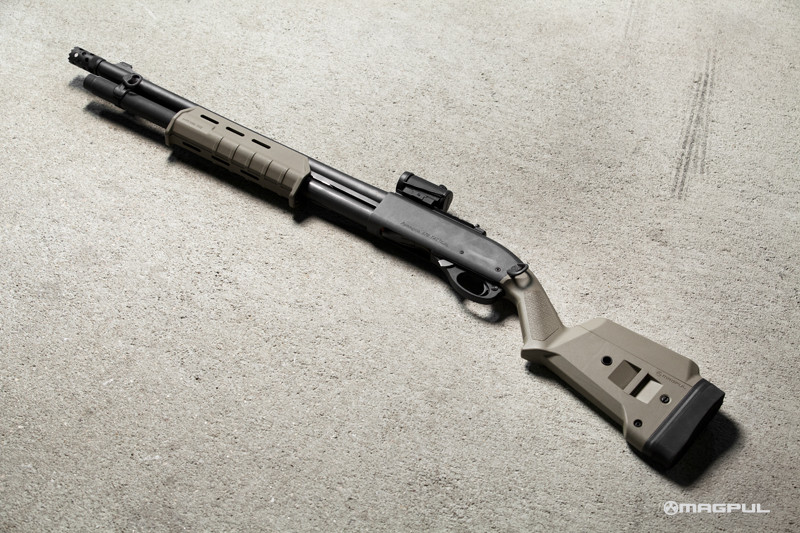
Pump action shotguns are actually a relatively recent invention, really hitting their stride in the last century, a good pump action is like a terminator. theyre notoriously long lived.
Their reliability made them a favorite on the front lines, and in WWI Germany lobbied for their ban from warfare. They were unsuccessful, and the Pump action has been a troop staple since then.
Pump action shotguns are also very popular with hunters. They are a relatively low cost, low maintenance option that still allows a shooter a fairly quick followup shot. Many feature interchangeable barrels, allowing one shotgun to be a hunting, slug, and home defense shotgun.
Their main shortfalls are slow reloads (although this can be shortened significantly with practice), and high recoil, as there is nothing to modify felt recoil.
The most popular pump action shotguns are the Remington 870, followed by the Mossberg 500.
(Pictured: Remington 870 with Magpul MOE furniture, US)
Heavy punch, light kick: The Autoloader

Autoloader shotguns are (unsurprisingly) also a relatively recent invention. Back before the advent of plastics, shotgun shells were often made of paper. Shells taken on a waterfowling trip would often swell, making reliable loading an enormous challenge.
Famed inventor John Moses Browning solved this problem in the form of the Browning A5. The history of the A5 is a subject for another article, but the short story is this: It worked. It was somewhat crude, it wasnt gentle, and it could be complicated to maintain. But in an era of inconsistent shells, it could put three or more shells downrange faster than anything else.
Since WWII autoloader tech has improved immensely. Todays models require less maintenance, can be had with featherweight frames that practically require guy wires to keep from floating away, and offer recoil on par with that of an air rifle.
Their main downside is that they can still be slightly complicated internally. This is somewhat offset by newer models having long maintenance intervals.
Autoloaders are available from nearly every manufacturer, but the crown jewels are usually considered to be the models put out by Benelli and Berretta.
(Pictured: A brace of A5s in various levels of trim, US or Belgian)
The old hand: Lever Action

Lever action shotguns are the original repeating shotguns, designed once again by John Moses Browning.
The model 1887 lever action shotgun was a take-off of the lever action rifle, popular at the time. In fact, this gun owes its existence to the Winchester companies popular line of lever action rifles. Browning (rightly) told Winchester that a pump action shotgun would be a better design. Winchester ignored him, and told him to design a lever action shotgun anyways.
The original run was really only popular for around 30 years or so before introduction of pump action shotguns, and the introduction of smokeless powder finally sealed the fate on this oddity.
Nevertheless, there still exists a niche market for these firearms, and modern reproductions are still in production.
(Pictured: a Chiappa reproduction of the M1887, Italy)
The original: The Single Barrel, Break Action

Break action shotguns are more or less the oldest shotguns, the cartridge evolution of a blunderbuss.
The barrel pivots on a hinge just behind the foregrip. A shell is inserted into the breech. The barrel is snapped shut, and the firearm is now loaded.
This simple action formed the basis of millions of break action shotguns. A break action weapon is among the simplest to produce, and easiest to maintain. They can be made smaller and tougher than just about any other action out there. Conversion sleeves let them shoot just about any gauge there is.
A break action is the bare minimum a shotgun is, a minimalist blend of form and function.
They are not gentle, punching like a heavyweight boxer, and take a long time to reload, but for millions of people they represent a way of feeding their family and defending their homes.
(Pictured: New England Arms Pardner, US)
The Aristocrat: The Side by Side Double

One day, perhaps after missing their first shot with a single shotgun, someone had the idea of essentially taping two singles together.
A little engineering finagling later, and the Side by Side double was born. Two barrels line up next to each other, enabling a quick follow up shot.
Doubles are, by their nature, very expensive beasts. The actions are very complex, the mechanisms requiring the utmost attention to detail during manufacturing. The barrels must be precisely lined up. Fitment for many of these is customized to the shooter. They can be had with a dual tigger, or single selective trigger.
The best of these, somewhat arguably, come from London. These come out as exquisite works of art, covered in engraving, and pointing like an extension of ones body. They also cost as much as a house, with six figure guns not being unheard of.
At one point, America made some very nice doubles, but those days have since passed. The Three Parker Invincibles however are considered priceless.
Certainly there are more economical doubles to be had, but nothing brings the prestige like a London Double in 'Best' grade.
In practical use, Side by Sides have been supplanted by Over Under shotguns
(Pictured: Parker Invincible)
The young gentleman: The Over Under

Side by Side doubles can be tricky to shoot. The barrels straddle the centerline of the firearm, making aiming difficult.
An over under, true to the name, has the barrels stacked one atop the other. This makes aiming much simpler, although the barrels still need to be properly aligned. The mechanism isnt as complex, and there is usually only on trigger to deal with.
There are a wide variety of O/U shotguns to choose from, although as with anything, you get what you pay for. They can be had from a few hundred bucks to (again) as much as a house.
Many will tell you that if you want to win at clay games (skeet, trap, sporting clays), you MUST shoot an O/U. This is partly myth, as a good auto can keep up if not surpass an O/U in the right hands.
O/U shotguns have been considered by many to be the new 'prestige' gun of choice for the last couple generations of shotgunners.
(Pictured: Holland and Holland O/U, UK)
The Tank: Slug Rifle
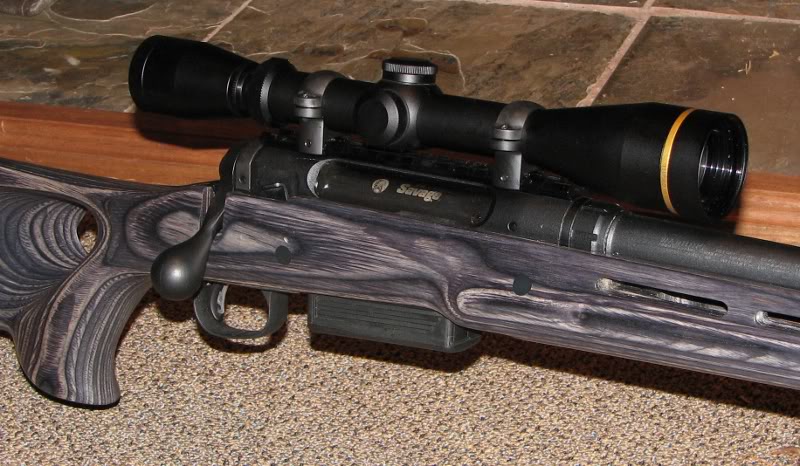
A slug is simply a big hunk of lead. When accelerated to 1800 feet per second, it is capable of killing anything from a deer to a Chevrolet Small Block engine.
The biggest challenge is shooting them accurately. Most shotguns are smoothbore, meaning accuracy is more theory then practice when using them with slugs. Many shotguns will accept rifled barrels, meaning a shooter can put the slug on paper at 75-100yds, but not much beyond that. Rifled barrels are an inexpensive way to shoot slugs at practical ranges.
But some times that isnt good enough, and greater accuracy is called for. The slug rifle fills that gap.
The idea of shooting a slug through a purpose built rifle is very recent, making these particular beasts somewhat rare. They are very potent, some being capable of shooting 1" or smaller groups at 100yds (MOA or better), pin point accuracy when the round itself is .5" or larger.
Slug rifles are slowly gaining popularity for shooters who hunt at shorter ranges, but are still something of a curiosity.
(Pictured: Savage 220, US)
The Oddity: The Combo Gun
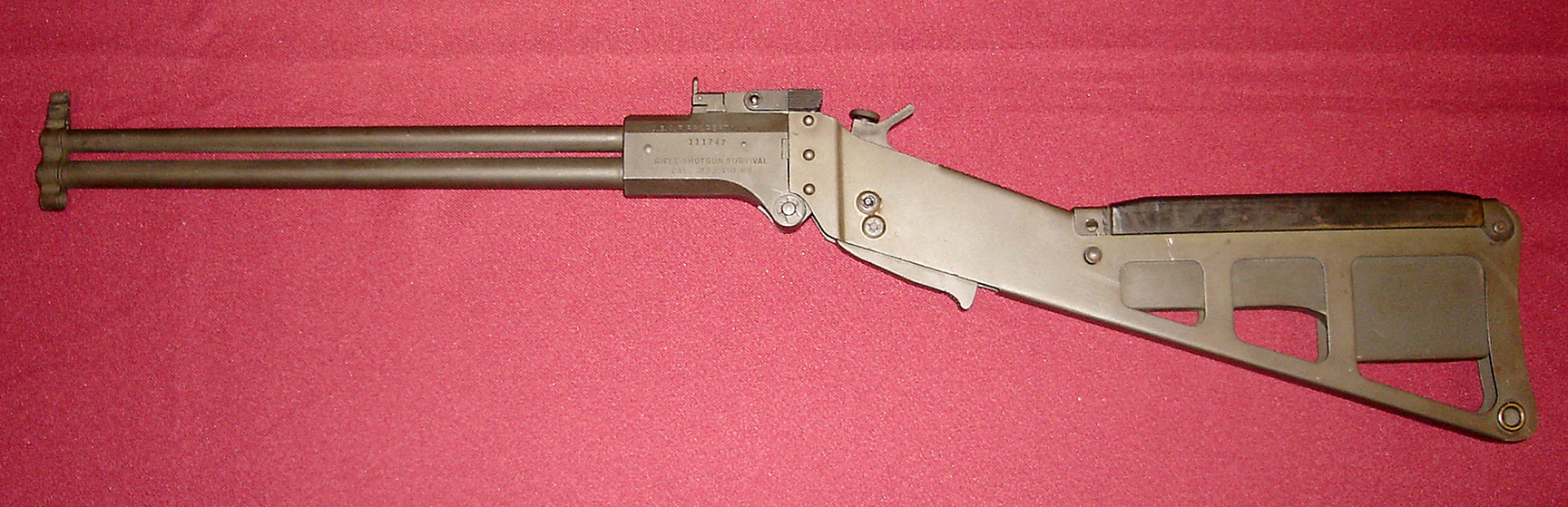
If you take an over under and replace one of the barrels with a rifle, you get a combo gun.
Combo guns are, im told, somewhat popular in Germany, available in a multitude of gauges and calibers, with up to four barrels. They can cost exorbitant amounts, often made by custom gunsmiths.
Perhaps then, the most common combo gun is one made for the United States Air Force.
Chambered in .22LR or .22 Hornet in one barrel, and .410 shotgun shells in another (although .45 Colt could also be used), this weapon flew with air crews, meant to be used as a hunting weapon in the case of a plane crash.
Combo guns overall are fairly rare (especially examples with more than one barrel).
(Pictured: M6 Aircrew Survival Weapon)
Shotshell explanation

Shotshells, to those not in the know can have a mysterious array of markings.
Here is a quick rundown, using my preferred shotshell for clay games:
Size 8 Shot, 1oz load, 1200FPS, 2 3/4" Shell
Shot size: The higher a shot size, the smaller the pellets inside the shell. Size 7.5-9 shot is used for small birds and clay games. 6.5 is good for late season birds. These sizes are commonly referred to as
Buckshot is labelled as such, with 0, 00, and 000 buckshot available. 00 (Double-ought) buckshot is the most common, being effective for larger game, or home defense.
Shot comes in lead and lead free varieties. Lead free shot may be steel, or bismuth. Lead free shot should only be used in guns marked as suitable for such. It should never be used in older shotguns.
Slugs come in several varieties, with rifled slugs, and saboted slugs being the most common.
Shot load: This is the weight of the shot in the shell. More shot means more pellets, meaning more damage. Heavier loads also mean more recoil. I use 1oz loads for clays because I shoot 150 shells or more during a day of shooting.
Velocity: Measured in feet per second, this number indicates the exit speed of the shot, as it leaves the barrel. Higher numbers mean more recoil, but less need to lead the target when shooting at a moving bird or clay.
Length: There are several case lengths, the two most common are 2 3/4" and 3", a larger shell means more powder and more shot, again translating into more power, at the expense of more recoil. If a shell is described as a magnum, it is usually a 3 1/2" shell, and should be shot with the realization that it will punch very very hard.
I hope youve enjoyed this brief introduction to shotguns. If this is popular I will keep doing these.
HULKSMASHBettycrylatherrinserepeat
Good intro, OP, lots of knowledge being shared!
FarmerFrance
What do you need to have to shoot slugs? I have a Rem 870 w/ 18.5 barrel and the Rem tactical choke tube. Will that choke work?
COVCREO
Good job OP!
FarmerFrance
Just bought a shotgun and this is awesome! Especially the info on shotshells. Upvote 4 U!
[deleted]
[deleted]
catsandbeerandbeerandcats
his safety course books and I think I am going to go get my license soon :)
DictatorofPussy
I like shotguns.
jaaku
Please keep doing these. Incredibly interesting!
thelonedart
The amount of gun education we are exposed to on this site is subtly brilliant
nearurod
I work in a large hospital, in the US. I see more GSW from failed suicides than from assaults. Your hobby is more dangerous than you think.
jaaku
I think it's safe to say anyone who owns a gun knows it's dangerous. But it can also be incredibly rewarding.
chansuke
The simplest reason for that is that shotguns are difficult to conceal, even when cut down. I am aware how dangerous shooting is.