
TheJuiceLoosener

8535

377

7
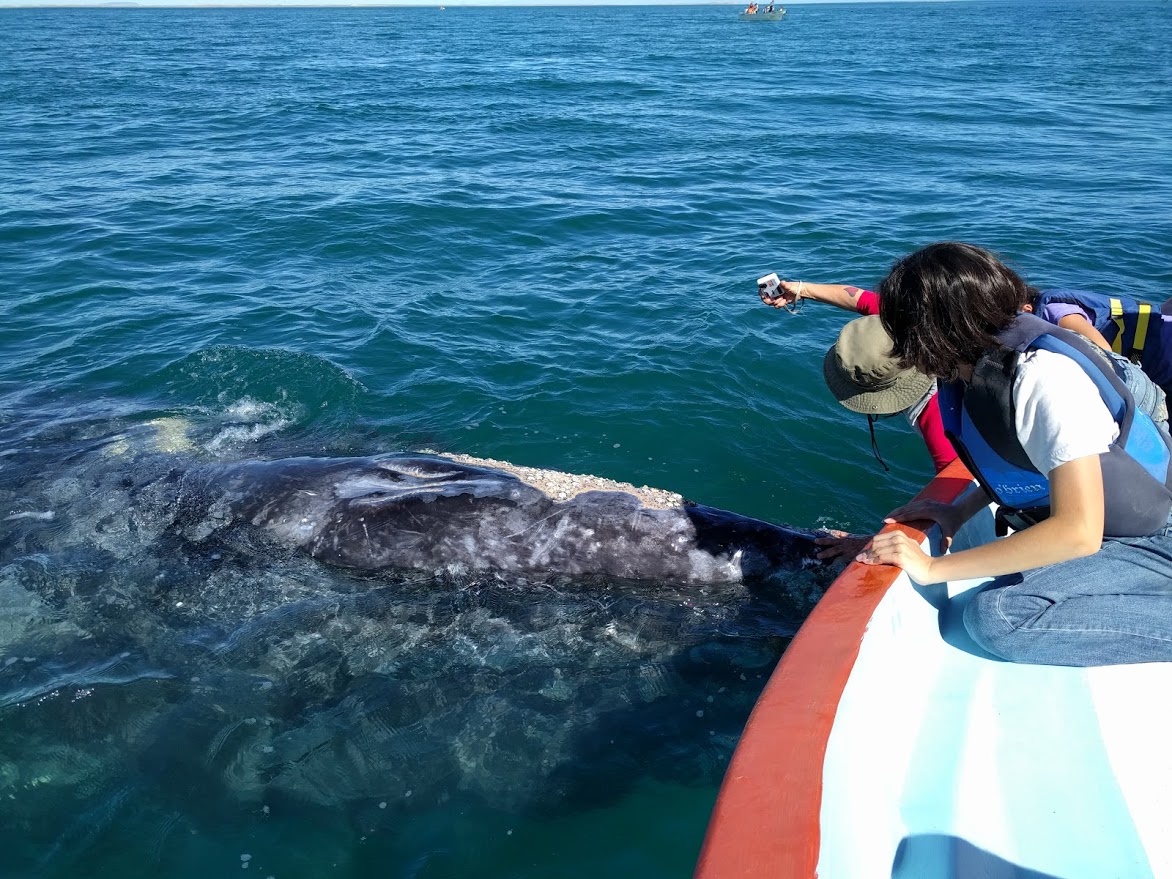
Seeing a lot of videos on here lately of people visiting the gray whales at the calving lagoons in Baja. I'm a biologist who sits on the board of a whale conservation nonprofit in California and I'd like to clarify a few facts.
1) Why now? The grays spend their time in two places, the Arctic and the coastal lagoons of Baja California, Mexico. The Arctic is considered their feeding grounds and Baja is considered their calving grounds, basically a nursery. Around Sep/Oct, sea ice begins to form in the Arctic. Sea ice floats on top of the water and because grays are obligated to come to the surface to breathe, the formation of sea ice physically excludes them from their feeding area and pushes them out to the south. They take that as their signal to head much further south, 5,000 - 7,000 miles south. They famously migrate down the western coast of North America, where viewing them mid-migration, from a distance, is a popular tourist activity. Some give birth along the way, others give birth in the lagoons. They typically start arriving in Mexico in January and early April tends to be the end of the season down there, when they take the long journey back toward the Arctic, giving folks on the West Coast another chance to view them heading north. Peak lagoon season is Feb/Mar, which is why we're seeing these videos now.
2) What's the legality of this? US law prohibits people from engaging in any activity which causes a marine mammal to alter its behavior. However, these photos and videos are not from the US. In Mexico, the laws are different. These coastal lagoons are biological reserves overseen by the Mexican government and these tours are concessions authorized and overseen by the Mexican government. I have been to two of the three most famous calving lagoons and both are set up with designated "viewing areas," or geographically bounded areas within the waters of the lagoons where stopping to view/interact is legal. The lagoons are large and the designated viewing areas are relatively small in comparison. The pangas, the small boats that carry up to ~15 passengers, are not allowed to stop outside the viewing areas to interact with whales. The number of boats is limited, time within the viewing area is limited, the pangas each carry a transmitter that tracks their location, and the captains are part of a local cooperative. I will not say that this is a perfect system, but in my observation, the system runs well. I've been on 20+ tours and have never seen any activity, either by the boats, the crew, or the passengers that I felt harmed the whales in any way.
3) Ok, what are the imperfections? The lagoons are extensive and the viewing areas are limited, yes, but the viewing areas are placed in locations known to be popular with the whales. Of course, the whales are free to come and go as they please, but there's no way to know if/how a whale understands that there are certain areas where they may interact with boats and other areas where they will not. That said, they ARE free to come and go, and they do appear to do so. There are hundreds if not thousands of whales in the lagoons at any time and probably fewer than 100 within the viewing area at any time. The rest, presumably, are off elsewhere in the lagoons, doing gray whale stuff. Also, the viewing areas in the two northernmost lagoons are at the mouths of the lagoons, so any whale that wishes to enter or exit the lagoon must at least traverse the viewing area, though even then, they can probably avoid the boats if they wanted. Whales that seek out interaction are called "friendlies" and there are usually enough of them at any given moment that the pangas have no need to chase down or follow a whale that's just swimming by.
4) So, these friendlies, is it what these videos make it look like? Yeah, pretty much. It's hard to explain, really, but these giant wild animals act like big puppies. Many seek out the boats, you can see them approaching on a beeline from a ways away. They are absolutely coming over for scritches. Visitors are instructed prior to boarding the pangas about some basic whale anatomy and are told to try to avoid touching the whales near their eyes, blowholes, inside their mouths, and their fins and tails. I'm sure there are some obnoxious tourists that disregard these instructions, but I've never seen it. The tourists are overwhelmingly respectful of the rules.
5) Does this acclimate the whales to the presence of people and/or boats? Short answer, of course. Long answer, not apparently. The thing to understand is that these lagoons seem to be a special place for the whales. Many of the females have just given birth. They're probably tired and their babies are curious. Many of the solo whales are more interested in getting started on next year's crop of calves, if you catch my drift, so they tend to be less interested in interacting. When the whales are along the migratory route, they show no interest in interacting with boats. They are in transit. By contrast, in the lagoons, they no longer are traveling and have no destination. They're just hanging out. And they seem to be open to interacting there in a way they just don't when they're in the open ocean. So while theoretically yes, this acclimates them to people/boats, in reality, there is no evidence that these experiences alter their behavior either along the migratory route or indeed back in the Arctic. My whale conservation group hosted a speaker a while back who has been a gray whale researcher for 25 years, based in the Arctic. He observes the grays from small boats, not dissimilar to the pangas. He says he's never seen the grays engage in any similar activity in the Arctic, at all. In fact, it was only a few years ago that he himself visited the lagoons for the first time. He said he barely recognized these animals there, even though he literally recognizes the individuals, as their behavior was so different from what he's seen in the Arctic. These tours have been operating for decades in the lagoons, under ever-increasing oversight/regulation, so it's not that the tours are new and the impacts are just starting to be felt. Many adults in the lagoons today were once the calves that were coming up to the pangas for scritches themselves. Also worth noting, these pangas are operating with 150HP outboard motors. If a whale approaches the stern while the engine is running, the captains either click the engine into neutral or lift the outboard out of the water, so as to avoid a prop strike. The enormity of the difference between a 22' boat with a 150HP outboard and a Panamax-class cargo ship cannot be overstated. There really is no evidence that acclimating to a small outboard motor increases the likelihood that the whales come to view shipping vessels as harmless and wind up having severe/fatal interactions with them. I want to re-emphasize that while I agree with the letter and the spirit of the US laws, the situation of the grays in Mexico is just different from what they are doing in US waters. You could not have an interaction with a migrating gray like this, even if you wanted to break the US laws. I have also done frequent whale watching off the California coast, in a variety of boat sizes, and have NEVER seen a gray acting like this in our waters.
6) Does their exhaled spouted air stink? Not really. As I mentioned before, the Arctic is their feeding ground. Convention wisdom is that they do not eat along the migration or in the lagoons. In reality, they have been observed to eat opportunistically both along the migration and in the lagoons. It isn't uncommon to get sprayed by the exhalation, but it isn't sticky and if it does smell, it only lasts for a second. Mostly, it seems to be water.
7) What do the whales feel like? Their skin is rubbery. Touching them maybe feels like poking your finger on a slick yoga mat or maybe like a full plastic gallon milk jug. Grays do carry large ectoparasite loads, so barnacles and lice and such. The whales often rub themselves on the hull of the panga, leaving the impression they might be trying to scrape or scratch themselves. While it's definitely interesting to be on a boat when an animal twice the size of the boat rubs up against it, again, I've never heard of a negative interaction.
8) Are the whales sick? No. Although there have been a few "unusual mortality events" in the last few years, broadly, the population is healthy. Unhealthy individuals tend to be starving; noticeably thin necks (like a peanut or a figure-8) are diagnostic. They close their eyes at the surface probably because their eyesight is geared for bottom feeding in the Arctic Circle, so a very dark place. Baja sunlight at the surface is probably a lot for them.
9) Are they endangered? No. Despite the recent unusual mortality events, the North Pacific population is thought to be at or near the ecological carrying capacity (~20k), though estimating historical abundance can be tricky. The Pacific grays were hunted to near-extinction and were considered critically endangered but the international treaties to reduce commercial whaling have allowed the population to successfully recover. In fact, the recovery of the Pacific grays is a remarkable success story, rebounding from a population in the hundreds to tens of thousands today. Also, the recovery of the grays has benefited the orca populations that predate on the calves. An estimated 20%-33% of the calves are eaten by orca in the Aleutians.
10) I don't know. If y'all have any other questions, feel free to comment and I'll try my best to make up something convincing. En espanol, tambien, siquieras.
andBingowashisNameOh
Thanks for sharing this!! I did this in San Ignacio Lagoon and it was incredible.
redexodus
thanks dude, you are in reality, cooler than kanye
thebadplace
I wonder if it has to do with there intelligence if they are as intelligent as even a dog then it could be learned behavior, a dog can learn to do a trick in one place and one place only if not trained anywhere else. If they are more intelligent than dogs they could know where and when to engage in such behaviors. I don’t know the intelligence of a grey whale so just a thought experiment but some marine animals show surprisingly high levels of intelligence.
lastmanonearthbutidroppedmyglasses
Cool post though. Thanks!
Niagaran
Lies and bullshit.
eilonwy
This is a really interesting, informative post, @OP. Thanks for making it!
Feralkyn
So it's not actually as bad/harmful as people claim? This is an interesting post, regardless; puts a lot of context on it all, thank you!
TheJuiceLoosener
On the long list of harmful things people do to wildlife/nature, this is pretty far down.
Anmeloe
Thank you, really interesting!
CloudsandRainandSunandWind
Thanks for taking the time to explain that! I'd only learned the "close whale watching=bad" principle, nice to get some nuance. Also, I'm
CloudsandRainandSunandWind
super jealous of your experiences and knowledge on the subject!
TeeweeAndSmashboy
A population culled to a few hundred, then bred to ~20K... that must have a massive adverse effect on the bio-diversity(?) of the species eh
TheJuiceLoosener
Without a doubt. Big bottleneck, at the hands of mankind. Still better than being extinct.
bravotipo
quality post!
glennthepilot
"... make up something convincing."? Are you saying you made this whole thing up?
TheJuiceLoosener
C'mon guy. I guess I'm flattered that you don't have any other questions. Many people ask about how the whales perceive the experience,
TheJuiceLoosener
but since I'm a biologist and not a whale psychic, I just try to be clear that there are limits to what is known
glennthepilot
I get that. And I'm very interested in this. But your wording indicates that you're making it all up. I don't mean to offend....
glennthepilot
Just want to be clear on it. +1 for very interesting read.
Polymathena
TL;DR, but leave the poor creatures ALONE.
TheJuiceLoosener
Also, why comment if you can't be bothered to even read and consider someone else's perspective?
TheJuiceLoosener
Guess you don't understand what ecosystems are all about. Nothing on Earth gets left alone.
Polymathena
Yep. Not since shittycancerhumans arrived.
TheJuiceLoosener
For centuries, we hunted the grays with harpoons and rendered their blubber for lamp oil. We denude the oceans with trawlers, gill nets, 1/
TheJuiceLoosener
and long lines. We dump toxic chemicals in huge amounts. We're warming the planet and acidifying the ocean. Oh, and a handful of pangas 2/
TheJuiceLoosener
allow people to touch whales that approach them. Between 1 in 5 and 1 in 3 gray whale calves will be eaten by orca in the Aleutians 3/
gentledruid
ô_o well as a biologist you know that preserving is a huge deal. I get that by showing people, so they can actually relate might be a way
TheJuiceLoosener
Again, there is no evidence that, outside of the preserve, these whales approach vessels or are acclimated to people in any way
TheJuiceLoosener
These tours have been running for decades and the whales still don't approach along their migration nor in their Arctic feeding grounds
gentledruid
but its not the only way. And I still dont think its ok to signal them that things boat related are good per se. Cause...
gentledruid
outside of these lagoons they are not save and not protected.
MehEdits
I'm fairly certain they already learned not to approach in open ocean due to whale hunting when it was legal even. If they can learn to