
Aurelio2010

2347

4

1
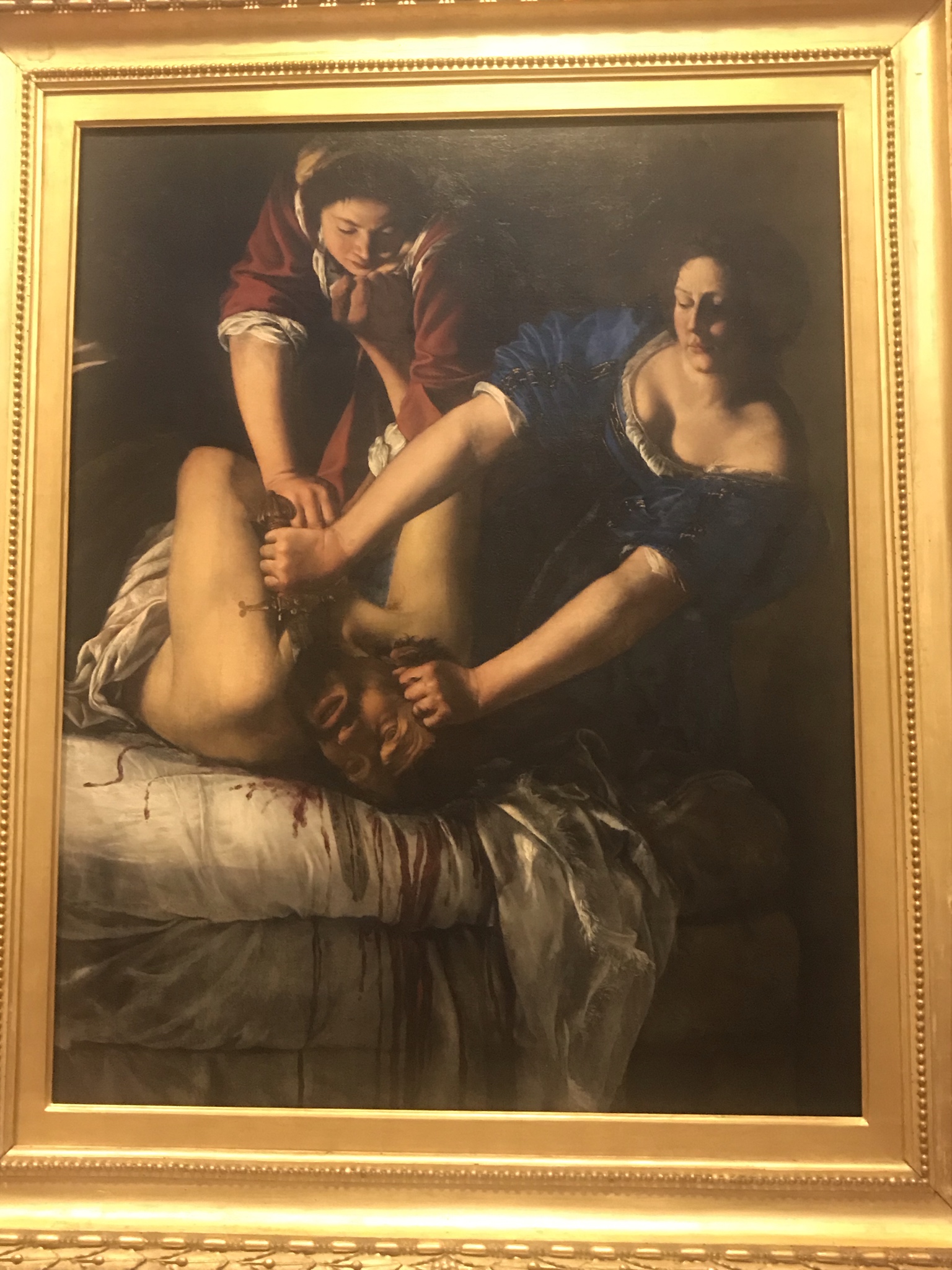
Artemisia Lomi or Artemisia Gentileschi (US: /ˌdʒɛntɪˈlɛski, -tiːˈ-/,[1][2] Italian: [arteˈmiːzja dʒentiˈleski]; July 8, 1593 – c. 1656) was an Italian Baroque painter, today considered one of the most accomplished painters in the generation following that of Caravaggio. In an era when female painters were not easily accepted by the artistic community or patrons, she was the first woman to become a member of the Accademia di Arte del Disegno in Florence and had international clientele.[3][4]
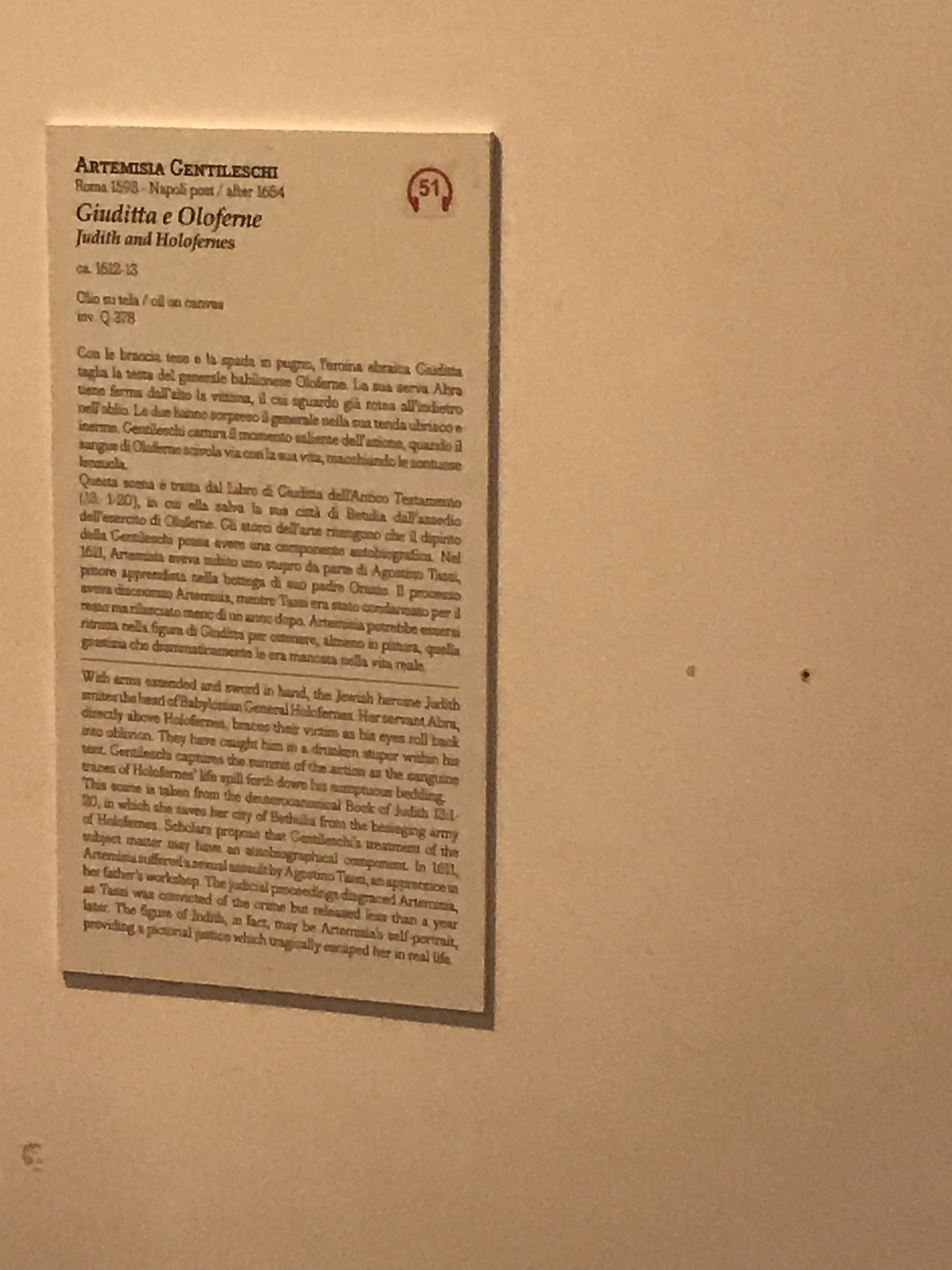
She specialized in painting pictures of strong and suffering women from myths, allegories, and the Bible—victims, suicides, warriors.[5] Some of her best known themes are Susanna and the Elders (particularly the 1610 version in Pommersfelden) and Judith Slaying Holofernes (most famous is her 1614–20 version in the Uffizi gallery) and Judith and Her Maidservant (her version of 1625 at the Detroit Institute of Arts).
Judith and her Maidservant, 1625, Detroit Institute of Arts
She was known for being able to convincingly depict the female figure, anywhere between nude and fully clothed.[6][7] Artemisia was also famous for her skill and talent in handling color, both overall in the composition but also in building depth.[8][9]
That she was a woman painting in the seventeenth century and that she was raped as a young woman by Agostino Tassi and participated in the prosecution of her rapist long overshadowed her achievements as an artist.[10] For many years she was regarded as a curiosity. Today she is regarded as one of the most progressive and expressive painters of her generation, and is due to be celebrated at the exhibition at the National Gallery in London in 2020.[11]
Early life
Edit
Susanna and the Elders, 1610, her first known work, Schönborn Collection, Pommersfelden
Artemisia Gentileschi was born Artemisia Gentileschi Lomi in Rome on July 8, 1593, although her birth certificate from the Archivio di Stato indicated she was born in 1590, the eldest child of the Tuscan painter Orazio Gentileschi and Prudenzia di Ottaviano Montoni.[12] Artemisia was introduced to painting in her father's workshop, showing much more talent than her brothers, who worked alongside her. She learned drawing, how to mix color, and how to paint. "By 1612, when she was not yet nineteen years old, her father could boast of her extraordinary talents, claiming that in the profession of painting, which she had practiced for three years, she had no peer".[13]
Since her father's style took inspiration from Caravaggio during that period, her style was just as heavily influenced in turn. Her approach to subject matter was different from her father's, however, as her paintings are highly naturalistic, where Orazio's are idealized. At the same time, Artemisia had to resist the "traditional attitude and psychological submission to this brainwashing and jealousy of her obvious talent".[14] By doing so, she gained great respect and recognition for her work.[15]
The first surviving work of the seventeen-year-old Artemisia was the Susanna and the Elders (1610, Schönborn collection in Pommersfelden). At the time some, influenced by the prevailing misconceptions, suspected that she was helped by her father. The painting shows how Artemisia assimilated the realism of Caravaggio without being indifferent to the language of Annibale Carracci and the Bologna school. It is one of the few paintings on the theme of Susanna showing the sexual accosting by the two Elders as a traumatic event.
Raped by Agostino Tassi
Edit
Salome with the Head of Saint John the Baptist, c. 1610–1615, Budapest
In 1611, her father was working with Agostino Tassi to decorate the vaults of Casino delle Muse inside the Palazzo Pallavicini-Rospigliosi in Rome, so Orazio hired the painter to tutor his daughter privately. During this tutelage, Tassi raped Artemisia.[16][17] Another man, Cosimo Quorli, was also involved.[18]
After the rape, Artemisia continued to have sexual relations with Tassi, with the expectation that they were going to be married and with the hope to restore her dignity and her future. Tassi reneged on his promise to marry Artemisia. Nine months after the rape, when he learnt that Artemisia and Tassi were not going to be married, Orazio pressed charges against Tassi.[19] Orazio also claimed that Tassi stole a painting of Judith from the Gentileschi household. The major issue of this trial was the fact that Tassi had taken Artemisia's virginity. If Artemisia had not been a virgin before Tassi raped her, the Gentileschis would not have been able to press charges. During the ensuing seven-month trial, it was discovered that Tassi had planned to murder his wife, had engaged in adultery with his sister-in-law, and planned to steal some of Orazio's paintings. At the end of the trial Tassi was exiled from Rome, although they never carried out the sentence.[20] Artemisia was tortured with thumbscrews at the trial, with the intention of verifying her testimony.[21]
Artemisia was surrounded mainly by males since the loss of her mother at age 12. When Artemisia was 17, Orazio rented the upstairs apartment of their home to a female tenant, Tuzia. Artemisia befriended Tuzia; however, Tuzia allowed Agostino Tassi and Cosimo Quorlis to accompany Artemisia in Artemisia's home on multiple occasions. The day the rape occurred, Artemisia cried for the help of Tuzia, but Tuzia simply ignored Artemisia and pretended she knew nothing of what happened. Artemisia felt betrayed by Tuzia, and Tuzia's role in facilitating the rape has been compared to the role of a procuress who is complicit in the sexual exploitation of a prostitute.[22]
The painting called Mother and Child is attributed to those early years. The baby has been interpreted as an indirect reference to Agostino Tassi, her rapist, as it dates to 1612, just 2 years after the rape. The painting appeared in a Swedish private collection during the 1960s. It depicts a strong and suffering woman and casts light on her anguish and expressive artistic capability.[23][24]
Florentine period (1614–20)
Edit
Self-Portrait as a Lute Player, 1615–17
Jael and Sisera, c. 1620
Judith Slaying Holofernes, 1614–20, 199×162 cm, Galleria degli Uffizi, Florence
A month after the trial, Orazio arranged for his daughter to marry Pierantonio Stiattesi, a modest artist from Florence. Shortly afterward the couple moved to Florence, where Artemisia received a commission for a painting at Casa Buonarroti. She became a successful court painter, enjoying the patronage of the House of Medici and Charles I of England. It has been proposed that during this period Artemisia also painted the Virgin and Child, now in the Palazzo Spada, Rome.
While in Florence, Artemisia and Pierantonio had a daughter around 1618, Prudentia, but who was also known as Palmira, which has led some scholars to conclude erroneously that Artemisia had two children, not one.[25] Prudentia was named after Artemisia's mother, who died when Artemisia was 12. It is noteworthy that her daughter was a painter, trained by her mother, although nothing is known of her work.[26]
In Florence, Artemisia appears to have enjoyed significant success. She was the first woman accepted into the Accademia delle Arti del Disegno (Academy of the Arts of Drawing). She maintained good relations with the most respected artists of her time, such as Cristofano Allori, and was able to garner the favors and the protection of influential people, starting with Cosimo II de' Medici, Grand Duke of Tuscany and especially of the Grand Duchess, Christina of Lorraine. Her acquaintance with Galileo Galilei, evident from a letter she wrote to the scientist in 1635, appears to stem from her Florentine years.
She was esteemed by Michelangelo Buonarroti the younger (nephew of the great Michelangelo): busy with construction of Casa Buonarroti to celebrate his notable relative, he asked Artemisia—along with other Florentine artists, including Agostino Ciampelli, Sigismondo Coccapani, Giovan Battista Guidoni, and Zanobi Rosi—to contribute a painting for the ceiling. Each artist was commissioned to present an allegory of a virtue associated with Michelangelo, and Artemisia was assigned the Allegory of Inclination, presented in the form of a nude young woman holding a compass. It is believed that the subject bears a resemblance to Artemisia. Indeed, in several of her paintings, Artemisia's energetic heroines resemble her self-portraits.
In 2011, Francesco Solinas discovered of a collection of thirty-six letters, dating from about 1616 to 1620, that provide new insight into Gentileschi's personal and financial life in Florence.[27] Most unexpectedly, they show that she had a passionate love affair with a wealthy Florentine nobleman named Francesco Maria Maringhi. Curiously, her husband, Stiattesi, was well aware of their relationship, and maintained a correspondence with Maringhi on the back of Artemisia's love letters. Nevertheless, he tolerated it, presumably because Maringhi was a powerful ally who provided the couple financial support. However, by 1620, rumors of the affair had begun to spread in the Florentine court, and this fact, combined with ongoing financial and legal problems, led them to resettle in Rome.
Notable works from this period include La Conversione della Maddalena (The Conversion of the Magdalene), Self-Portrait as a Lute Player (in the collection of the Wadsworth Atheneum Museum of Art) and Giuditta con la sua ancella (Judith and her Maidservant), now in the Palazzo Pitti. Artemisia painted a second version of Judith beheading Holofernes, which now is housed in the Uffizi Gallery of Florence. The first, smaller Judith Beheading Holofernes (1612–13) is displayed in the Museo di Capodimonte, Naples. Despite her success, financial excesses borne by her for her husband led to problems with creditors, and she fell out with her husband. She returned without him to Rome in 1621.
Return to Rome, Venetian period (1621–30)
Edit
Artemisia arrived in Rome the same year her father Orazio departed for Genoa. While there is not enough evidence for this, some believe that Artemisia followed her father to Genoa, asserting that this time together would have accentuated the similarity of their styles, making it often difficult to determine which of the two painted certain works. Most of the evidence, however, supports the notion that Artemisia remained in Rome, trying to find a home and raise her daughter.
Although the master had been dead over a decade, Caravaggio's style was still highly influential and converted many painters to following his style (the so-called Caravaggisti), such as Carlo Saraceni (who returned to Venice 1620), Bartolomeo Manfredi, and Simon Vouet. She and Vouet would go on to have a professional relationship and would influence each other in terms of style and their learnings from Caravaggio's style.[28] Painting styles in Rome during the early seventeenth century were diverse, however, demonstrating a more classic manner of the Bolognese disciples of the Carracci and the baroque style of Pietro da Cortona.
It appears that Artemisia also was associated with the Academy of the Desiosi. She was celebrated with a portrait carrying the inscription "Pincturare miraculum invidendum facilius quam imitandum" (To paint a wonder is more easily envied than imitated). During the same period she became associated with Cassiano dal Pozzo, a humanist and a collector and lover of arts, while the visiting French artist Pierre Dumonstier II produced a black and red chalk drawing of her right hand in 1625.[29]
Despite her artistic reputation, her strong personality, and her numerous good relationships, however, Rome was not so lucrative as she hoped. Her style, tone of defiance, and strength relaxed. She painted less intense works; for instance, her second version of Susanna and the Elders (1622).[30] The appreciation of her art was narrowed down to portraits and to her ability with biblical heroines. She did not receive any of the lucrative commissions for altarpieces. The absence of sufficient documentation makes it difficult to follow Artemisia's movements in this period. It is certain that between 1627 and as late as 1630, she moved to Venice, perhaps in search of richer commissions. Evidence for this is that verses and letters were composed in appreciation of her and her works in Venice.
Although it is sometimes difficult to date her paintings, it is possible to assign certain works by her to these years, the Portrait of a Gonfaloniere, today in Bologna (a rare example of her capacity as portrait painter) and the Judith and her Maidservant today in the Detroit Institute of Arts. The Detroit painting is notable for her mastery of chiaroscuro and tenebrism (the effects of extreme lights and darks), techniques for which Gerrit van Honthorst, Trophime Bigot, and many others in Rome were famous. Her The Sleeping Venus, today in the Virginia Museum of Fine Arts, Richmond, and her Esther and Ahasuerus now in the Metropolitan Museum of Art in New York, are testimony to her assimilation of the lessons of Venetian luminism.
Naples and the English period (1630–1654)
Edit
Cleopatra, 1633–35
In 1630 Artemisia moved to Naples, a city rich with workshops and art lovers, in search of new and more lucrative job opportunities. The 18th-century biographer Bernardo de' Dominici speculated that Artemisia was already known in Naples before her arrival.[31] She may have been invited to Naples by the Duke of Alcalá, Fernando Enriquez Afan de Ribera, who had three of her paintings: a Penitent Magdalene, Christ Blessing the Children, and David with a Harp.[32] Many other artists, including Caravaggio, Annibale Carracci, and Simon Vouet had stayed in Naples for some time in their lives. At that time, Jusepe de Ribera, Massimo Stanzione, and Domenichino were working there, and later, Giovanni Lanfranco and many others would flock to the city. The Neapolitan debut of Artemisia is represented by the Annunciation in the Capodimonte Museum.[32] She remained in Naples for the remainder of her career with the exceptions of a brief trip to London and some other journeys.
On Saturday, March 18, 1634, the traveller Bullen Reymes records in his diary visiting Artemisia and Palmira ('who also paints') with a group of fellow-Englishmen.[33] She had relations with many renowned artists, among them Massimo Stanzione, with whom, Bernardo de' Dominici reports, she started an artistic collaboration based on a real friendship and artistic similarities. Artemisia's work influenced Stanzione's use of colors as seen in his Assumption of the Virgin, c. 1630. De' Dominici states that "Stanzione learned how to compose an istoria from Domenichino, but learned his coloring from Artemisia".[31]
In Naples for the first time Artemisia started working on paintings in a cathedral, dedicated to San Gennaro nell'anfiteatro di Pozzuoli (Saint Januarius in the amphitheater of Pozzuoli) in Pozzuoli. During her first Neapolitan period she painted the Birth of Saint John the Baptist now in the Prado in Madrid, and Corisca e il satiro (Corisca and the satyr), in a private collection. In these paintings Artemisia again demonstrates her ability to adapt to the novelties of the period and handle different subjects, instead of the usual Judith, Susanna, Bathsheba, and Penitent Magdalenes, for which she already was known. Many of these paintings were collaborations; Bathsheba, for instance, was attributed to Artemisia, Codazzi, and Gargiulo.[32]
In 1638 Artemisia joined her father in London at the court of Charles I of England, where Orazio became court painter and received the important job of decorating a ceiling allegory of Triumph of Peace and the Arts in the Queen's House, Greenwich built for Queen Henrietta Maria. Father and daughter were working together once again, although helping her father probably was not her only reason for travelling to London: Charles I had invited her to his court, and it was not possible to refuse. Charles I was an enthusiastic collector, willing to incur criticism for his spending on art. The fame of Artemisia probably intrigued him, and it is not a coincidence that his collection included a painting of great suggestion, the Self-Portrait as the Allegory of Painting, which is the lead image of this article.
Orazio died suddenly in 1639. Artemisia had her own commissions to fulfill after her father's death, although there are no known works assignable with certainty to this period. It is known that Artemisia had already left England by 1642, when the English Civil War was just starting. Nothing much is known about her subsequent movements. Historians know that in 1649 she was in Naples again, corresponding with Don Antonio Ruffo of Sicily, who became her mentor during this second Neapolitan period. The last known letter to her mentor is dated 1650 and makes clear that she still was fully active.
Sleeping Venus, c. 1625–1630, Virginia Museum of Fine Arts
As Artemisia grew older, her work became more graceful and "feminine," and while this was to some extent part of the general shift in taste and sensibility, it must also have resulted from the artist becoming more and more self-consciously a woman painter.[34]
Artemisia was once thought to have died in 1652/1653;[5] however, recent evidence has shown that she was still accepting commissions in 1654, although she was increasingly dependent upon her assistant, Onofrio Palumbo.[35]
Some have speculated that she died in the devastating plague that swept Naples in 1656 and virtually wiped out an entire generation of Neapolitan artists.
Some works in this period are the Susanna and the Elders today in Brno, the Virgin and Child with a Rosary today in El Escorial, the David and Bathsheba today in Columbus, Ohio, and the Bathsheba today in Leipzig.
irisewithredeyes
More photos, less text ffs...
BismuthSA
Did you mean to have more images in here? The text keeps referencing pictures you didnt post
Aurelio2010
I post all Artemisia life, couse it is really intresting e inusuale a woman painter during that period. I think she deserve a focus
BismuthSA
I agree, but she was a painter, include her paintings!