
soteksotek526

3639

55

2

[A Grumman F3F-1 0232 fighter of U.S. Navy fighter squadron VF-4 in the 1939-01-13 - VF-4 was assigned to the aircraft carrier USS Ranger (CV-4).
Date 13 January 1939] The Grumman F3F was a biplane fighter aircraft produced by the Grumman aircraft for the United States Navy during the mid-1930s. Designed as an improvement on the F2F, it entered service in 1936 as the last biplane to be delivered to any American military air arm. It was retired from front line squadrons at the end of 1941 before it could serve in World War II, and replaced by the Brewster F2A Buffalo. The F3F, which inherited the Leroy Grumman-designed retractable main landing gear configuration first used on the Grumman FF, served as the basis for a biplane design ultimately developed into the much more successful F4F Wildcat that succeeded the subpar Buffalo.


Design and development [A Grumman F3F-2 assigned to Naval Air Station Anacostia, Washington D.C. (USA), probably in early 1941.
Date circa 1941] The Navy's experience with the F2F revealed issues with stability and unfavorable spin characteristics, prompting the 15 October 1934 contract for the improved XF3F-1, placed before F2F deliveries began. The contract also required a capability for ground attack, in addition to the design's fighter role. Powered by the same Pratt & Whitney R-1535-72 Twin Wasp Junior engine as the F2F, the fuselage was lengthened and wing area increased over the earlier design. A reduction in wheel diameter allowed greater fuselage streamlining, eliminating the prominent bulge behind the cowling of the F2F.
The prototype, BuNo. 9727, was delivered and first flown on 20 March 1935 with company test pilot Jimmy Collins making three flights that day. Two days later, six dive-recovery flights took place; on the 10th dive, the aircraft's pullout at 8,000 ft (2,438 m) registered 14 g on the test equipment. The aircraft broke up in midair, crashing in a cemetery and killing Collins. A second, strengthened prototype was built, but it crashed on 9 May of the same year following the pilot's bailout during an unsuccessful spin recovery. The second prototype was rebuilt in three weeks, flying on 20 June 1935. An order for 54 F3F-1fighters was placed on 24 August of that year, following the conclusion of the flight test program.

Operational history [The better known F4F Wildcat of World War II was a monoplane development of an improved F3F biplane design. This XF4F-3 prototype clearly shows the family lines.] The first production F3F-1 (BuNo 0211) was delivered on 29 January 1936 to the test group at Naval Air Station Anacostia, with squadron service beginning in March to VF-5B of Ranger and VF-6B of Saratoga. Marine squadron VF-4M received the last six in January 1937.
Grumman, wanting to take advantage of the powerful new 950 hp (708 kW) Wright R-1820 supercharged radial engine, began work on the F3F-2 without a contract; the order for 81 aircraft was not placed until 25 July 1936, two days before the type's first flight. The engine's larger diameter changed the cowling's appearance, making the aircraft look even more like a barrel, though top speed increased to 255 mph (410 km/h) at 12,000 ft (3,658 m).
The entire F3F-2 production series was delivered in between 1937 and 1938; when deliveries ended, all seven Navy and Marine Corps pursuit squadrons were equipped with Grumman single-seat fighters. Further aerodynamic improvements were made to an F3F-2 (BuNo 1031) based on wind tunnel studies in the NACA Langley 30' x 60' full-scale wind tunnel and became the XF3F-3. It featured a larger-diameter propeller, and a complete revision of the fuselage skinning forward of the aft cabane strut in order to improve aerodynamics and reduce carbon monoxide intrusion. On 21 June 1938, the Navy ordered 27 F3F-3s, as new monoplane fighters like the Brewster F2A and Grumman's own F4F Wildcat were taking longer to develop than had been planned.
With the introduction of the Brewster F2A-1, the Navy's biplane fighter days were numbered. All F3Fs were withdrawn from squadron service by the end of 1941, though 117 were assigned to naval bases (Mainly NAS Miami and NAS Corpus Christi) and used for training and utility duties until December 1943.
The G-32 and G-32A two-place aircraft were used by the U.S. Army Air Force as ferry-pilot trainers, under the designation UC-103/UC-103A.
A civilian aerobatic two-seat variant, the G-22A "Gulfhawk II," was constructed in 1936 and flown by Major Alfred "Al" Williams, head of Gulf Oil's aviation department.
Variants
Data from: Aerofiles - Grumman
G-11
Company designation for F3F-1 carrier-borne fighters
XF3F-1
Three prototypes of the F3F (all with the same Bureau Number, 9727), powered by single 700 hp (520 kW) Pratt & Whitney R-1535-84 Twin Wasp Juniors
F3F-1
Initial production version for the US Navy, 54 built. BuNos 0211 through 0264.
G-19
Company designation for the F3F-2 and F3F-3
XF3F-2
A single prototype (BuNo 0452), powered by a single 850 hp (630 kW) Wright XR-1820-22 Cyclone G
F3F-2
Second production model for the US Navy, powered by a single 950 hp (710 kW) Wright R-1820-22 Cyclone, 81 built. BuNos 0967 through 1047.
XF3F-3
A single prototype (BuNo 1031) of the F3F-3 with curved windshield, a modified forward fuselage with a widened diameter and cowling with a single cowl flap on either side
F3F-3
Final production variant for the US Navy, 27 built. Featured a redesigned forward fuselage forward of the aft cabane struts. BuNos 1444 through 1470.
G-22 Gulfhawk II

[G-22 Gulfhawk II at the Steven F. Udvar-Hazy Center of the National Air and Space Museum] A single hybrid F2F/F3F, powered by a 1,000 hp (750 kW) Wright R-1820 Cyclone, for display pilot Al Williams, sponsored by the Gulf Oil Company for demonstration flights and aerobatic displays. The G-22 Gulfhawk II was retired to the National Air Museum in October 1948.
G-32 Gulfhawk III / G-32A
A two-seat civilian variant of the F3F series, powered by a 1,000 hp (750 kW) Wright R-1820 Cyclone. Two aircraft were built, one (G-32, NC1051) for noted Gulf Oil pilot Alford Williams as the "Gulfhawk III", and the second (G-32A, NC1326) retained by Grumman as a fast executive transport-chase aircraft. Both of these aircraft incorporated landing flaps into the lower surface of the upper wing, the only variant of the series to be so fitted.
UC-103
Both G-32 aircraft were impressed into the USAAF in 1942; Williams's G-32 Gulfhawk III was destroyed in a crash in Florida and the G-32A survived until 1971 when it crashed after being abandoned due to an inflight fire
Operators
United States
United States Army Air Forces
United States Marine Corps
VF-4M
VMF-1
VMF-2
VMF-211
VMJ-1
United States Navy
VF-2B
VF-3B
VF-5B
VF-6B
VF-2
VF-3
VF-4
VF-5
VF-6
VF-71
VF-72

Surviving aircraft [Grumman F3F-2 Flying Barrel, Naval Aviation Museum, Pensacola, Florida
Date 2007] Today, there are four flying aircraft, three F3F-2 models and the Grumman demonstrator G-32A, all which were restored by Herb Tischler's Texas Airplane Factory in Fort Worth. The restorations took four years and consisted of rebuilding the G-32A from original blueprints with tooling built at the Texas Airplane Factory. The wreckage of three -2 aircraft which had originally crashed in Hawaii were utilized to complete the other restorations.
0972 – F3F-2 owned by Hawks Zeroq3 in Sonoma, California. This airframe was restored by Chris Prevost and has been on the flight line at Vintage Aircraft in Sonoma, California. It has since been sold to Lewis Air Legends in Texas.
0976 – F3F-2 on static display at the National Naval Aviation Museum in Pensacola, Florida. This aircraft was ditched off the coast of San Diego on 29 August 1940 while attempting a landing on Saratoga. The fighter was rediscovered by a U.S. Navy submarine in June 1988, and recovered on 5 April 1991. It was restored at the San Diego Aerospace Museum before going on display at the National Naval Aviation Museum.
1028 – F3F-2 on display at the Fantasy of Flight in Polk City, Florida.
1033 – F3F-2 owned by the Greatest Generation Naval Museum in Carlsbad, California.
335 – G-22 on static display at the Steven F. Udvar-Hazy Center of the National Air and Space Museum in Chantilly, Virginia.
Replica – G-32A owned by Comanche Warbirds Inc in Houston, Texas. This airframe is a replica rebuilt at the Texas Airplane Factory using the identity of G-32A construction number 447, which crashed in 1971.

Specifications (F3F-2) [Three-side drawing of an F3F-1] General characteristics
Crew: one pilot
Length: 23 ft 2 in (7.06 m)
Wingspan: 32 ft 0 in (9.75 m)
Height: 9 ft 4 in (2.84 m)
Wing area: 260 sq ft (24.15 m2)
Empty weight: 3,285 lb (1,490 kg)
Max takeoff weight: 4,795 lb (2,175 kg)
Powerplant: 1 × Wright R-1820-22 "Cyclone" 9-cylinder radial engine, 950 hp (710 kW)
Performance
Maximum speed: 264 mph (425 km/h, 229 kn) at 15,250 ft (4,658 m)
Cruise speed: 150 mph (240 km/h, 130 kn)
Range: 980 mi (1,600 km, 850 nmi)
Service ceiling: 33,200 ft (10,120 m)
Rate of climb: 2,800 ft/min (14 m/s) at sea level
Armament
Guns:
1× 0.30 in (7.62 mm) M1919 machine gun, 500 rounds (left)
1× 0.50 in (12.7 mm) M2 machine gun, 200 rounds (right)
Bombs: 2× 116 lb (52.6 kg) Mk IV bombs, one under each wing
Popular culture
The F3F was featured as the XFAA-1 "experimental fighter" in Warner Bros.'s Wings of the Navy (1939). The F3F-2 was featured in the 1940 film Flight Command, starring Robert Taylor as a pilot whose work developing instrument landing systems helps his lost squadron return to NAS North Island.
Perhaps the most prominent and popular record of F3Fs is in the 1941 Technicolor film Dive Bomber, also set at NAS North Island. This film extensively used parked F3Fs as background, and one single F3F-2 from Fighting Squadron SIX, (BuNo 0989, 6-F-4) in flight in the last action scene.

English: (Complete Caption) USS Ranger (CV-4) Ship's senior officers and heads of departments, 10 June 1941. Lieutenant Commander Herbert W. Taylor, Jr., USN, Navigation Department; Commander Francis G. Ulen, USN(DC), Dental Department; Commander Francis W. Carll, USN(MC), Medical Department; Captain Alfred E. Montgomery, USN, Commanding Officer; Commander Thomas L. Sprague, USN, Executive Officer; Commander Allen H. White, USN(SC), Supply Department, and Lieutenant Commander John M. Hoskins, USN. Captain Thomas B. Hughes, USMC, Marine Detachment; Lieutenant Commander Warren W. Johnson, USN, Engineering Department; Lieutenant Commander Edward J. Robbins, USN (ChC), Chaplain; Lieutenant Commander Jefferson D. Beard, USN, Damage Control Department and First Lieutenant; Lieutenant Commander John R. Van Nagell, USN, Gunnery Department, and Lieutenant John H. Brockway, USN. In the background are Grumman F3F aircraft of Fighting Squadron Five, which was on its way back to the U.S. to receive new F4F aircraft. Photograph from Department of the Navy collections in the U.S. National Archives.
Date 10 June 1941

Av. Cadet Thanas and his Grumman F3F at the Naval Air Base, Corpus Christi, Texas
Date August 1942

Grumman F3F and F4F Wildcat/Martlet fighters at the Grumman Aircraft Engineering Corporation, Bethpage, Long Island (USA), in 1940.
Date 12 October 1940

F3F-2 1/4 Rear
Date 23 September 2012

F3F-2 Engine Detail
Date 22 September 2012

U.S. Navy Grumman F3F-3 fighters from Fighting Squadron 5 (VF-5) from the aircraft carrier USS Yorktown (CV-5) in a three-plane formation over the southern California coast, circa 1939-40.

Three Grumman F3F-1 fighters of U.S. Navy fighter squadron VF-4 from the aircraft carrier USS Ranger (CV-4) over Southern California, January 1939. The F3F BuNo 0261 is in the foreground.
Date January 1939

A U.S. Navy Grumman XF3F-1 fighter (BuNo 9727) in flight, 10 January 1936. The date indicates that this is the second XF3F-1 prototype, which had the same Bureau Number as the first.
Date 10 January 1936

F3F-3 (Bu# 1463) in flight, ¾ rear view at Naval Air Station, Anacostia, Washington, D.C. Photograph released April 7, 1939. Official U.S. Navy photograph, now in the collections of the National Archives.
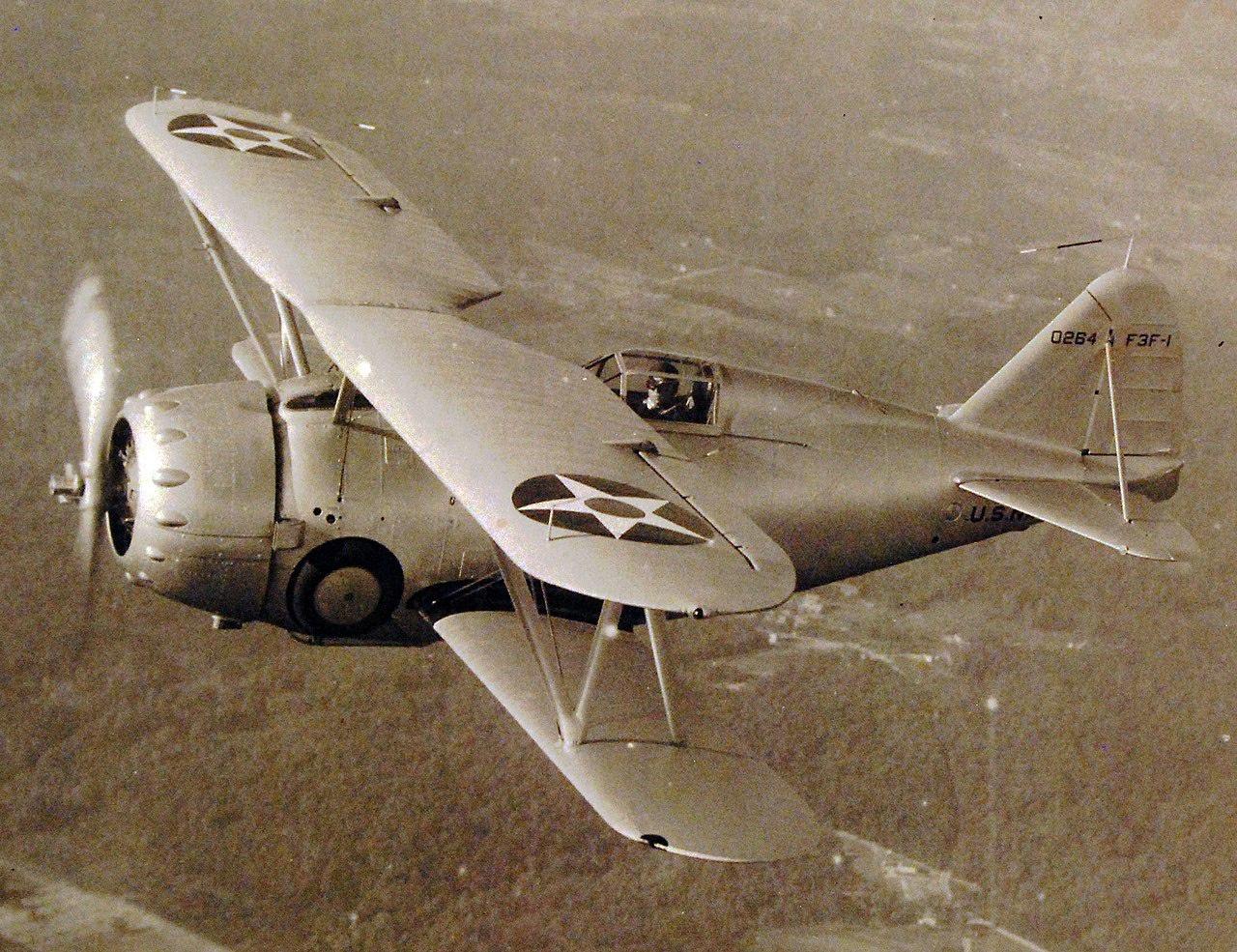
F3F-1, (Bu#0264), in flight, Photographed October 13, 1936. U.S. Navy Photograph, now in the collections of the National Archives.
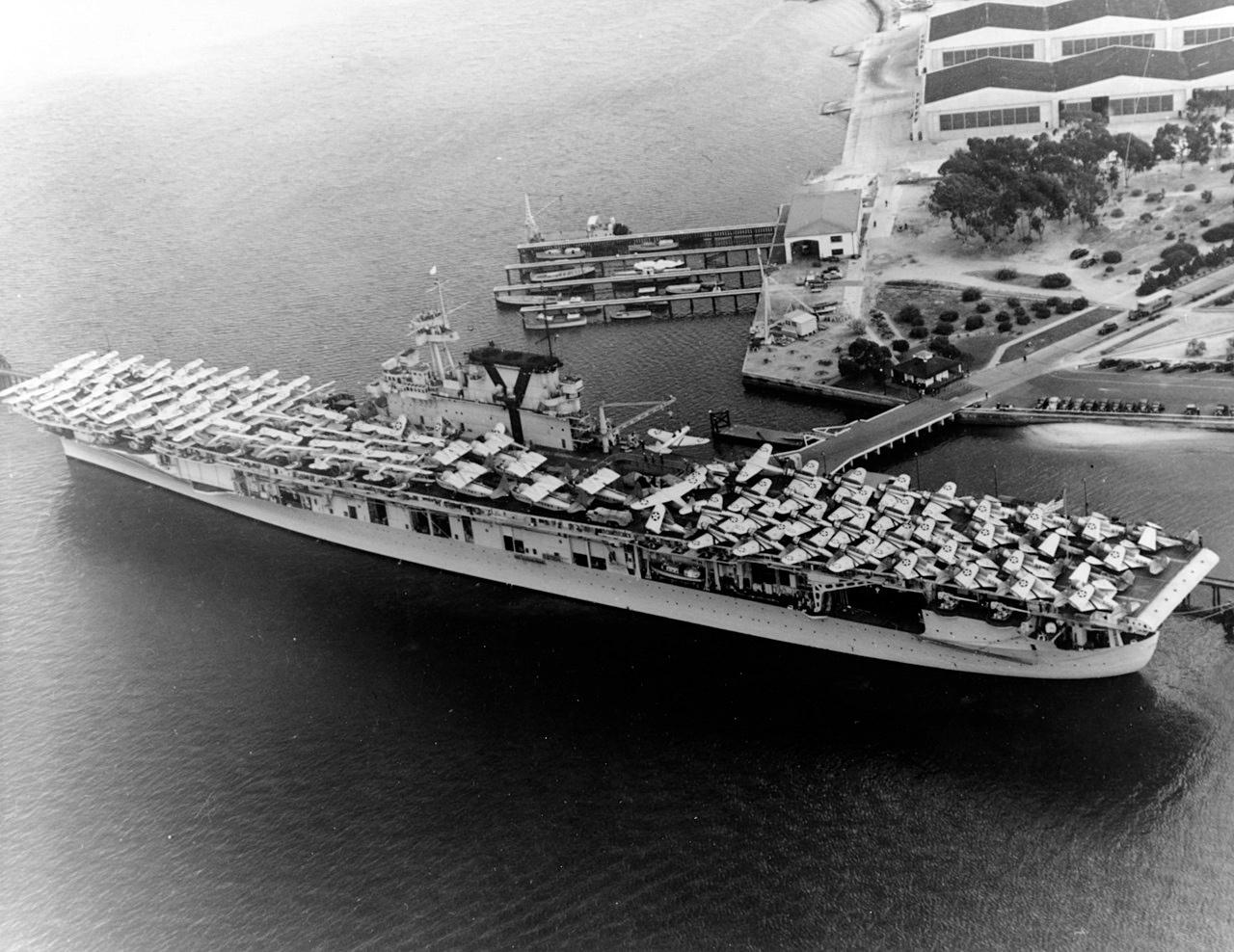
USS Yorktown (CV-5). At Naval Air Station, North Island, San Diego, California, in June 1940, embarking aircraft and vehicles prior to sailing for Hawaii. Aircraft types on her flight deck include TBD-1, BT-1, SBC-3, F3F-2, F3F-3, SB2U, JRF, J2F and JRS-1. Some of these planes were on board for transportation, while others were members of the ship's air group. Three Torpedo Squadron Five (VT-5) TBDs at the after end of the flight deck are painted in experimental camouflage schemes tested during Fleet Problem XXI. Official U.S. Navy Photograph, now in the collections of the U.S. National Archives.

Aircraft at the U.S. Marine Corps Air Station Ewa, Territory of Hawaii, circa in early 1941. Visible are four Grumman F3F-2 of Marine Fighting Squadron 2 (VMF-2), 13 Douglas SBD-1 Dauntless of Marine Bombing Squdron 2 (VMB-2) and a utility plane (probably a Vought O3U/SU). VMF-2 and VMB-2 were re-designated VMF-211 and VMSB-232 on 1 July 1941. VMSB-232 lost nine SBDs during the Japanese Attack on Pearl Harbor.
Date early 1941

Three Grumman F3F-3 fighters used for flight training near the Naval Air Station Corpus Christi, Texas (USA), in 1942.

Grumman F3F Flying Barrel, Chino, California
Date 2007

A Grumman F3F-2 (BuNo 0967) at the Langley Aeronautical Laboratory wind tunnel at Hampton, Virginia (USA). The first of the production Grumman F3F-2s is seen here during moment of inertia (MOI) testing.
Date 8 November 1937

A former U.S. Marine Corps Grumman F3F-2 (BuNo 0976) after its salvage on 5 April 1990 at the U.S. Naval Aviation Depot North Island, California (USA). This F3F-2 was assigned to the U.S. Marine Corps at Quantico, Virginia (USA), on 21 December 1937. The aircraft served briefly with Aircraft Squadron One (later Marine fighter squadron VMF-1), but was assigned to VMF-2 at Naval Air Station (NAS) San Diego, California (USA), on 17 January 1938. On 29 August 1940 the plane was piloted by 1st Lt. Bob Galer (later a brigadier general) for carrier qualification aboard the aircraft carrier USS Saratoga (CV-3) off the coast of California. On approach for one landing Galer switched fuel tanks, causing the engine to quit and leaving Galer with no choice but to ditch the aircraft. It sank to a depth of 600 m and was discovered in 1989. It could be salvaged by the USNS Narragansett (T-ATF 167) on 5 April 1990 and was restored at the San Diego Aerospace Museum for three years and is today on display at the National Museum of Naval Aviation at Pensacola, Florida (USA).
Date April 1990

F3F-2 fighters at the Grumman factory, Feb. 1938

A U.S. Navy Landing Signal Officer guides a Grumman F3F training plane to the runway at Naval Air Station Corpus Christi, Texas (USA).
Date 1941
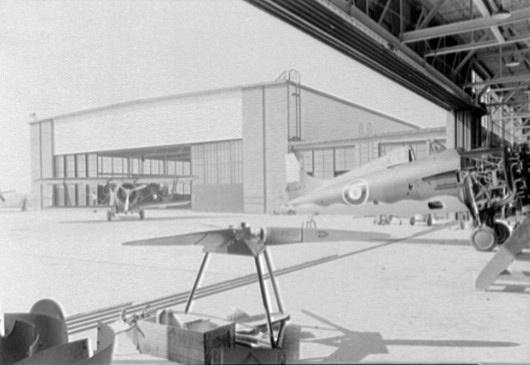
The Grumman Aircraft Engineering Corporation at Bethpage, Long Island (USA), on 12 October 1940. The aircraft visible in the foreground is most probably a G-36A. This was the export version of the F4F Wildcat for France. After the defeat of France in June 1940, all contracts were taken over by Britain. The planes were reequipped with British/US equipment and gun by Blackburn and renamed Martlet Mk.I. An F3F is visible to the left.
Date 12 October 1940

A U.S. Navy Douglas TBD-1 Devastator (BuNo 0322) of Torpedo Squadron 6 (VT-6) joins and Grumman F3F-2 of Fighting Squadron 6 (VF-6) and an Ccurtiss SBC-3 Helldiver (BuNo 0545) of Scouting Squadron 6 (VS-6) in a flight over the Virginia countryside. All squadrons were part of the Enterprise Air Group.
The TBD-1 0322 was lost when it stalled on take-off from the aircraft carrier USS Enterprise (CV-6) on 10 March 1939. The crew was not injured.
Date circa 1938

WWII-US Aircraft. “Over the Nest”. Grumman F3F-2 fighters over aircraft carrier. Artwork by Charles H. Hubbell. Courtesy of the Library of Congress.
ScarecrowSticks
Chonky
Lovethesmelloftoastedsourdoughbread
Girth vs length
UnitConversionBot
2,438 m ≈ 7 feet, 12 inches
UnitConversionBot
14 g ≈ .0022 stone or .494 ounces
UnitConversionBot
8,000 ft ≈ 2.4 kilometres
the3th
Grumman?!? I hardly know him!