
DdCno1

2402

8

1
In the Realm of Shadows

Translation:
Under Nicolae Ceaușescu, Romania has become Europe's worst dictatorship
Left page:
For almost 25 years now, using a bizarre cult of personality, Nicolae Ceaușescu has reigned over the Socialist Republic of Romania. In his honor, palaces are built, whole districts are razed for grand avenues, hymns are composed and official holidays are being created. The people are enduring and remain silent, contained by the omnipotent secret service "Securitate". Now the "Great Leader" wants to wipe intact Romanian villages from the map and relocate their inhabitants. While Romania's foreign debt has been reduced to almost zero by employing a ruthless austerity program, people are starving in the formerly blooming agrarian nation
Underneath the image:
His subjects are required to constantly praise their head of state. Journalists of the Hungarian weekly "Reform" have collected Ceausescus most outlandish titles:
- Our new *evening star*
- *Mountain,* who is guarding the land
- *Savior* of the war-torn Earth
- Symbol of *peace*
- Our warm *spring*
- *Warrantor* of Romania's bloom
- *Heart* of the people
- Sweet *kiss* of native soil
- Our eternal *pride*
- Enlightened *stragegist* of joy
- Chosen *titan* among titans
- *Universal genius*
- Glorious *father* of the homeland
- Treasury of *wisdom*
- Our path into the *future*

Image caption:
In the village Scornicești movable walls are praising the glory of its greatest son - and that of his wife Elena, the "Comrade Member of the Academy Doctor Engineer". In the whole nation, villages are been "systemized", and in most cases this means: torn down. Small places in the Carpathians, which do not fit into the scheme of Romanian "efficiency" aren't even worth the use of bulldozers - they are simply decaying. Soon there will be peace here. Graveyard peace
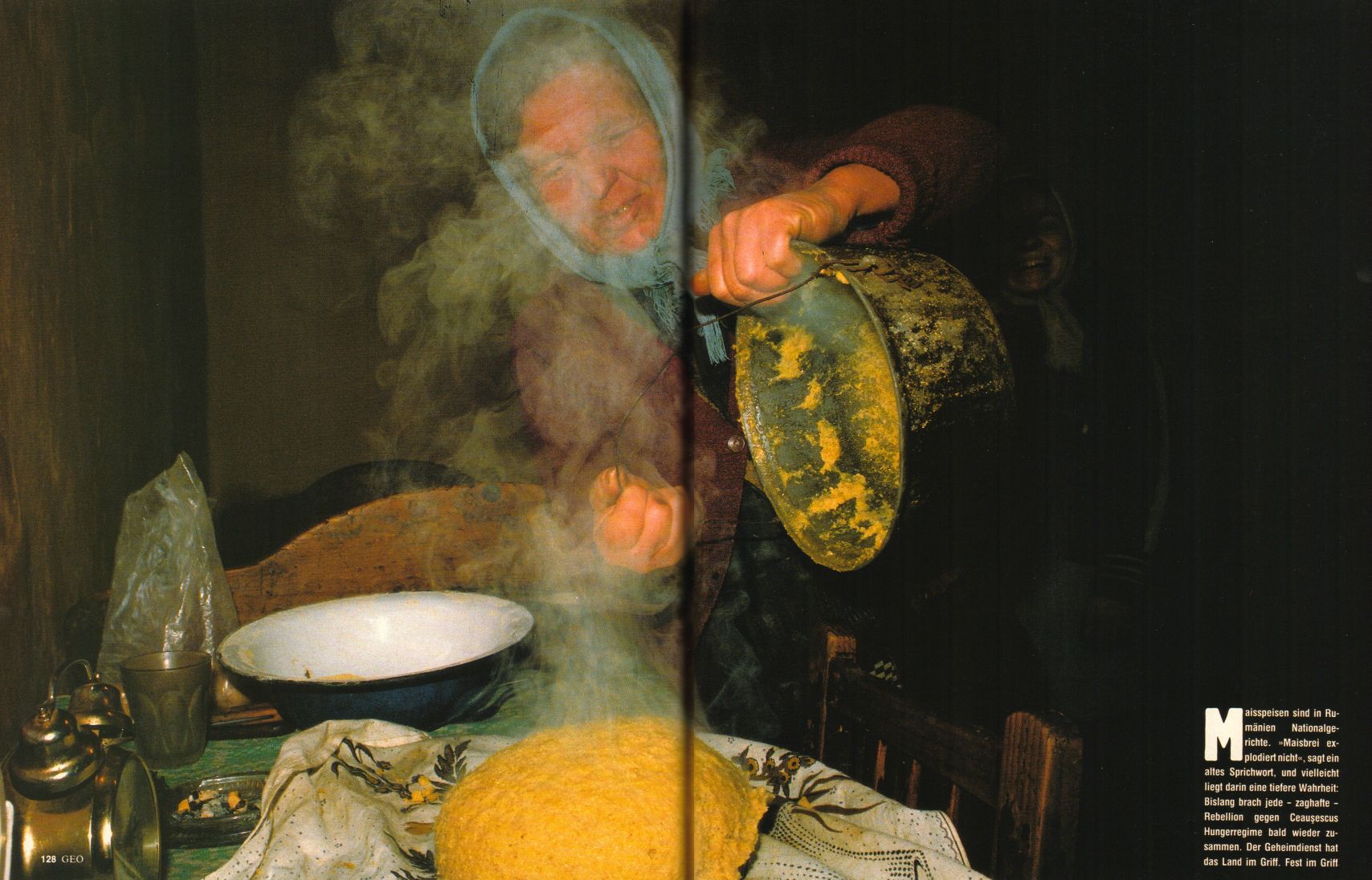
Corn meals are a national dish in Romania. According to a proverb, "Mush doesn't explode", and maybe there is a deeper truth in this: For now every - tentative - rebellion against Ceaușescu's hunger regime has collapsed fast. The secret service has the country under control. Firmly under control

The dust of the cement factory near Hoghigz covers the roofs of the adjacent houses. There are no filters here, and "ecology" is still a foreign word. The workers are getting ill fast and then, long before their time, lay in bed like old men and wait. For death

Workers of a construction brigade have set camp at the roadside after patching damaged roads for hours. There are few machines that could lessen their burden and there are now special rations: For lunch, just dry bread is being roasted over an open flame. Ceaușescu has put his whole people on a diet. On a strict diet

In the past, Biertan (German name Birthälm) was a seat of a bishop and inhabited by "Saxons". Now though, most villagers have returned to the "Empire", that's what they are calling the Federal Republic of Germany. Once lovingly painted houses are decaying. Just a few more years and this place will be empty. Most just want to go away. Just away
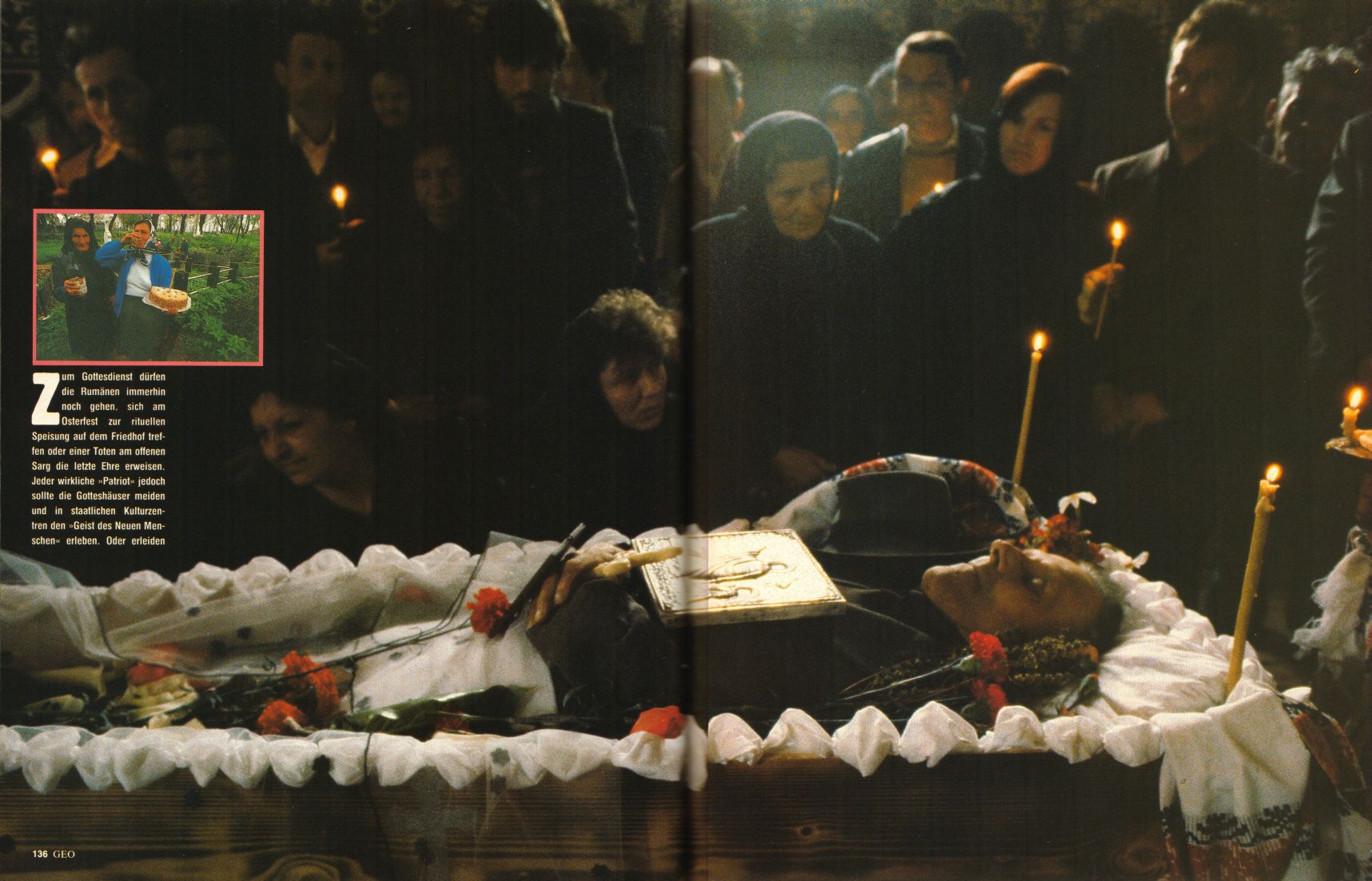
Romanians are still at least allowed to go to church, visit the graveyard for a ritual meal or pay their last respects to a dead man lying in an open coffin. Every real "patriot" though should avoid houses of worship and rather experience the "spirit of the new man" in government culture centers. Or suffer it

Translation of the article:
https://www.reddit.com/r/europe/comments/24v1an/as_requested_in_the_realm_of_shadows_romania_in/
Bold text on the left page:
A short conversation already raises suspicion with the militia
Image caption:
Taking part in festivities, many are trying to forget the daily misery. A marriage is one such event that is saved for for several years, so that the often more than 400 guests can be entertained - using everything that's strictly rationed. This old pensioner receives 300 grams of bread each day and half a liter of oil and a pound of wheat, corn and sugar each month. Her food ration card can only be use in one shop - when it's not supplied, there is no replacement. Many grow vegetables or have a pig
Note: A translation of the article can be found in the comments.

Bold text on the right page:
Architecture becomes a political weapon
Image caption:
Defiantly, as if it was the palace of a monarch, Ceaușescu's new seat of government rises over the roofs of Bucharest, almost big enough for the "revolutionary who even defies the Sun". His paralyzingly boring speeches have been collected in 30 volumes and are adorning almost every book store now, right next to the works of Shakespeare and Chekhov. Contemporary Romanian authors meanwhile are only printed if they have passed censorship. Only then
**Red box:**
GEO Data
The red monarch's civil war [wordplay suggesting a war against the citizen - translator's note]
Ceaușescu has a simple reason for the war he is waging against his people: He needs money, because during the almost 25 years of is reign - which he is already demanding to be celebrated as "Epoca de Aur", a "golden age" - he has mainly brought economical disasters without equal over Romania. The oil wells of Ploiești have turned out to be insufficient for the petrochemical combines built on top. Falling world market prices have rendered the steelworks totally unprofitable. And nobody needs the new Danube–Black Sea Canal, a prestige project costing two Billion dollars.
Having existed mainly as an agrarian nation without any noteworthy industry, Romania received, starting in 1948 and especially the '60s, industrial centers all over the nation, mostly over-sized mammoth projects. Until 1980, Romania had Western debts of almost 10.8 Billion dollars. Suddenly, the great "Conducator" decided to alter the course and starve the nation back to health. In 1990 the mountain of debt will be wiped away, he proclaimed and began the total bargain sale of the country. Because Romanian industrial products are not in demand internationally, the export of agrarian products and a brutal austerity program against the own people were the only option. In fact, it worked and foreign debt was reduced to zero by March 1989.
In the spring of 1988, using secret paths, a 22 page handwritten report by a small underground group calling themselves the "Romanian Democratic Action" got to Vienna. The document was signed by 13 pseudonyms and is about the country's ecological situation. Because there is no correct information on pollution, the authors were forced to resort to observation and hearsay. "A giant red cloud hangs above Târgoviște, day and night", they write and decry the contamination of the land caused by steel combines in Hunedoara, Reșița, Galați and Călărași. A long list of Romanian environmental crimes follows.
Lack of funds, both domestic and foreign protests are thwarting Ceaușescu's ambitious "village systemizing" project. One half of the villages is supposed to be razed and 550 "agro-industrial complexes" built. In this urban units, three Million people are supposed to live by the turn of the milenium. Manageable and ethnically mixed, farmers are going to inhabit small, flat blocks, while for workers and the Intelligentsia, for example teachers and engineers, apartments in houses containing three to four floors are intended. Every agrarian city is going to receive health care centers, kindergartens and cultural centers.
Ceaușescu's systemizing program pursues several goals: Despite all attempts at industrialization, 49% of Romanians are still living in villages and are losing labor time by commuting. Furthermore, Romania would gain additional 350'000 hectares of arable land thanks to systemizing - which, admittedly, is just 3% of Romania's total arable land.
The land use policy is not only supposed to tighten control over the population. Ceausescu also hopes to fulfill an old wish of his: The cultural expulsion of unloved minorities, such as the almost 200'000 Germans and more than 2 Million Hungarians in the northwestern part of the country.

Bold text:
Even the possession of a typewriter has to be registered
Red box:
"The world has changed, we have not"
An official interview is not possible, regretted the assistant, because then the question needed to be delivered beforehand and checked. The high-ranking Romanian government offical only allows an unofficial interview. "It's not my style to provide quotes", he ensures again as we are finally sinking into the fauteuils of his office's conference room. "And please, no audiotape."
He appears friendly, a man in his 50s, gray chaplet, bulge, laugh lines and bright eyes. In contrast, his assistant: Small, thin mustache, light skin and dark eyes that don't come to rest.
Around us a marble floor, fabric wallpaper, a wood-paneled ceiling, ethnic paintings on the walls. This government official's conference room is the exact opposite of the daily shabbiness, which we witnessed everywhere in Romania. How can a poor nation like Romania spend so much money on new buildings and "agro-industrial centers" and tear down old, solid buildings?
"Did you really see destroyed villages?" the official asks.
"Yes", we answer.
"I'm under the impression that you have only talked to people who are not authorized to talk to you. You should talk to our chief architect. People can pick their choice from 600 models of different new houses."
"I have only talked to people who do not want any new houses."
"Most likely, you have misunderstood many things. I know many who like it. Until recently, there was a list of people who wanted new houses."
The assistant is focussing a point on the fabric wallpaper behind me, as if he is being prompted from there. From time to time, he helps out his boss with helpful arguments in Romanian. The boss sips at the coffee, then he comes up with an analogy: "Nobody is prosecuting the mayor of Frankfurt, because he built a glass box in the city center and destroyed old neighborhoods."
My remark that the real reason for systemizing is perhaps the decimation of ethnic minorities rather amuses him: "What do you want? We are elevating the standard of living. The origin is unimportant. You are confusing ethological and economic problems."
And the constant shortages? The government official shrugs. Pure imagination, the nice gentleman explains to me fatherly: "The people's imagination is outrageous. They are telling stories. Just recently a Western European member of parliamant told me: 'People are claiming they have nothing to eat. But they look well fed. I would like a few of them as workers in my factory."
The assistant looks at the clock, then again at the point on the ceiling. I raise the question of political prisoners. The assistant has enough: "Are you talking about political prisoners in Argentina? We don't have those", he rumbles.
There are no mandatory gynecological examinations in order to prevent abortions? "You are portraying this erroneously", the boss says, "every factory has a medical service. Regular examinations are there for everyone, for men and women."
Are they voluntary?
"I don't know anyone who would refuse this unique service."
Democratization has captured larg parts of the Eastern block. Why, I ask, is there nothing like it in Romania?
"We are exactly as open as in the '70s", says the friendly elder gentleman, "we have the same leadership as then. We are still advancing the same view. The world has changed, we have not."
Bold text:
Act of state for a Potemkin cinema
Image caption:
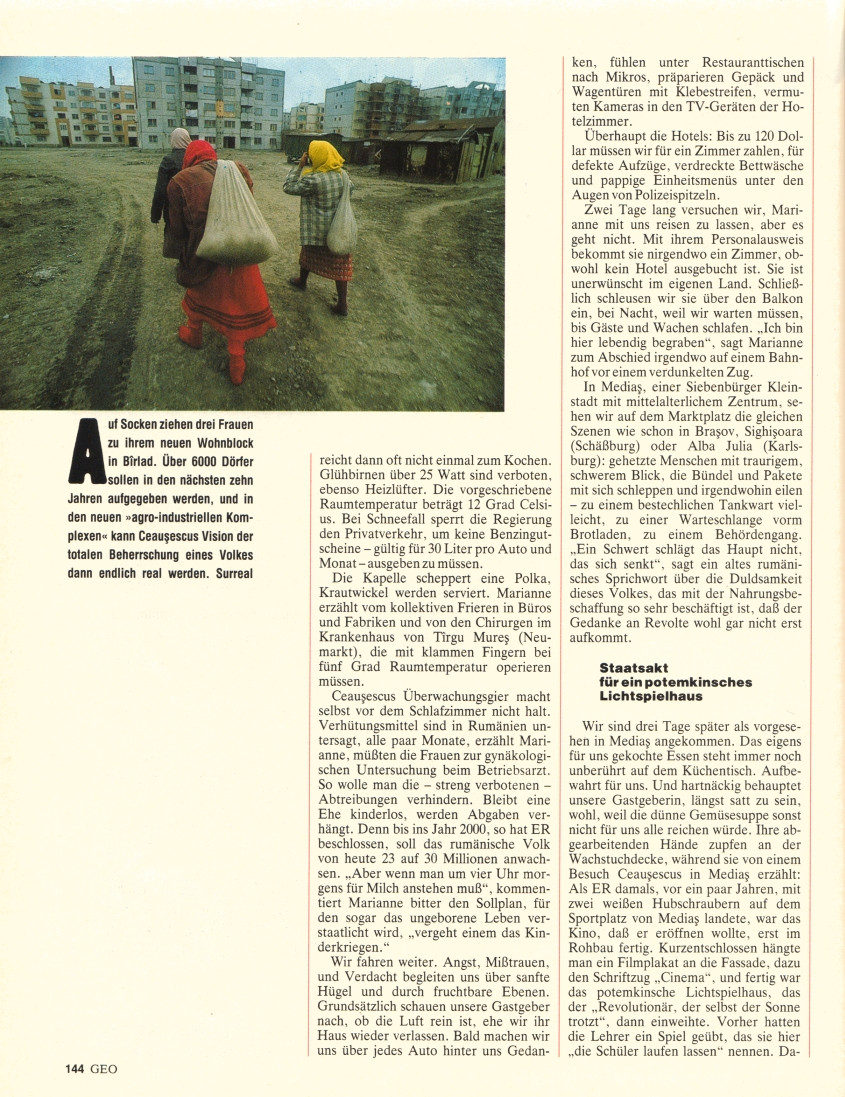
Wearing socks, three women are moving into their new housing block in Bârlad. More than 6000 villages are supposed to be given up over the next ten years and in the new "agro-industrial complexes", Ceaușescu can finally make his vision of total control over a people a reality. Surreality

Bold text:
Only the museum is gold in Ceaușescu's age
Bottom right corner:
Thomas Wartman, 36, could not travel as a reporter through Romania and had to disguise himself as a traveler in order to visit Ceaușescu's poor realm and to talk to his subjects. His partner Hans Madej, 35, member of the photo agency "Bilderberg", had never before faced similar difficulties: Photography was only covertly or camouflaged as a flaneur possible and his films needed to be smuggled over the border of Romania.