
theitinerantnaturalist

230657

5907

94
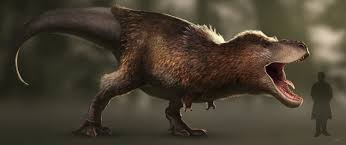
Credit to @Arvalis and Chris Masna for coming up with a lot of these images.
T. rex needs no introduction, as anyone above three years old would almost certainly have heard of it.
But the various pop culture depictions of the beast-and even some scientific hypothesis-are not representative of the actual animal.
This post intends to showcase what we actually know about the beast and what is plausible, and what is false. Thankfully, we have a lot of data from T. rex due to a large number of fossils, so this post is going to be huge.

To understand T. rex, it is important to understand the evolutionary history of its clan. Tyrannosaur (known as Tyrannosauroidea) evolution underwent a long, convoluted path that ended up coming up with T. rex.
Despite their large size, the derived tyrannosaurs that we instantly recognize as such are more closely related to animals such as Deinonychus or Oviraptor than to other large predatory dinosaurs. Tyrannosaurs are members of Coelurosauria, a very diverse group of theropods that includes modern birds. They have proportionately larger brains (this DOES NOT mean they were smarter than other theropods), and, at least ancestrally, tend to be lightly built.
The first tyrannosaurs are from the mid-Jurassic, but at this point in time, they were tiny, and hunted insects, small lizards and early mammals. The dominant large predators at this time were the carnosaurs-large predators with thin, slicing teeth for cutting through flesh and bone. This continued into the Late Jurassic, by which point tyrannosaurs were widespread over Laurasia (Eurasia and North America).
In the Early Cretaceous, tyrannosaurs first started venturing into the role of top predator, with forms like Yutyrannus and Eotyrannus. Overall, however, carnosaurs still held sway, and this is reflected by the fact these early large tyrannosaurs are superficially quite similar to carnosaurs: slim, long-armed, and equipped with slicing teeth and a weaker bite.
It was the Cenomanian-Turonian Boundary Event, an extinction event that divides the Cretaceous in two, that allowed tyrannosaurs to take over. With their former overlords, the carnosaurs, suddenly dead, tyrannosaurs could rise to fill the gap. Rather than becoming exact ecological equivalents to their predecessors, however, tyrannosaurs evolved towards a more specialized path.
While the earlier, carnosaur-like forms did not die out, the "main" lineage of tyrannosaurs (Tyrannosauridae) developed into the short-armed, long-legged, bone-crushing animals we are familiar with.

It's now that things get even more complicated.
One line of tyrannosaurs, the albertosaurines (represented by Albertosaurus and Gorgosaurus) broke off. These were swift, long-legged runners with a slender body plan. They retained the serrated teeth of the first tyrannosaurs, albeit with reduced cutting ability.
The other line, the tyrannosaurines, became more oriented towards brute force than mobility. While still decently fast runners, these animals were built much more powerfully, with shorter limbs and a major focus on crushing bites. They shared the North American landscape alongside the albertosaurines due to this difference in behaviour.
Eventually, some of the tyrannosaurines crossed over to Asia via Alaska, where they evolved into huge predators like Tarbosaurus and Zhuchengtyrannus, both far larger than any prior tyrannosaurs. This branch from the main tyrannosaur lineage became increasingly robustly built, with an ever more massive head.
T. rex was the very last of these Asian tyrannosaurs, and it migrated back into western North America, becoming the apex predator there.

As testament to how far tyrannosaurs have come, take a look at this contemporary of T. rex: Dryptosaurus. While T. rex ruled the western side of North America (Laradima), Dryptosaurus ruled the eastern side (Appalachia).
Being a long-lost offshoot of the tyrannosaur clan, it not only kept the ancestral look of tyrannosaurs, but evolved in the opposite direction from T. rex: Dryptosaurus had a light build, thin slicing teeth and frightening claws on massive fingers and arms.


The main formation T. rex is known from is the Hell Creek Formation, in Montana. It has been also found in nearby Lance formation, as well as farther north in Canada and south into Mexico.
All of the formations come from the very end of the Cretaceous, meaning T. rex indeed was finished off by the asteroid impact that triggered the K-T event.

During this time, Montana had a warm temperate climate, similar to South Carolina today. There would be distinct seasons, with summer being hot and humid, and winter being cool (occasionally snowy) and dry.
The local habitat included a mixture of old-growth forest, prairies and, most importantly, floodplains/swamps crossed by large rivers.

The largest T. rex specimens reached 40 feet long, not 50 as often claimed.
There are a few digit bones that seem to be larger, but digit sizes are variable within the same species, so these fossils cannot be used to determine the size of the whole animal.
Even so, T. rex seems to be one of the (maybe "the") heaviest of predatory dinosaurs: size estimates for the large adults run at around 7.5 to 8 tons at their most reliable.
There are some more liberal estimates that range up to 12 tons, but this would require a downright obese tyrannosaur.

T. rex (second from right) compared to three of its closest rivals for the title of "largest theropod": Spinosaurus, Giganotosaurus, and Carcharodontosaurus. T. rex, along with Spinosaurus, is the heaviest of the lot. However, the two other theropods, though smaller, kill much more dangerous prey than T. rex or Spinosaurus.
Seriously why isn't that guy running?

Despite the fact T. rex is shorter than many other predatory dinosaurs, it beats almost all of them (exceptions being Spinosaurus and maybe Mapusaurus, which tie it) in weight.
This is due to the fact it's heavily built for its size. As seen in this image, fully mature adults had stout torsos and barrel-shaped chests. T. rex is easily the most robust of the predatory dinosaurs.

As with many animals that humans never met, reconstructions of T. rex were wildly inaccurate at first.
The original reconstruction by Barnum Brown was inaccurate even for its time, because its arms were too large and had too many digits. Later, the actual arms were recognized, and T. rex was depicted as a bipedal, tail-dragging reptile with tiny arms.
With the advent of the Dinosaur Renaissance, which saw dinosaurs become recognized as warm-blooded, active animals that still exist today as birds, T. rex became a much more dynamic animal. This is the version that appears in Jurassic Park.
Unfortunately, a common tendency that comes from this period is "shrinkwrapping", or the act of depicting a dinosaur or any animal as a walking skeleton within a skin, with only the minimum amount of muscles and other soft tissue. This issue is now being addressed in the most up-to date depictions, which give T. rex a realistic amount of muscles as well as lips that cover the teeth when the mouth is closed.
And the fact it most likely had feathers is now increasingly becoming accepted.

Yes. Feathers.
T. rex's ancestors, and some of its earlier relatives (including a large predator known as Yutyrannus) definitely had feathers. So did the ancestral coelurosaur.
In fact, feathers are the ancestral condition for dinosaurs as a whole: homologous structures have been found from both sides of the dinosaur family tree, and it is becoming increasingly likely that the pycnofibers found in pterosaurs are homologous to feathers as well. It is even possible that the genes that code for feathers go back as far as the common ancestor of birds and alligators.
It seems that the question is not "who evolved feathers", but "who lost feathers". And since evolution does not get rid of traits that present no major issue for reproductive success, there is no reason to presume T. rex lost feathers in the absence of an extensive and well-preserved skin impression.
There are partial scale impressions from T. rex, but these come from parts of the body had scales in even otherwise feathered dinosaurs (tail, vent, belly), and cannot be used as an evidence against plumage. It is even possible that some of the areas that did have scales also had feathers: this wouldn't the the first time a dinosaur had feathers and scales on the same patch of skin, as a dinosaur named Juravenator had both feathers and scales on its rump and tail, and both feathers and scales completely covered the same appendage. So even the areas where scales are known to have existed might have been covered over by plumage in life.
A major argument presented against feathered tyrannosaurs is that big animals have a smaller relative surface area than small animals, so they overheat faster in warm climates and must lose insulation. This has happened with large mammals, they argue, so why not dinosaurs?
This idea falls apart when you actually examine physiological differences between dinosaurs and mammals.
- feathers not only trap heat near the animal as fur does, they also block external sources of heat, something fur cannot do. Think of a layer of feathers as a thermos: the contents don't lose heat, but they don't gain heat either. Therefore, feathers not only do not cause overheating issues (as long as you have a way to remove internal heat), they actually reduce overheating in hot climates: this has been demonstrated in a study involving emus and kangaroos.
- dinosaurs have a far larger surface area in comparison to mammals of similar mass, so have a much higher size limit before overheating becomes a major issue.
- warm-blooded carnivores generate far less body heat than warm-blooded herbivores, as meat doesn't need to be fermented for digestion and therefore doesn't produce intestinal heat.
- dinosaurs do not have the insulating brown fat that is found in mammals.
- the extensive network of air sacs and one-directional airflow found in the lungs of all archosaurs cools the body effectively (as well as extracting double the amount of oxygen than in mammalian lungs), meaning that they don't need to be fully or mostly naked to shed heat.
Therefore, there is no physiological reason for T. rex, or any theropod (except for one so huge it would be unable to live anyways), to lose feathers. On the other hand, feathers serve a variety of functions (keeping the animal warm or cool, camouflage, protection from UV rays, etc) that make it redundant to lose feathers then re-evolve scales for these same functions.
See http://www.eartharchives.org/articles/is-the-tyrannosaur-feather-debate-really-over/ For more discussion.
But just because a T. rex depiction has feathers doesn't mean it's scientifically accurate.

While this reconstruction is feathered properly, it's still quite inaccurate. It's way too colourful for an animal that, as a hunter, needs to maintain stealth.
Some may use the fact dinosaurs likely had colour vision to argue for bright colours in theropods, since colour can be used for communication if you have colour vision. But for large predators, the prevalence of colour vision in dinosaurs would actually mean that they had to be more, not less, camouflaged (since the prey also had colour vision).
These reconstructions do nothing but cause people to believe feathered dinosaurs would have to be colourful and garish, leading them to dislike accurate feathered dinosaurs.

This is a scientifically accurate reconstruction: it's the best we can do with current data.

Contrary to popular belief, T. rex wasn't unique among non-avian dinosaurs in having binocular vision. It did, however, have the largest overlapping field of view, so while it wasn't unique at having binocular vision, it had a larger area of binocular vision.
Note that the eyes face straight ahead, rather than diagonally forward as in many other theropods.

T. rex teeth aren't knife-like blades, but stout spikes. Not only are the teeth not thin and blade-like, much of their notorious serrations actually doesn't exist.
The leading edge has no serrations. The trailing side still has a row of serrations, but these have been reduced in size, and offset to the side rather than forming a sharp trailing edge.
As a result, there is no cutting edge seen in the dentition of earlier tyrannosaurs or other predatory dinosaurs. T. rex ripped and crushed, not sliced and diced, when it bit.

Over half of the tooth is root, necessary when the tooth is subjected to crushing forces during a bite. A tooth with shorter roots could break or fall out during such a bite.

T. rex easily has the highest bite force of any predatory dinosaur (not that this was always a good thing: see below). While most predatory dinosaurs could dismember bone, T. rex could simply crush through it, rather than sawing it in two.
In fact, only a handful of animals can rival or exceed it in terms of brute jaw power, namely the giant shark Carcharocles megalodon and likely the predatory whale Livyatan. Both of these are over six times the mass of T. rex. Some giant crocodylomorphs like Purussaurus also come close to T. rex in jaw power.

Something missing in most T. rex reconstructions, that should really be more prevalent, are these bulging jaw muscles.
Biting power in vertebrates comes from either the temporalis, on the top of the head, and from the adductor muscles, located around the jaw joints.
While the bites of most mammalian hunters are mainly powered by the temporalis, those of reptiles and birds usually involve the adductor. These are the areas that, in crocodilians, bulge outwards from the jaw joint and neck.
T. rex, a member of Archosauria, likely also relied on these muscles for biting power.
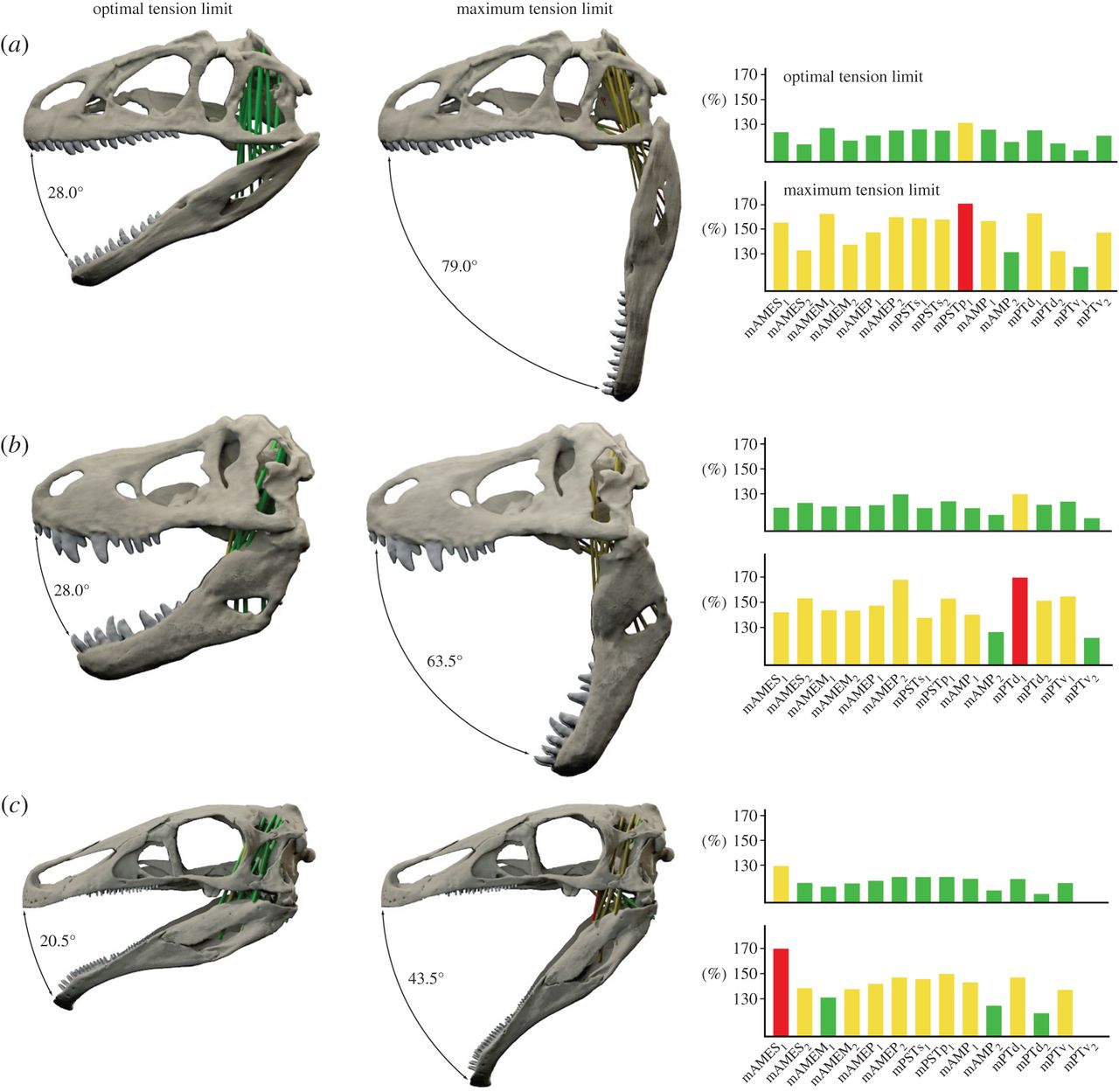
That jaw power came at a price, however: those jaw muscles reduced the gape.
Compared to Allosaurus (top) or most other predatory dinosaurs, T. rex could only open its jaws to a smaller degree (around 60 degrees). By comparison, Allosaurus had a 80 degree gape.
This in turn affected prey size, since T. rex relied on biting to kill prey and the prey had to be small enough that parts of its anatomy can fit inside its mouth. Sauropods, therefore, have to go off the menu of T. rex, with the exception of smaller juveniles. Even if T. rex could get its jaws around a leg or other appendage of a large sauropod, its jaws would be near or at its maximum gape, making it impossible to use the full force of its bite and score a blow.
This is in contrast to the carnosaurs, which could also eat larger juveniles and even small adults simply because they had bigger mouths. Those dinosaurs, at any rate, were relying on finesse rather than outright force to kill or process bone. So not being able to bite hard didn't matter for them.

The largest, most famous and most complete T. rex specimen of all is Sue (FMNH PR2081), housed in the Field Museum in Chicago.
The brickhouse profile, characteristic of a fully grown T. rex, reaches its peak with Sue; she's bulky even for a T. rex.

Besides Sue, many complete T. rex specimens have been found and given names. This is Stan (BHI 3033), a smaller adult.

There is Trix (no code name yet), who is nearly Sue's size, and the longest-lived T. rex specimen yet discovered (beating Sue's record of 28 years).

B-Rex (MOR 1125) is notable due to the fact when some of the bones were purposely broken (for transport), they revealed a wealth of data. More on this later.

Samson is notable for having the best-preserved skull of any T. rex.

And this is Jane (BMRP 2002.4.1), an adolescent.
Jane is very important to palaeontology, because she helped resolve one of the most controversial debates regarding T. rex.

For years, a tyrannosaur known as Nanotyrannus was believed to have ruled alongside T. rex. This predator was smaller, but more importantly, it was lightly built compared to the battleship bulk of a T. rex, and had slicing teeth. The consensus was that it was an albertosaurine.
But as studies on tyrannosaurs increased, scientists began to notice that young tyrannosaurs of various species didn't look much like their parents, but recalled the earlier lineages, being lankier and having double-serrated teeth. As they grew up, the legs became proportionately shorter and the teeth changed from blades to spikes.
So the question arose: was Nanotyrannus a real dinosaur, or simply the young of T. rex? All that was needed to resolve the dilemma was a T. rex specimen that looked like a large Nanotyrannus.
Jane was that specimen, and allowed scientists to assemble the entire life cycle of T. rex.
As it turned out, "Nanotyrannus" was indeed the juvenile form of T. rex, with Jane being a juvenile on the verge of becoming a massive adult like Sue or Stan. This means the juveniles and adults either hunted different prey, and/or had different roles while hunting together.

T. rex, as well as all other tyrannosaurs (and troodontids, oviraptorsaurs and ornithomimids) had something called the arctometatarsalian pes.
In this condition, the metatarsals (bones between the toes and the ankle) are pinched together as seen here, and are further supported by stout tendons that wrap around all the toes, binding them alongside one another. In short, all three of the metatarsals became one solid unit.
While this adaptation initially gave tyrannosaurs stress-absorbing feet and so enabled higher running speeds, it came with a problem.

The price of having metatarsals that are tightly bound together is that the ankle structure becomes much less flexible. This is good when running in a straight line, but not so good when you need to turn, jump, or climb.
In small animals, however, the arctometatarsi still allowed for a measure of increased agility, as it absorbed then released torsion during turns and allowed an animal to pivot on its feet. Since tyrannosaurs were mostly small until the last 15 million or so years of their existence, the arctometatarsi was a reasonable adaptation.
But as the animals got larger, the cost of having inflexible feet began to outweigh this benefit, and the arctometatarsi now cost, rather than increase, manoeuvrability.
To add to this, all other adaptations for specialized running had been lost in mature T. rex during the growth into adulthood. As a result, adult T. rex received little benefit from this trait, except perhaps added stability when running. Perhaps it's a vestigial trait inherited from its fleet-footed ancestors, maintained only because it helped the juveniles to survive and grow.

The "was T. rex a predator or scavenger" debate is probably the best-known, and stupidest, paleontological disagreement of all time. It was started by palaeontologist Jack Horner, who claimed T. rex was a scavenger and popularized the idea, before being proven wrong by other palaeontologists. In recent years, Horner has begun to claim that he came up with the idea just to get people arguing, though this only seems like an excuse.
The ideas behind T. rex being a scavenger was :
- it had a keen sense of smell
- it was slow
- it had crushing jaws, which are useful when eating bones from dead animals. (Ironically, people have argued that it's the carnivores with weak bites that rely on scavenging, which is also false)
There are a number of reasons why the whole scavenger hypothesis was flawed from the start:
- most animals that hunt prey have a keen sense of smell, so that cannot be seen as a scavenging adaptation. In addition, keen vision is common in predators, and T. rex actually had it.
- T. rex wasn't that slow. It wasn't the fastest runner around, but it was faster than most of the local herbivores. And many predators have few issues attacking prey faster or more agile than themselves.
- Carnivores with unusually strong (or unusually weak) bites don't tend to be scavengers. They tend to focus on hunting. In addition, eating bone was a common activity in predatory dinosaurs, regardless of their bite forces.
However, the greatest argument against T. rex relying on scavenging is ecology.
No large, terrestrial carnivore today actually relies on scavenging as a regular source of food. Spotted hyenas-often used as tyrannosaur analogues due to high bite forces-prey mostly on their own kills.
In fact, it is metabolically impossible for any flightless vertebrate (and most flying vertebrates) to rely on scavenging. For a good reason. While dead animals are easy meals, they are few and far between, and highly sought after. Any animal looking to rely on such a food source must travel long distances while using hardly any energy. This necessitates that the animal spend most of its waking hours soaring effortlessly over land, something only vultures have managed today.
T. rex was obviously incapable of soaring on thermals, so it had to travel by foot. And that meant that most of the time, it would be unable to actually reach a carcass before starvation claimed it. Therefore, like every other large carnivore incapable of flight, it had to kill for a living.
It would certainly eat dead animals if it found one, but it wouldn't expect to come across carrion while patrolling.

And finally, we have direct evidence of T. rex attack on live prey.
This tail vertebra from a hadrosaur shows indications of it having escaped a T. rex attack. The pencil points at a T. rex tooth that was broken off, and the bone has healed around it.

Diagram of the above fossil

This specimen shows (in the circled area) that a T. rex had bitten off part of the vertebrae, with the wound having recovered.
The tendency to bite the base of the tail is quite reasonable when you realize that in dinosaurs, the muscles that power the thighs-the caudofemoralis-are attached to the pelvis and tail vertebrae. By biting this muscle, a predator could cripple the prey effectively.
But how did T. rex get close enough to bite the caudofemoralis?

"Running" down prey is one possibility. T. rex had an estimated top speed of around 18 to 25 miles per hour as an adult, which is faster than most if not all humans, and certainly fast enough to overtake prey.
However, as mentioned above, the combination of immense bulk, small inner ears and inflexible ankles meant that it wasn't capable of making tight turns during a chase. If a hadrosaur swerved out of the way, T. rex would have to slow down or double back over a long distance.
It must have had another advantage over prey if it was to win, and that could have been endurance. While the arctometatarsus was useless for improving maneuverability, it was useful in stability during long-term running. And as theropods in general had the same lungs as living birds, they had plenty of oxygen for a marathon run.
Running down prey would have been especially helpful for the leggy juveniles.

Above: The nocturnal terror of Hell Creek. A fully grown T. rex silently closes in on a herd of Edmontosaurus. Credit to Robin Liesens.
Stealth-hunting, especially at night, has also been suggested for T. rex. The large adults almost certainly benefitted from this, since they relied heavily on strength rather than mobility. While the juveniles were using flat-out speed and targeting smaller prey, the big adults were using stealth, speed and endurance to target ceratopsians and hadrosaurs.
Animals similar to T. rex in size can be surprisingly stealthy: even elephants can walk silently through thick vegetation, and elephants are far less stealthy than large predators. A large adult T. rex, old and experienced, would have been able to sneak up on prey silently, making full use of every bit of cover to hide its approach, before launching an attack from right next to its intended victim.
The advantage of a sneak attack would be maximized at night, when the hunter has keen senses and a cloak of darkness on its side. As a rule, predatory or omnivorous animals have far better night vision than herbivores; therefore this type of nocturnal assassination could have been typical not only for T. rex, but predators in general throughout time.

Large hadrosaurs, especially Edmontosaurus annectens, were probably the most common prey items, as the above bite marks indicate.
While hadrosaurs seem to be the most defenceless of the large Mesozoic herbivores (since they aren't huge like sauropods, not that quick and lack defensive weapons), even they could fight back or escape.
The very largest hadrosaurs that lived with T. rex actually outweighed it by a few tons, so while small compared to the towering Alamosaurus (the only sauropod T. rex ever saw), they were still quite large. At this size, they could use blunt impact to defend themselves.
T. rex was faster than Edmontosaurus, but speed isn't the only asset during a chase. Hadrosaurs were nimble, especially considered to the freight train of a theropod that was Tyrannosaurus. Nevertheless, there are enough incidences of T. rex-on-Edmontosaurus violence that we can say with certainty that hadrosaurs went on the menu.

Another animal definitely eaten by T. rex was Triceratops. It was likely even more challenging than Edmontosaurus, since it had superior weaponry.
Nevertheless, there are plenty of reasons to suggest that the two did engage each other: there is a Triceratops specimen with healed wounds on the horn from a tyrannosaur bite, and as both dinosaurs were among the most common in the area, they would have definitely met each other.

For the lanky juveniles formerly known as "Nanotyrannus", swift prey like these Ornithomimus were a likely staple.
The adults would have to rely on endurance or stealth to catch prey this fast, but young T. rex were capable of matching the quarry's speed and running it down.

A study has shown that T. rex likely decapitated Triceratops in order to eat parts of the body covered by the ceratopsian's frill (see above diagram).
This is part of the reason for Triceratops fossils often being just their skulls-T. rex ate the rest of the body.

T. rex was a cannibal: this toe bone shows the signs of having been gouged by another T. rex during feeding.
Considering that toe bones have almost no meat in them, this rex must have been desperate.

With Nanotyrannus out of the picture, the only competition left for T. rex is the recently described Dakotaraptor (which really needs its own profile). In many ways, it resembles a dromaeosaur trying to run like a young tyrannosaur, but with major differences.
A giant, long-legged dromaeosaur (aka raptor) the weight of a large male grizzly, Dakotaraptor is the exact opposite of T. rex in many ways. While T. rex was a common animal, Dakotaraptor was rarer, and relied heavily on finesse to wound its prey.
Dromaeosaurs lack arctometatarsalian pes, and tend to have average-sized legs for theropods. This indicates a greater reliance on agility and overall mobility than raw speed. But Dakotaraptor had longer legs for higher speeds. At the same time, however, the adaptations for agility-flexible joints and metatarsals-were still present, meaning this animal was almost as fast as a young T. rex and much more agile.
While small compared to adult Tyrannosaurus, Dakotaraptor may well have been the nemesis of adolescent tyrannosaurs.
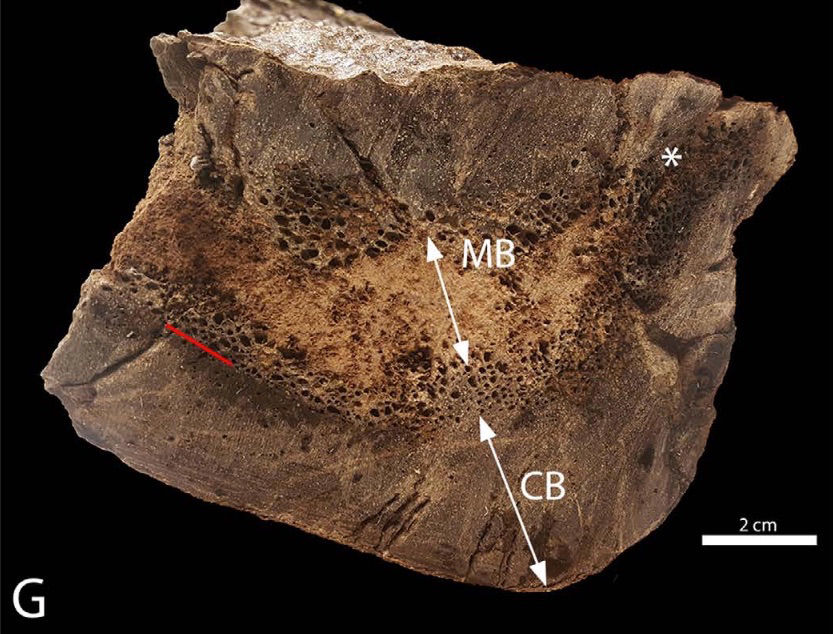
We have one specimen of T. rex that we know the gender for sure: it's B-Rex, and it was a she.
The reason we know she was a she is the layer of bone labeled "MB". That is the medullary bone.
In archosaurs, including birds, the medullary bone provides the calcium needed for the eggshell. Only females about to lay eggs ever develop this type of bone tissue.

It has been suggested by some that, like some modern predators, T. rex males bit the females while having sex.

There are only a few T. rex egg fossils. While no fossil nests was ever found, we can safely presume that the eggs would be arranged in a rough circle, with at least one parent in the centre or off to the side to guard the eggs.
Since brooding the eggs is impractical for a 8 ton animal, it's more likely that the eggs were covered with some form of insulation.
"Rexlings" were capable of hunting on their own from birth, but they probably did rely on their parents for protection.

As mentioned above, T. rex changed its dimensions dramatically as it grew. They started as tiny fuzzballs, became hunters of small prey as juveniles, then transformed into lightening-quick, long-legged "Nanotyrannus" in adolescence before finally becoming the massive adults. It is now thought such transformations were common in large predatory dinosaurs.
But why would such a trait evolve? At first glance it appears that this is simply the effect of ontogeny, when young animals resemble ancestral species. It is now thought, however, that in this case ontogeny had a benefit. Each life stage has different ecological roles, allowing a much larger number of individuals to exist at any one time via spreading out their use of resources.

If crocodilians are any indication, this transformation brought a second benefit. While crocs are normally lone hunters, they occasionally join forces and form well-organized hunting packs. And what makes croc packs far more organized than even orca pods is how the division of labour is done. In many cases, the smaller, younger animals act to set the trap, while the larger adults provide firepower.
Maybe tyrannosaurs (and other types of predatory theropods) did the same, sending their young ahead to chase, harass and distract the prey while they moved in for the kill. There is no evidence T. rex hunted in packs, but a very recent set of tracks from an earlier tyrannosaur shows three animals turning in unison, likely to pursue a ceratopsian charging away from them at full speed (and leaving its own tracks).
In the above image, Jane distracts and harries a dying Triceratops as Bucky (a subadult specimen), Sue and another specimen known as Devil's Rex use their might to restrain and kill it.

The growth curve of T. rex was similar to our own, with a massive growth spurt in the teenage years.
Tyrannosauri didn't live very long: Trix, the oldest specimen, died in her early thirties. The maximum life expectancy is 40 years. And 99% of all T. rex eggs ever laid never made it that far, succumbing to predators, starvation, or disease.

Many have expressed disappointment or even hatred as T. rex became more and more accurate. This view is anti-intellectual, immature, and IMHO, should be stopped.
T. rex doesn't need to match your expectations. Why? Because it's T. rex, and not a superhero or a god. It's an organism, with realistic limits.
T. rex doesn't need to be the largest predatory dinosaur (though it seems it could be). It just needs to be big enough to survive.
T. rex doesn't need to kill prey much larger than itself. Prey its own size would be enough to sustain it.
T. rex (the adults) doesn't need to run at incredibly speeds. It's true velocity of 20-25 miles per hour, combined with its endurance, is fast enough to catch up to most land animals living or extinct.
T. rex cannot defy the law of physics and have both slicing teeth and a crushing bite force. It's one or the other.
And "we want a new tyrannosaur" is not a reason to make Nanotyrannus its own species rather than a juvenile T. rex.
The new T. rex indeed lacks many of what we thought was "cool" about it, but this is more than made up for with new discoveries: more muscles (befitting a 8-ton animal), an even stronger bite than we expected, cannibalistic tendencies, and a penchant for decapitation.
Animals do not need to be monsters of fantasy to sprite our imagination. The reality is just as, if not more, spectacular than the imaginations of children.

Besides, if you saw this while time-travelling, wouldn't you need your brown pants anyways?
RobertZimmermanWasRight
Tl;dr
Claydawg003
The thought of T.rex being a night/stealth hunter is terrifying
BigBallsRandy
Why am I reading this when I am supposed to work.
Sureletsgowiththat
Too bad the History Channel's gone to shit. OP could probably make a decent documentary with this knowledge.
BenedictCumberbatchsFace
Think about that for a second. Those animals lived on earth at one point....
Loy71
Didn't read a word but looked sciencish and like a hellotawork when scrolling through the pictures. Upvote.
greeneyesandshirt
Should've been doing work, instead I learned about the T.Rex. better use of my time
Captaincuttlefish
This was fantastic I loved it also knowing T-Rex decapitated it's prey just makes it more badass
skinsock
Apart from dumps this is the largest post I've ever seen
BiIICosby
Fukyu2dei
Fukyu2dei
BillHaleyandHisBANNEDComments2
I saw laod 39 more images and screamed in joy... this is fantastic shit
KitValentina
This was an amazing educational post. Congrats! I learned a bit more than I already did :D
Ralfanans
The last picture... just imagine seeing that in the middle of the woods..
YummyPusher
It's ok, he gave us the answer. ZIG ZAG LIKE A MOTHER FUCKER!!!
Sauroctonus
And don't expose your tail!
Sauroctonus
And don't expose your tail!
NotGoneYet
'Short-armed, long-legged, bone-crushing' hens. But with teeth. And bigger.
theincredibledork
If you guys think some of the art in this post is cool, it comes from a game in development called Saurian, where you play as a T-Rex. Link:
theincredibledork
http://saurian.maxmediacorp.com/
flexxen
Thanks Professor Geller.
ConnorsDadimprettysure
TIL that I don't want to be bitten by an orangutan.
InternationalPhoneticAlphabet
protip: every single great ape, even if it's young enough to be the same weight as a fit human (i.e. a boxer) will punch your lights out >
Sauroctonus
Apes are fucking scary.
theitinerantnaturalist
They also use weapons, go to war, torture other apes, and can even hunt prey to extinction (at least, chimps are close to that)
InternationalPhoneticAlphabet
> with incredible force. if you ever need to fight apes, stay in the distance (if you can ...) and throw rocks.
midrampage
Thanks for turning in your homework on time.
ArthurTaft
#15 picture reminds me of a penguin, and I would gladly pet it right before death.
grimwalker
PyroDragon
@OP
IFixClickbait
Saving-rex
THEGREATCRESTEDNEWT
Ok but how did its little hands compare to the scale of trump's
ahboydrt
MOAR DINOSAURS
InboxMeGreatDanes
YES MORE DINOSAURS!
theitinerantnaturalist
I did a Spinosaurus post and a Deinonychus post, if you're interested
InboxMeGreatDanes
YOU MEAN THE LARGEST CARNIVORE AND VELOCIRAPTOR'S MORE BADASS COUSIN? HELL YEAH I AM
theitinerantnaturalist
Look in my post history.
Tractorfist
I'm 31 years old. Does anyone remember a series of short illustrated books that were basically a day in the life of various dinosaurs?
DoktorFist
30 y/o here, yes. Hardcover, with watercolor pictures and maybe a square foot in dimension?
Tractorfist
Exactly! I used to sneak out of 1st grade to go read them in the library. Do you happen to recall the name of them? Publisher maybe?
DoktorFist
Found em! mine had newer bindings: https://www.amazon.com/s/ref=nb_sb_noss?url=search-alias%3Dstripbooks&field-keywords=Dinosaur+lib+series
Tractorfist
:D This has been in the back of my mind for years. You're awesome!
Gladearia
As much as I love the cold blooded murder lizards of the 90's, I get a lot of satisfaction thinking of t-Rex as a giant death chicken.
Gladearia
Shout out to @nickblight for 'cold blooded murder lizard'
NickBlight
Well I'm glad someone is happy with this frozen yogurt when we were all promised ice cream :(
insongwhang
zeggitttttttttttt
https://imgs.xkcd.com/comics/feathers.png
AntiProtonBoy
The white plumage is badass imo
savageworld
Eight ton death chickens. Who hunted in family packs. Maybe at night.
Selerox
No part of that sentence makes them any less scary.
Fallatus
If anything, It makes it more.
Fallatus
If anything, It makes it more.
KonaDarbles
I was a bit gutted when they announced they had feathers, I'll still always picture them without.
ethanhawkeye
Think of it as a giant, muscular hawk with razor sharp teeth.
ScaryScarab
Honestly feathers would look so much more badass in my head, it's either Elephant skin, or freaking Eagle feathers.
busdriverdan
Theres plenty of artistic depictions of them with feathers that look a lot more badass than the normal ones.
Raithul
In this post, even...
MandsLeanan
They couldn't roar, either. Imagine this giant death chicken squawking and flapping their tiny arms to claim territory.
theitinerantnaturalist
If cassowaries are an indication, they could growl.
QuestionableLifeChoices
Have you heard a hawk scream? Those bastards only weigh a couple pounds, so extrapolate to a multi-ton predator.
MandsLeanan
Only red-taileds can scream like that. Every other raptor I've ever heard (including the big eagles) sounds like a child's toy.
QuestionableLifeChoices
I grew up in Texas so the red-tails are what I'm used to. Now I get to track down actual eagle screams!
Thorbane
They sound vaguely seagull like.
YamatoIouko
...but haven't they determined that t.rex is warm-blooded? :P
Automatvapen
It's just a figure of speech.
YamatoIouko
If you have figures, I would very much appreciate seeing them.
Automatvapen
All I have is treefiddy
MushySnugs
closer to a giant flightless vulture
aReasonableMan
Did you not read the post?
Sauroctonus
More like a giant bird-bear.
MissMarbles18
We need more content like this on imgur. I like learning
KillingTheJoke6
Cool, I have a few things I can teach you
IOnlyCommentWithIrony
Too bad this is not very detailed or accurate. Downvoted
Rockonman
Username checks out.
SL4pthePANCAKES
Sarcasm detected
DarwinGreen5
wouldn't this be sardonic?
RussianJudge
RussianJudge
bigblindguy
Sarcasm is not something you understand very well is it?
BigRCG
How are you even typing? No, scratch that.... How you even READing this stuff??
InterfectorFactory
I'd like to hear what's not accurate about it, out of curiosity.
frondy
Check username
InterfectorFactory
Goddammit
Rayei
I'm not trying to argue or something, but could you give some examples of why this is wrong?
KillingTheJoke6
Poe's law
frondy
Check username
Rayei
Oh shit
candiduscorvus
I laugh when people don't get the joke.
[deleted]
[deleted]
frondy
Check username
Sauroctonus
I agree, The mindset of "I liked the old version better", as if it were some re-worked fictional canon is really annoying. (1/2)
Sauroctonus
This isn't Star Wars of LotR, it's natural history. It also doesn't matter if you think it's "scary looking" or not (2/3)
Sauroctonus
The giant bird-bear don't care. (3/3)
firebreatheralpha
Phenomenal fucking post. We could do with a lot more like it. +1 and hearted.
Lolzorski
I want to subscribe to OP's newsletter.
HowBoutThemDogs
Same
JMaxGarage
One of the bests post in imgur. Megalomaniac should be next!
JMaxGarage
Megalodon. Fuck this iPhone.
theitinerantnaturalist
It will be done within this week.
blueygooey
*favorited
ImOldGregMotherLicker
fixboxsix
I concur. Now I know I would rather be bitten by a wolf than an orangutan. Thanks @firebreatheralpha for the smarts!
sorryyouhavebeenchopped
I want a Megalodon post.
theitinerantnaturalist
I made one after this post. Check post history
UrsaUrsa
How about a Sharktopus post?
sorryyouhavebeenchopped
Pretty much anything about the deep dark ocean lol.
BerserkQuatch
Go though OPs post history! One of his has a decent section about just that!
sorryyouhavebeenchopped
You're awesome. Thank you.
YourFriendlyNeighborhoodWizard
Time to play ARK I guess...
Badgerlord
So you can see Rex get owned by giginatosaurus? I hate how they did that. Rex would easily kill with its crushing jaws.
theitinerantnaturalist
Crushing jaws are not the only way to kill an opponent
Badgerlord
In a fight between two similar sized bipedal carnivores I think it's the deciding factor. If Rex gets one bite it's over.
theitinerantnaturalist
Actually the deciding factor is the level of damage dealt, and crushing bone isn't the only way (or even the best way) for that
YourFriendlyNeighborhoodWizard
Gigantosaurus is pretty weak in ark. (After tamed) a wild "giga" can be taken out by a 200+ Rex pretty easily. They just have tons of health