
Ngugi

17885

382

7

This is a longer lore account on what little is written about the great creatures, from to oldest writings to The Hobbit and on to the emergence of the Ents.

“Giants occur in several of Tolkien’s works, but we never learn a great deal about them.”
– The History of The Hobbit; Second Phase; IV Goblins; II The Giants
A quote by Tolkien scholar John D. Rateliff from one of my three main sources in this endeavour to shed light on the ambiguous beasts lurking at the fringes of known lore.

Gigantic humans and humanoids are common in mythologies around the world. For example Kuafu above, a Chinese giant who chased the sun, drank rivers, and after his death his body became mountains, or his club a forest (unknown artist).
In European mythology giants are perhaps best known from the Greek Titans, the mighty children of Uranus (Sky) and Gaia (Earth). The Olympian gods were the offspring and usurpers of the Titans, and would have giant children as the cyclops.

Giants were part of the world as understood by Medieval Germanic and Baltic-Finnic folks, which inspired Tolkien in the creation of his own fictitious mythology.
Above is seen the great Kaleva, or Kalevi, with a huge eagle. Kaleva fathered among others the giants, who gave shape to the lands. One giant is Iku-Turso, a sea monster that has been called a war god (art by Oskar Kallis).

In Norse mythology the world was created from the body of Ymir, a primordial giant. From him came the Jötnar, often translated as Giants since some were huge or could take gigantic form (art of Thor and friends following Skrymir by N.C. Wyeth).
Still many of that kindred were alike humans and most gods in size; some Æsir gods in Asgard descended from Jötnar [the mother of Odin was a Jötunn for example], and some Asgardians [like Loki and Heimdall] were Jötnar who joined the gods.

The main distinction between them is that the Æsir and their allies sought order while ordinary Jötnar represented disorder, strife and perils. They were generally associated with wilderness or forces of nature: ice and cold, winds, storm, seas, mountains, dark forests, or fire (art of Surtr, the fire giant lord, by an unknown artist).
The belief in and significance of giants diminished with Christianity, but they would not disappear from popular imagination (ThoTH; Second Phase; IV Goblins; Notes; 2);

“Whether called ogres, trolls, cyclopes, or giants, cannibalistic giant-folk loom large in the folklore of Europe.”
In folktales they often are greedy and foolish foes of clever and brave heroes. There are examples from the continent, as The Brave Little Tailor in Germany, though Tolkien scholar Rateliff notes that the colossal brutes were especially popular across the English channel (art by Alexander Zick);

“One distinctive feature of English fairy tales, as opposed to German (Grimm) or French (Mother Goose), is their fascination with giants, a motif going back at least as far as Geoffrey of Monmouth and Arthur’s battle with the giant of Mont St. Michel. The two most popular of all English fairy tales were ‘Jack the Giant Killer’ and ‘Jack and the Beanstalk’.”
– ThoTH; First Phase; I(b); Notes; 16 (art of Arthur and the giant by Richard Doyle)
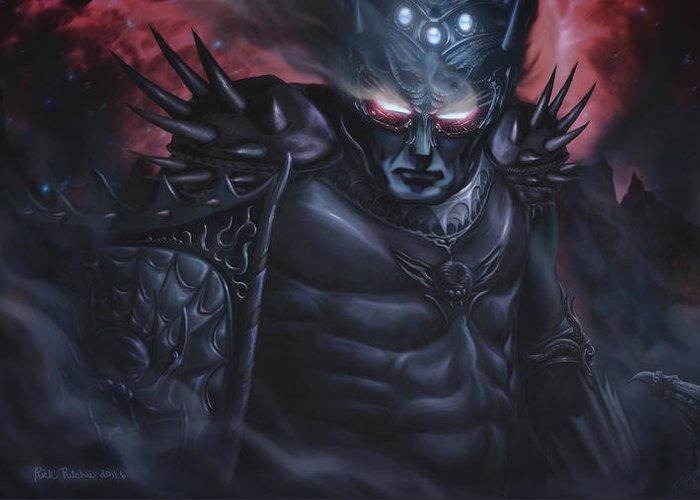
Tolkien in early texts about his legendarium, from about 1920, imagined that the original Dark Lord Melko [Melkor a.k.a. Morgoth] could create life on his own. The creatures he created were the Úvanimor (art by Rick Ritchie):
“At this point in the story the agents of Melko appear, the Úvanimor, 'bred in the earth' by him (Úvanimor, ’who are monsters, giants, and ogres’...);” (The History of Middle-earth 1; X). This would also include both “goblins and dwarves” (HoME 2; II).

Yet there is a clear absence of giants, in evil armies or elsewhere. A poem sung by Lúthien names “the neck of Gilim the giant that is taller than many elm trees” (HoME 2; I) and “the sword of Nan” (HoME 2; I; Notes; iii onwards, art by Ted Nasmith).
Christopher Tolkien notes that the meaning of these two entries “seem now lost beyond recall” though “Gilim is called ’the giant of Eruman’.” Eruman in early texts is a fair, northern desert region west off the sea, and is associated with the Afterlife.
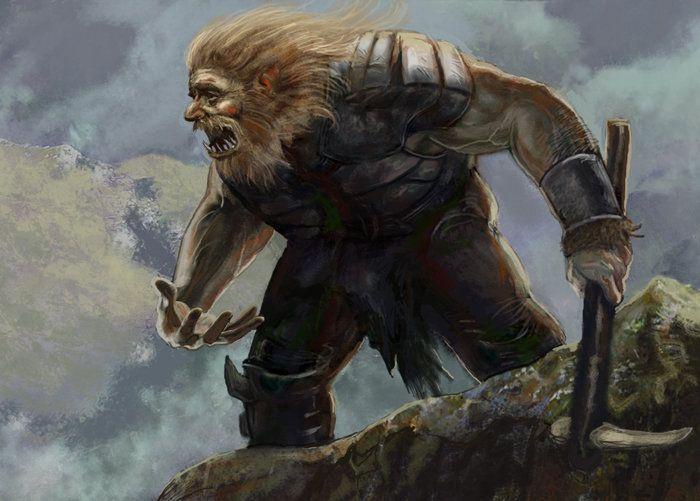
Christopher continues with that Gilim from Elvish was translated as Winter, while “a jotting, very difficult to read, in the little notebook used for memoranda ... seems to say that Nan was a ’giant of summer of the South’, and that he was like an elm.”
This presumably means he had the height of an elm; English elm species can reach a height of 98.43 ft or 30 meters, with rare taller specimens (unknown artist).

On Gilim and Nan Rateliff draws a reasonable parallel to the Norse Jötnar in the two Edda books (ThoTH; Second Phase; IV Goblins; II The Giants, art by Charles E. Brock):
“The contrast between summer and winter seems obvious, perhaps harkening back to the fire-giants and frost-giants of Eddic lore, but whatever story Tolkien may have had in mind behind these shadowy figures (if indeed he had any at all) was apparently never written down.”

The association between giants and nature by Tolkien continued. A poem from ca 1925 tells how into a river a rock “rolled from the distant mountains vast, when giants in tumult hurtled past” (HoME 3; III). On it Elves built the fortress Minas Tirith, after which the fortress in Gondor millennia later was named (art by Stefan Meisl).

Tolkien wrote The Hobbit in 1930 - 1932 and it was published in 1934. It would have a great impact on his Middle-earth, such as making the Dwarves a sympathetic folk and no longer associates of Melkor, and it offers a first clear appearance of giants.
The children’s book was however not yet a part of the author’s main legendarium; it merely borrowed elements to invoke a sense of history and depth [first while writing The Lord of the Rings in 1937 - 1954 also The Hobbit got included].

The Hobbit opens with the Wizard Gandalf visiting the hobbit Bilbo Baggins, to recruit him for a quest together with a group of Dwarves (art by the Brothers Hildebrandt).
Bilbo recalls how Gandalf the Grey used to visit the Shire long ago and that he used to tell the hobbits tales “about dragons and goblins and giants and the rescue of princesses and the unexpected luck of widows’ sons” (The Hobbit; I).

In early drafts the role of Gandalf belonged to Bladorthin, a traditional fairy-tale enchanter. Rateliff explains that among the deed of Bladorthin were the slaying of “‘unlamented giants’, exactly what we would expect of a hero from one of the old stories collected by Joseph Jacobs or Jacob & Wilhelm Grimm.” (ThoTH; First Phase; I(b); ii). Note: Jacobs was a publisher of folktales, especially from the British Isles.

A night Bilbo and his Dwarf friends met stone-trolls, which turned to stone by sunlight after they were distracted until dawn. This event may had partly giant inspiration (ThoTH; Second Phase; Trolls, art by J.R.R. Tolkien):
“Tolkien’s source, insofar as he had a specific source, was probably one of two poems from the Elder Edda, Helgaqviða Hjervarðzsonar (‘The Lay of Helgi Hjorvard’s Son’) and Alvíssmál (‘The Lay of Alvis’). In the former, the heroes... prolong a conversation with the giantess Hrimgerd, who seeks to destroy their ship and drown them all, until the sun rises and petrifies her...”

In Alvíssmál Thor debates Alvis the Dwarf until sunlight turns Alvis to stone. A giant and a dwarf are not trolls in the work by Tolkien “but Jacob Grimm notes in his massive compendium and overview of religion and folklore, Teutonic Mythology, ‘numerous approximations and overlappings between the giant-legend and those of dwarfs... as the comprehensive name troll in Scandinavian tradition would itself indicate. Dwarfs of the mountains are, like giants, liable to transformation into stone, as indeed they have sprung out of stone’...” –ibid

Back to The Hobbit the company ascended the Misty Mountains and took shelter under a hanging rock a stormy night. Bilbo was curious (TH; IV, art by Robertofc):
“When he peeped out in the lightning-flashes, he saw that across the valley the stone-giants were out and were hurling rocks at one another for a game, and catching them, and tossing them down into the darkness where they smashed among the trees far below, or splintered into little bits with a bang.”

Soon the company was getting drenched by rain (ibid, art by Jagoba):
“They could hear the giants guffawing and shouting all over the mountainsides.
`This won’t do at all!’ said Thorin. `If we don’t get blown off or drowned, or struck by lightning, we shall be picked up by some giant and kicked sky-high for a football.’
`Well, if you know of anywhere better, take us there!’ said Gandalf, who was feeling very grumpy, and was far from happy about the giants himself.”

In the 2012 adaptation stone-giants not only kick the companions around but are of stone. Neither is in the book but the bodies are inspired by the Ents [who we will get to later]. It is a reasonable idea, knowing Ents, but in The Hobbit the intent was certainly for them to be human as in folklore [for Tolkien had not yet invented Ents].
Still four years after The Hobbit, in a LotR draft, giants are compared to us humans by hobbits, who call us the Big Folk (HoME 6; XV): “giants were spoken of, a Big Folk only far bigger and stronger than Men the [?ordinary] Big Folk....”

In the Misty Mountains the wicked Goblins had a new cave entrance by the mountain road, and there most of the companions of Bilbo were taken captive. Later we learn that some giants could be reasonable or perhaps even friendly, as the Grey Wizard pondered the entrance of the goblins (TH; VI, art by John Howe):
“`I must see if I can’t find a more or less decent giant to block it up again,’ said Gandalf, `or soon there will be no getting over the mountains at all.’”

While giants in the legendarium had been presented as creatures of Melkor, Rateliff points out that the stone-giants in The Hobbit arguably “are portrayed as a perilous but almost impersonal force, rather like the thunder-storm itself.... It seems, then, that giants occupy a neutral ground, neither good nor evil as a race but varying from individual to individual. Dangerous, certainly – but as Gandalf points out in speaking of Treebeard, powerful and perilous is not the same thing as evil...” (ThoTH; Second Phase; IV Goblins; II The Giants, art by TheRisingSoul).

Later the company came to Beorn, who could turn into a bear. For this reason some [inaccurately] believed that he was a bear that “descended from the great and ancient bears of the mountains that lived there before the giants came” (TH; VII).
Gandalf told Beorn about how “the stone-giants were out hurling rocks” earlier, and Beorn had no doubt that the colossi were real. Some readers have proposed that the giants were made up by Bilbo, since they do not reappear, but as will be seen I do not believe Tolkien had any such intent (at by Brothers Hildebrandt).

In December 1937 Tolkien began writing the sequel, The Lord of the Rings. In February 1939 he wrote to his editor Mr. Furth about his growing plans:
“Still there are more hobbits, far more of them and about them, in the new story. Gollum reappears, and Gandalf is to the fore: ’dwarves’ come in; and though there is no dragon (so far) there is going to be a Giant; and the new and (very alarming) Ringwraiths are a feature.”
– Footnote to Letter 35 (photo: the first page drafted of the LotR)

Among his inspirations was an Old English word, as he later recounted (Letter 157, 1954):
“I always felt that something ought to be done about the peculiar A. Saxon word ent for a ’giant’ or mighty person of long ago — to whom all old works were ascribed.”
He referred to “the Anglo-Saxon poem The Wanderer, 87: ’eald enta geweorc idlu stodon’, ’the old creations of giants [i.e. ancient buildings, erected by a former race] stood desolate.’” (Note 2 to Letter 163, 1955; photo of pages of The Wanderer).

This linguistic urge he soon implemented by naming a region Entish Dales, Entish Lands, later changed to the Ettenmoors and Trollfells [estimated in red]. Christopher comments that “Entish here was used in the Old English sense of ent, ’giant’, the Entish Lands were the ’troll-lands’” (HoME 6; XI; last note). Ent in this context is as Christopher stress “in no way associated with the Ents” which his father later created. Rateliff elaborates;

“...Ettenmoors... etten (ettin) being an old word for ‘giants’ (descended from the Old English eoten, ent) that remained in use up until the early 1600s.
Strider, in ‘Flight to the Ford’, glosses the term as ‘the troll-fells’ (LotR.216), troll being a mid-nineteenth-century borrowing from the Scandinavian which supplemented but did not replace giant (itself Anglo-Norman in origin).”
– ThoTH; Fifth Phase; New Chapter III; Text Notes; 2 (art by Pasi Leinonen)

I note that while Tolkien here used the two terms overlapping, and while in Old Norse troll applied to villainous magic users of various kinds* [because myths and folklore is not a DnD monster manual], his giants and trolls are not elsewhere equalised and remain different creatures (art by MatejCadil).
*Short summary by J. Crawford https://www.youtube.com/shorts/kVIPs6QpEQw Longer on Jötnar and troll https://youtu.be/8niyWXq7ios

The Etymologies, a kind of historical dictionary from 1937 - 1938, gives the word for a giant as ’norsa’ in the High Elf language of Quenya (HoME 5; III, art by Bryan Sola).
It derives from the root ’Noroth’ that remained the gloss in Sindarin, an Elven lingua franca in Middle-earth, that also Dúnedain spoke; https://www.elfdict.com/w/noroth

In the Shire Hobbits spoke about perils abroad, including giants which the hobbits as told knew as “a Big Folk only far bigger and stronger than Men the [?ordinary] Big Folk, and no stupider, indeed often full of cunning and wizardry.” (HoME 6; XV).
The line was altered to giants abroad being “of a new and more malevolent kind, no longer dull-witted but full of cunning and wizardry” (HoME 6; XIX), before the published line in the novel cuts out any giants completely (art by Justin Sweet).

The earliest version of the legendarium had referred to giants as one of the Úvanimor, or monster-folk, “a thoroughly traditional touch on Tolkien’s part; giants have a long, long tradition in folklore of being extremely dangerous if not downright wicked. Even Treebeard first appears in the LotR drafts as a distinctly sinister figure.” (ThoTH; Second Phase; IV Goblins; II The Giants, illustration of Jack and the Beanstalk by Arthur Rackham).

Enter Fangorn, a.k.a. Treebeard, after whom the forest is name. He was hostile and not yet an Ent, for the walking tree-creatures were not yet imagined. In an early draft Gandalf tells Frodo Baggins (HoME 6; XXI, art by Saryth Chareonpanichkul):
“I was caught in Fangorn and spent many weary days as a prisoner of the Giant Treebeard. It was a desperately anxious time, for I was hurrying back to the Shire to help you.”

Treebeard was first directly described in July 1939, and though not yet an Ent he was now a tree-like giant. Frodo “looked at the tree, and even as he looked, it took a stride towards him” (HoME 6; XXII).
Drafting the book plot JRR wrote how “Frodo meets Giant Treebeard ... he is deceived by the giant who pretends to be friendly, but is really in league with the Enemy” (art by Woodside Illustrations).

The concept of Ents emerged and step by step as the plot evolved. In 1940 for a last time was it questioned whether Treebeard was an Ent or an ordinary giant, whereafter the Ents as a people were firmly established (HoME 7; XIII):
“At departure Elves give them travel food. They describe the Stone hills, and bid them beware of Fangorn Forest upon the Ogodruth or Entwash. He is an Ent or great giant.”

Turning back to the topic of giant origin, Melkor, the former master of Sauron, could create life until Tolkien changed his mind while writing the LotR. Hence it is said that “naught that had life of its own, nor the semblance of life, could ever Melkor make...” (The Silmarillion; III; III). Instead he corrupted and twisted pre-existing creatures, like how the Orcs were made from Elves and/or Men (art by Dymond Starr).
If so it is possible that giants had a similar origin to the trolls: in “their beginning far back in the twilight of the Elder Days, these were creatures of dull and lumpish nature and had no more language than beasts.” (RotK; Appendix F).

Or on the more speculative but not unreasonabel side, giants may not be a living species but incarnated spirits, like Maiar [the kind that Sauron, the Balrogs and the Wizards belonged to], which Melkor had lured into his service and who incarnated as huge humanoids. Compare here with the Balrogs, which were created by Melkor until Tolkien change his mind and so became corrupted Maiar.
So far it has been presumed that Melkor had a hand in their creation, but if he had not [as their absence in his wars and the portrayal in The Hobbit might imply] it is possible that they were Maiar or some kind of nature spirits which are little known because they simply minded their own business (art by Disse86).

Regardless, after the apperance of the tree-like Ents in the legendarium “giants in the traditional sense of large, dangerous monsters in more or less human form vanished from the more integrated Middle-earth of Tolkien’s later work.” (ThoTH; Second Phase; IV Goblins; II The Giants). This leaves them as an ambigious, but no less alluring, feature at the fringes of our knowledge about Middle-earth.

Some related accounts (art by Dmitry Prosvirnin):
Trolls https://imgur.com/gallery/mrTmJa4
Melkor/Morgoth https://imgur.com/gallery/pogRoXS
Balrogs https://imgur.com/gallery/z269MAv

— — — — —
INDEX: character bios https://imgur.com/gallery/axV2mPF
INDEX: folks, animals, items, etc https://imgur.com/gallery/AQK9pJL
netharia
*raucous applause*
Chort26
elten
AyatollahBahloni
Amazing mythology.
Ngugi
Herebychoice
Well this post was a giant undertaking what with the citations and all ....
BosunMark
One does not simply troll Ngugi..
Ngugi
BenderRodriguz1010
"They have a fucking Cave Troll!" - Boromir, probably lol
MissivesFromTheTower
Pippin: *sigh* *unzips*
Ngugi
BenderRodriguz1010
🎶 unst unst unst unst WHOMMM WHOMMM unst unst unst 🎶
TheFastpaws
Interesting history for them in the world.
idiotsonfire
Wow, probably one of your much more in depth posts, surprised there was even that much about giants to make a full post about.
Ngugi
It should be up there! Ironically because of there being so little lore to dig up, hehe; usually much that is outdated can be skipped, but here any scrap of info has to be put forth in order to get a grasp of what JRR might had in mind ^^
DVSBSTrD
@OP I did not know Mother Goose was French.
Ngugi
Aye, it was published in France in the 1690s by a fellow named by Charles Perrault (1628 - 1703)
GoodChange
So trolls are not corrupted ents similar to orcs being corrupted elves? I thought I had read that somewhere; maybe I’m just mixing it up with the wheel of time where trollocs are corrupted ogier.
Ngugi
No, though you do recall Treebeard's words (TTT; 3; 4): "But Trolls are only counterfeits, made by the Enemy in the Great Darkness, in mockery of Ents, as Orcs were of Elves." It can appear he means Trolls were made from Ents, but he meant trolls were made [from some more animalistic proto-troll, as we learn in Appendix F] to counter the Ents. The assumption that trolls were made for this specific reason may however be a misunderstanding on Treebeard's part, JRR commented in Letter 153.
GoodChange
Yeah that’s it. I think I misunderstood what Treebeard meant.
Ngugi
LotR notification to @Kallas267 @ivanova4 @goste @schrodingerscatfood @joeyecho101 @lanabannana316910 @jonhamsandwich11 @albester @drduffer @oneduringwanderer @mngolfer @ydkmy @Clocke138 @EMH0594 @ItHappenedInThe20thCentury @Macewindow54 @DarkBusterBaron @FosterMomForKittens @AdeptusCannibus @OverTheEventHorizon @Identifyingasachair @GrimNyrah @DucklingFullOfTarantulas @Monmortmeplait @LariCheltsy @GreyKnightTemplar666 @circlebreaker @Jimthebutler @AtlasHuggedrescuepup @BTass @DumpsterDoughnuts
Ngugi
LotR notification to @Icheckalltheusernames @SaltyNick95 @yellowgage @burtreynlds @slapthebag24 @kimwimgoddess @Ijustwantquiet @TheFastpaws @BTass @thepunchline710 @WoollyHolePoker @SignificantAioli84 @thedudeman519 @DemonDarakna @blubberingbastard @GeneralZodsChicken @cyrusthevyrus @BeardicPerformance @HuntMason @rudejohn @PubMed12927120suckssobad @daviddado101 @ugis4evr @captapathy @johnnyunlikely
Ngugi
LotR notification to @joeyvelour @JayDeeDubs @BenderRodriguz1010 @flipj @Chort26 @Drix1942 @thefeckamisigningupwithfacebook @turbodog @GravyEducation @AyatollahBahloni @Herebychoice @Foehammer262 @BurrhusBacchus @ridureyu @nikolateslaismyhomeboy @scienz @Marcraffy @dormantmayonnaise @CodyBurkett @RedTailedHawk @tron11DireTide @elten @101Medic @Thelolzknight @Jyx123 @passion2beme @OurEndlessNumberedDays @politicalwanderer @baals @tarnok @JackTheButcher @RobertBunda @laiessar @mcodger @Barantor
Chort26
nikolateslaismyhomeboy
Drix1942
I'm a giant dwarf, or maybe a dwarf giant, @ngugi It falls on you, the expert, to classify which one I am. Note: Either answer is an insult to the other.
Ngugi
Alas! Giants call you a tall Dwarf while Dwarves call you a short Giant, but fact is that you are just a median Man!
Ngugi
Everyone is offended!
Drix1942
You're calling me average?!? Okay. :)